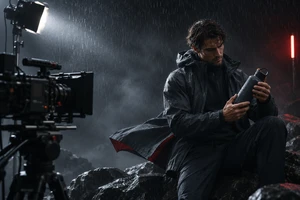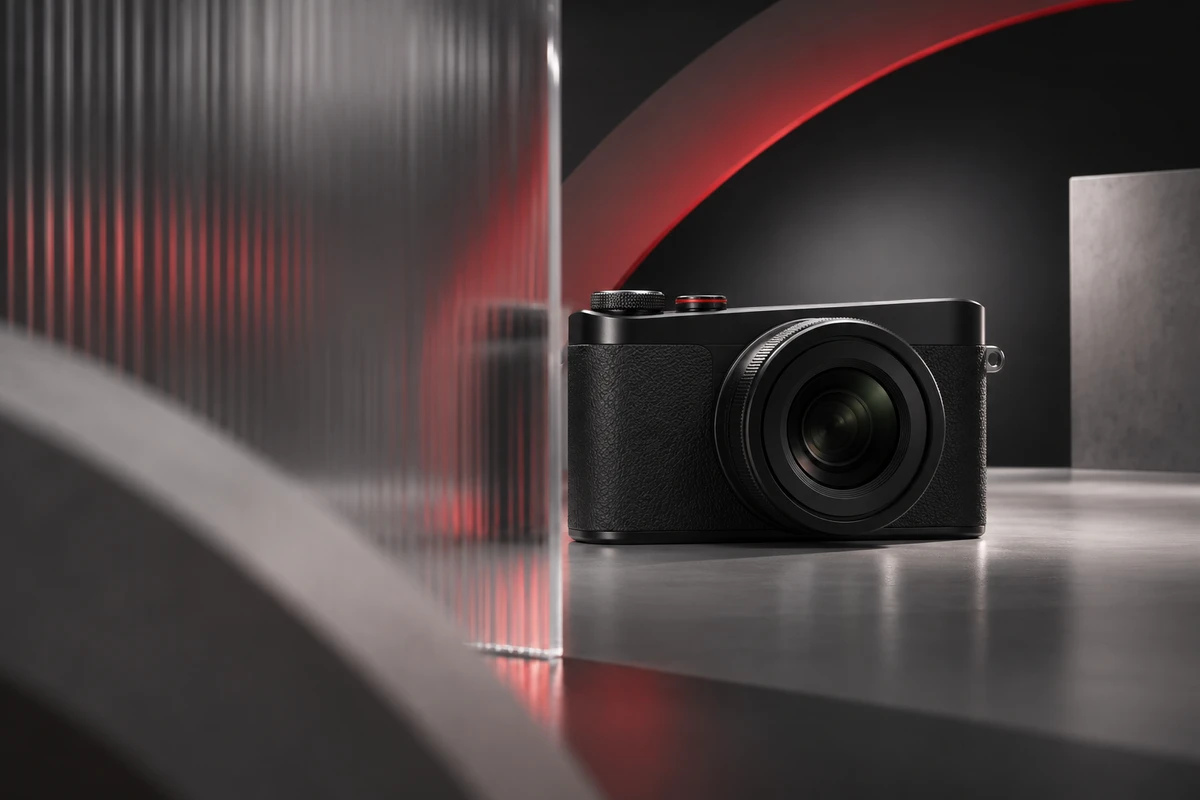
Foreground occlusion can give a product ad a sense of discovery, but its value is not simply that the image feels more cinematic. It controls the order in which information appears. What viewers notice in the silhouette, what function they confirm next, and when they finally receive a complete product image can all be organized through hiding and revealing. A useful test is simple: if removing the foreground only reduces atmosphere, the occlusion is decorative. If it also removes discovery, action, or a change in product state, it is doing narrative work.
Occlusion should delay one piece of information
A foreground element can temporarily hide part of the product so that viewers receive a more important cue first. The shot may establish context before revealing the object, make a human action clear before showing the product as its result, or present a distinctive fragment before confirming the full form. Occlusion does not delete information. It moves that information to a better moment.
A storyboard therefore needs more than “add foreground.” It should state what is hidden, how long the delay lasts, and what the viewer understands when the reveal happens. If the only answer is “more depth,” the foreground is probably set dressing rather than story structure.
Decide what the first glance must preserve
Product advertising often needs recognition, function, scale, and emotion at the same time. Adding a foreground element cannot make all four disappear. Even before the product is fully visible, the frame should preserve at least one recognizable cue: a distinctive outline, an interface position, a hand action, a material highlight, or the scale relationship between person and object.
A launch teaser may let a partial form arrive before the logo. A functional demonstration should keep the contact point and state change clear. A short commerce cut will usually need the full product earlier. There is no universal percentage of acceptable occlusion because the correct amount depends on the job of the shot.
Make the foreground belong to the product action
Let the setting produce the obstruction
Strong foreground elements usually come from the environment itself: a cabinet door in a kitchen, steam in a bathroom, branches outdoors, papers at a desk, or a performer's shoulder and hand. Their presence explains where the product lives without requiring another line of copy.
A random leaf, glass panel, or haze layer may create blur while having no relationship to the product. When the same leaf, flare, or smoke effect appears across unrelated categories, the image starts to feel templated. Shape, material, and motion should respond to the use case or the performer's action.
Let the reveal become a result of action
The camera does not always have to move the obstruction away. A person can open a drawer, lift fabric, push a door, or remove a cup. The reveal then becomes the result of behavior rather than a detached product display. Product, performer, and space enter the same causal chain.
When the foreground moves independently, its speed still needs a relationship to the action. A fast pass can feel like a transition preset; a slow one can make viewers miss the selling point. During rehearsal, review three moments together: when occlusion begins, when information first becomes readable, and when the product is fully revealed.
Camera movement needs a clear reveal landing
Tracking, orbiting, and push-pull moves can all use foreground parallax. Objects near the lens cross the frame more quickly while the distant product remains relatively stable, making depth visible. The move still needs a frame in which the product can be confirmed. Passing through objects is not a purpose on its own.
An executable shot often has three phases: occlusion creates expectation, movement releases information, and the camera lands on a clear product state. Cutting immediately after the product appears gives viewers motion without enough time for recognition. Holding too long after the reveal can make the earlier concealment feel affected.
Adobe's current cinematography guide treats framing, composition, lens choice, movement, and depth as connected storytelling decisions. Its over-the-shoulder guide also shows how a visible foreground subject can create layered perspective and spatial alignment. For product work, the practical implication is that foreground should be designed with camera position, performance, and shot duration rather than added as an isolated effect.
Hide the product without breaking functional logic
A function usually has an initial state, a contact action, and a result. The foreground may omit part of that sequence, but it should not break the causal connection. If a hand reaches toward an obscured device and the interface is suddenly active in the next moment, viewers know that something changed but may not understand how the product did it.
Functional shots often work better when the foreground hides the environment instead of the critical contact point. When an operation must remain hidden for mood, capture a clear side or overhead version as well. In commercial video production, an atmosphere shot and a proof shot have different jobs. Every shot does not need to carry every piece of information.
Horizontal and vertical cuts need different reveal lanes
In a horizontal frame, foreground elements can enter from the sides while the product remains near the center or a third. After a vertical crop, the same obstruction may cover the entire subject. Planning should map product safe areas for both 16:9 and 9:16 and test the path of the foreground, not only the final frame.
When one move cannot serve both formats, keep two executions. The horizontal version can use a longer lateral move to establish space, while the vertical version reveals the product through front-to-back layering or performer action. The creative principle stays consistent even when the camera path changes. This preserves the product, hand action, and copy area better than an aggressive crop.
Capture a clean plate behind the hero take
Record the product without the obstruction
The more complex the foreground, the more useful clean references become. Beyond the hero take, capture the same camera position as an empty plate, an unobstructed product pass, the foreground moving on its own, and necessary lighting and focus references. These elements may never appear directly in the edit, but they support vertical reframing, edge repair, and live-action or generative background extension.
Glass, steam, fabric, and hair receive background color while also changing the product edge. Treating them as a flat translucent overlay can produce inconsistent color, reflection, and motion. In compositing, foreground, product, and background still need one coherent light direction and focus relationship.
For projects that combine live action and generated environments, see ONCE brand film and commercial production for how a live-action master, art direction, and version plan can be designed together.
Some product shots should reveal immediately
Occlusion can increase comprehension cost when an interface contains dense text, the operation is brief, the structure must be understood at once, or the opening needs immediate launch recognition. Commerce cuts, product-page videos, and direct functional demonstrations often benefit from a clear product state. Mystery should not consume essential information.
Occlusion can also create a false inference. If the foreground hides a safety feature, interface, or scale relationship, viewers may interpret “not visible” as “not present.” When the scene communicates a functional promise, accurate product information should come before creative concealment.
Review the reveal as three connected questions
What can viewers still recognize when occlusion begins? What new information arrives during the reveal? Is the final product state worth the wait? If those three moments do not produce increasing understanding, the foreground is only an attractive obstacle.
If you are planning a product commercial, brand film, or a live-action and AI version system, share product images, essential functions, and horizontal and vertical requirements with the ONCE product film and brand content team. We can design foreground, performance, camera position, and clean plates around the order in which product information needs to appear.