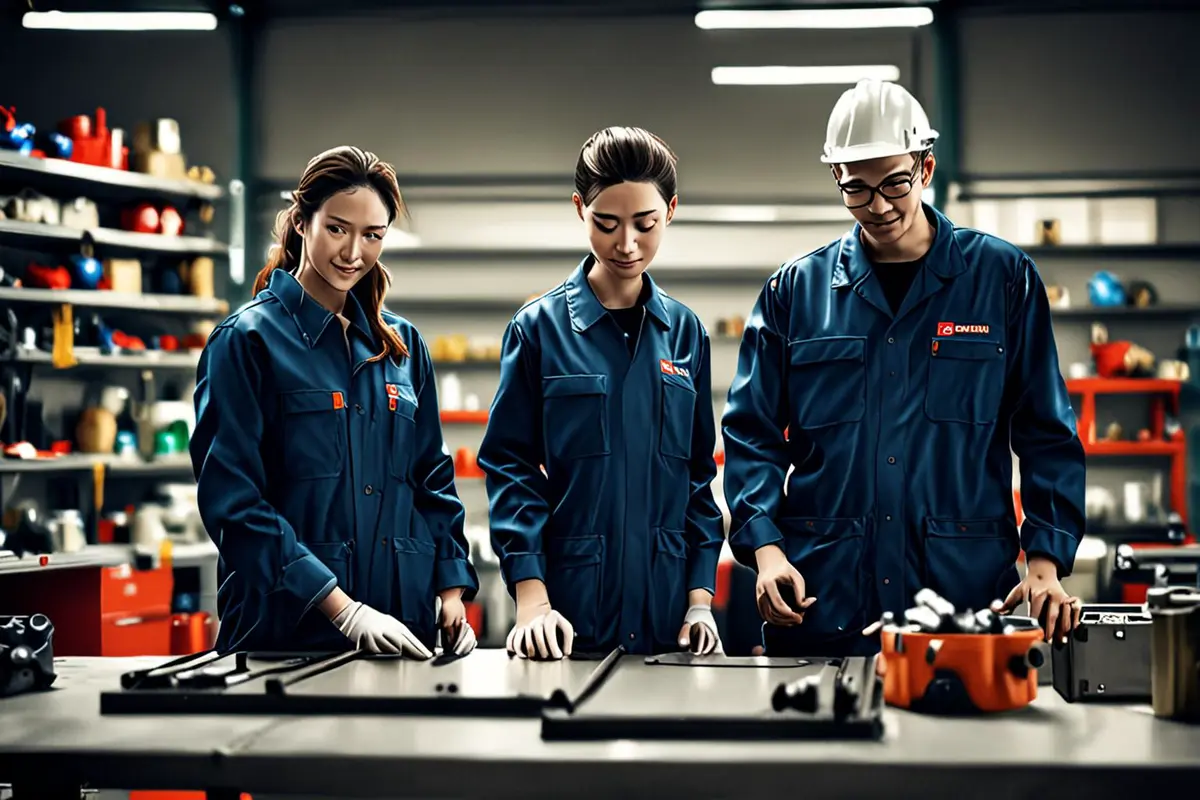
On one corporate film set, four employees were asked to pass the same sample from one person to the next. The camera move was smooth, the uniforms were neat, and everyone smiled. Yet the finished shot looked less like collaboration than a relay race. The problem was not weak acting. The action had no task. The film never explained why one person released the sample or what the next person would do with it. In real work, a handoff changes the object, the responsibility and the next step. In staged footage, it merely changes the pair of hands.
A handoff transfers a task, not only an object
Samples, tools, drawings and data records can all be passed, but they represent different work. When R&D gives a sample to testing, the question of whether it performs moves to another role. When an operator hands a tool to maintenance, the fault and the permission to act move with it. When an engineer passes a drawing to manufacturing, a particular version is entering its next stage.
Define that task before filming and people understand why the action exists. Without it, the director can only ask them to slow down, look at each other or behave more naturally. Those are still movement instructions. Our article on drawings in corporate films explains how a drawing should participate in thought. A handoff shot goes further: it shows thought moving into another role.
Both people should already be working before the handoff
The most common staged version begins with two people standing still, waiting for the director to call action, and extending their hands at the same time. Real collaboration rarely begins from a pose. The giver may first inspect, label, clean or package the item. The receiver may be adjusting equipment, putting on gloves or opening the correct record until the object enters their working area.
Give the receiver an unfinished action
A receiver with empty hands and nothing to do reads as an extra. Let them zero a calliper, clear a place on a tray, open the correct page or confirm an identifier on screen. The action does not need to explain the entire process. It only needs to show why this person needs the object now.
Leave a trace of the previous task with the giver
A label on a sample, a protective cover on a tool or a revised page clipped into a drawing can explain where the object came from. The trace should grow from the work rather than from a desire to make the set look busy. A final check of the identifier, dust removed from a surface, or a fragile side turned into a safe direction makes responsibility visible.
At the point of contact, show weight, authority and attention
The short moment when two people hold the same object is the most informative frame in a handoff. Weight determines hand position: heavy equipment needs support before release, while a thin document can be controlled at its edge. Authority determines who lets go first: with a fragile sample, the giver should wait until the receiver has a secure grip. Attention determines eye line: a precise connection deserves attention on the object, while a work confirmation may justify a brief glance at the other person.
Do not use eye contact as a universal symbol of teamwork
Eye contact can express confirmation, warning or a change in relationship, but it does not fit every task. If both people look at camera while connecting a component, professional credibility disappears. Build a sequence instead: look at the contact point, briefly acknowledge the colleague, then return to the next step. The relationship is present without interrupting the work.
Something new must happen after the receiver takes over
If the shot ends as the object leaves the first pair of hands, viewers see transfer but not collaboration. The receiver should move the task into a new state: place the sample in a fixture, read an identifier, compare a surface, connect equipment, mark a drawing or carry the tool to the point where it is needed. The clearer the new action, the less decorative the handoff feels.
This changes the edit point. Our previous article on cutting before a product action finishes discusses how to create anticipation. A workplace handoff needs enough of the result to prove that responsibility has moved. Cut after the next action begins, rather than the instant two hands touch the object.
Blocking should reveal the working relationship
Placing two people side by side and facing camera makes their faces easy to film, but turns the handoff into an award presentation. More credible blocking grows from equipment and paths. One person may remain inside a workstation while another enters from an aisle. An operator can stay at the machine while a colleague reaches in from the edge of frame. The film does not need to show every body in full. It needs to show an object entering a different working zone.
In group scenes, avoid making everyone busy at once. Our article on space density in corporate films explains how factory activity expresses a production state. In a handoff shot, foreground workers carry the main transfer while the background maintains work at the same rhythm. If everyone waves, turns and walks simultaneously, the primary relationship disappears into noise.
Different objects require different handoff grammar
A sample requires protection of its important surface and orientation, and often moves into observation or testing. A tool requires safe handling: the sharp, hot or loaded end should not point towards the receiver. A document needs a version and a point of attention; the open page and marked area matter more than the act of passing a folder. Information on a screen may not require moving the device at all. Rotating a display, making room and sharing the view can transfer authority.
The object also determines speed. A valuable or precise item passed too quickly feels weightless. Everyday consumables passed too slowly become ceremonial. Instead of asking every performer for slow motion, let them complete one pass according to the real weight and risk. Then choose the frame rate and shot duration.
Continuity includes more than hand position
A handoff may be assembled from a wide shot, a close view of the hands and a detail of the next task. Continuity includes left and right hands, but also label direction, cable tension, whether a protective cap has been removed, whether the receiver has already cleared the surface, and marks left in the previous shot. When these states jump, viewers may not name the error, but they feel that the action has been reset for camera.
The credibility of a technical expert often comes from how they handle uncertainty and the next step; see our discussion of uncertainty in expert interviews. Handoff performance can preserve similar human adjustments: finding the balance after receiving an object, turning it into a familiar working orientation, or checking the label before acting. These are professional habits, not mistakes.
Sound gives the handoff weight
The soft impact of a tray on a bench, a click from a latch, paper friction, or a gloved hand touching metal tells viewers that the object has material and resistance. The film does not need to exaggerate every sound, but if music covers every contact point, the action becomes a weightless visual symbol. Record one clean version of the real operation on set. Post-production can decide how much to retain instead of guessing from a generic effects library.
Dialogue does not need to become a corporate slogan. A short version number, warning or confirmation of the next step sounds more like work than a statement about innovation and excellence. Confidential information can be replaced with a plausible identifier, while the rhythm of the response should still fit the actual task.
AIGC can extend the space but struggles with contact
AIGC can expand a factory, add distant staff or adjust atmosphere. It is less reliable when two people share the same object. Finger count, grip pressure, label continuity and release order can fail at the exact moment the scene needs proof. When the handoff is core evidence, keep it in live action or use controlled CG with explicit object and hand paths. A generated background should follow the filmed movement instead of rearranging equipment, aisles and exits for visual richness.
In review, make the handoff answer three questions
Why does the object leave the first person now? What gives the receiver authority to take it? What changes in the work after they do? When the image answers all three, collaboration becomes visible. If the shot offers only two hands and a smile, return to task, blocking and result instead of asking performers for more enthusiasm.
If your corporate film needs to show R&D, production or service teams, write each important transfer as “previous task—handoff object—next task,” then discuss the scene with ONCE through our commercial video production solutions. One clear working relationship can explain how a team operates better than a row of employees facing the camera.