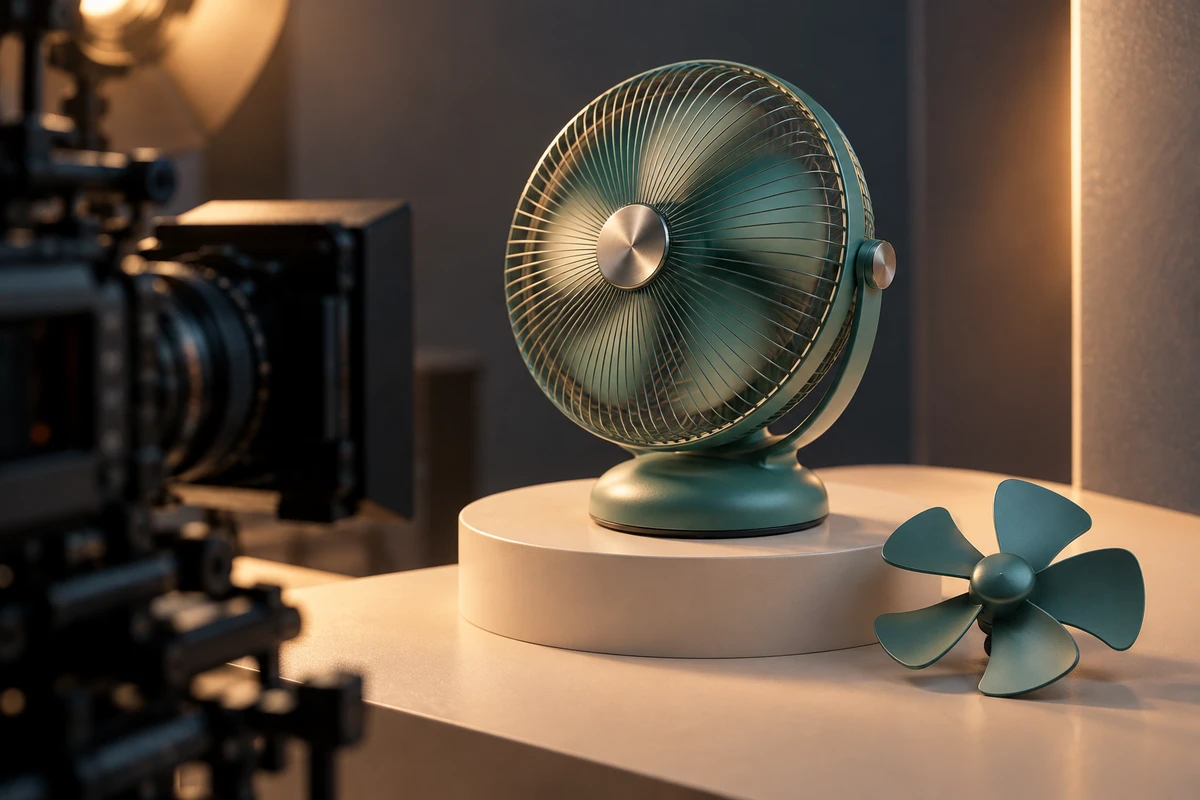
A supplier sends a test clip of a desk fan. Its housing looks excellent, but the blades appear bent. A second clip shows sharper blades that seem almost stationary. Before requesting another sample or a more expensive camera, the brand and production team need to agree on what each shot must demonstrate.
For brands working with a Chinese factory or filming team, ONCE proposes a shape–motion–number review. Approve the appearance of the component, the impression of operation and any numerical claim separately. This is a commissioning method, not a diagnostic test, and the examples below are hypothetical.
Two visual symptoms need different explanations
Axis's August 2026 white paper, Global shutter vs rolling shutter, explains that rolling shutter exposes rows at offset times. Fast rotation can therefore distort a blade within a single frame. The paper distinguishes this geometric distortion from motion blur.
Apparent stillness is a different issue. Arizona State University's Stroboscopic Effect teaching resource describes how periodic sampling can make rotating helicopter blades appear stationary. Its demonstration also describes apparently slow forward or backward movement under periodic illumination. Both sources were checked on October 27, 2026.
The production implication is that a camera addressing row-dependent distortion does not, by that fact alone, resolve every sampling illusion. A sharp frame and a convincing impression of rotation are separate achievements.
Shorter exposure is not a universal repair
Axis explains that exposure duration does not remove rolling-shutter distortion, while longer exposure can hide it under blur. Reducing blur may simply reveal a more sharply defined distorted blade. This principle is useful when reviewing a test; it is not a recommendation for one shutter setting across camera models and recording modes.
First decide whether the shot needs to reveal geometry or communicate operation. A stationary detail can explain blade shape. An operating shot may benefit from some blur if the audience still understands the product correctly. Requiring every blade to be crisp throughout a running demonstration can create an unnecessary constraint.
Put three separate approvals in the brief
| Review | Useful deliverable | What it cannot establish alone |
|---|---|---|
| Shape | A clear stationary reference; a separate moving-shape test if needed | Correct apparent direction during playback |
| Motion | An operating clip reviewed at the intended delivery rate | Actual rotational speed from visual impression |
| Number | Brand-approved specifications and operating conditions; separately agreed measurement where required | That ordinary advertising footage is a speed measurement |
Consider a hypothetical fan launch. A close-up introduces the blade design, a wider operating shot shows the product in use, and a separate graphic carries an approved speed specification. The production does not have to force precise geometry, fluid movement and measurable speed into one image.
Ask the factory team to identify the sample, the operating setting and the source of any specification. Ask the filming team to state which visual question each clip answers. This gives an overseas reviewer a more useful approval task than “make the fan look right.”
Compare capture choices under a declared operating condition
Keep the product setting and composition fixed for the first comparison. Record the camera mode, frame rate, exposure time and lighting settings beside each original clip. Change one capture variable at a time where practical. If the operating condition changes, treat that as another group rather than a directly comparable camera test.
Review normal playback first for the impression of motion, then inspect frames for shape. Include the planned delivery encode. If the original looks acceptable and the export does not, investigate post-production before arranging another shoot. If the original already has the problem, assess capture and illumination choices. These comparisons help locate a production issue; they do not certify that a mechanical sample is fault-free.
Keep protective guards in place and have appropriate personnel handle equipment operation. A different operating speed must not be presented as an unchanged condition simply because it photographs better.
Purchase an improvement that can be demonstrated
Separate the quotation into baseline testing, the selected production setup and any explanatory graphics or CG. Define the issue each part addresses, the comparisons included and how additional tests will be charged. A different sensor readout, recording mode or composition earns its place through the relevant sample comparison, rather than its equipment label.
Treat retouching just as explicitly. A reconstructed blade may be suitable for an explanatory animation, but that image should not retain the status of an untouched operating record. If actual rotational speed or vibration performance matters, agree on the engineering measurement and responsible party before planning its presentation.
For the next supplier brief, send three answers: which shapes must remain readable, which operating impression the film must convey, and who supplies the numerical information. Those answers determine whether the next step is a capture adjustment, another camera test, a clearer explanation or an engineering inspection.
For broader production planning, explore ONCE's Video Production articles. The method here addresses a narrower approval problem: separating the product from the way a camera samples its motion.