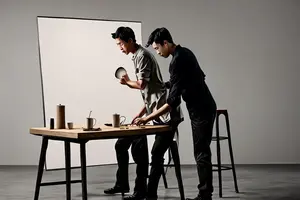
A person looks into the lens and delivers an ordinary line. Why does it sometimes feel like a private conversation and at other times like a salesperson stepping too close? The difference is not only whether the performance feels natural. It is the role that the gaze gives the viewer.
When a character looks at another person, a product, or something in the distance, the audience can usually remain an observer. When the character looks straight into the camera, the camera is no longer invisible. The viewer understands that the line is meant for “me.” Direct gaze is therefore not simply a facial expression. It is a declaration of relationship. A brand film should decide who has the right to address the audience before deciding where the eyes should land.
Once the camera is acknowledged, the viewer has a role
Most narrative images pretend that the camera does not exist. Characters follow their own desires, and the audience reads the scene from outside it. Direct-to-camera gaze turns that outside position into someone specific: a friend, a customer, a witness, a future self, or simply a person being asked to click.
That is why direct gaze can be powerful and why it can fail so quickly. It shortens the distance, but it also interrupts the previous mode of watching. In 2022, Google Creative Works described looking into the camera as a way to break the fourth wall and connect directly with viewers in its YouTube production guidance. TikTok for Business likewise advises first-person videos to speak to the camera as if talking to a friend. These recommendations show why the form suits direct communication, but directness does not automatically create credibility. If the speaker has no clear identity and nothing specific to say, sustained eye contact can make a brand line feel more performed, not less.
Explanation, invitation, and witness need different kinds of gaze
The first useful mode is explanation. A founder explains a decision, an engineer clarifies a complex issue, or a user demonstrates a real step. Direct gaze gives the information an accountable speaker. The delivery can be restrained, and the eyes do not need to stay locked on the lens. What matters is that viewers know who is speaking and why that person should be speaking.
The second mode is invitation. The character begins inside their own scene and looks into the lens only at a turning point, changing the viewer from observer to participant. That turn might follow a product experience or lead into the call to action. If the character holds eye contact from the first second to the last, an invitation can become continuous selling. When the gaze appears only at the moment the relationship changes, it becomes more concentrated.
The third mode is witness. The person is not presenting a product. They are acknowledging a situation, making a choice, or handing an unfinished thought to the viewer. This gaze needs time and must be allowed to carry silence. A dense block of explanatory supers will break the relationship because the viewer is being asked to hold the person’s eyes and rush through copy at the same time.
All three modes can appear in one film, but they should not be collapsed into the same direction to “make it more emotional.” The director should be able to say whether this look is explaining, inviting, or bearing witness.
If you want the audience inside the story, do not keep calling them out of it
Direct gaze is not a shortcut for every emotional ad. Rita Ngoc To and Vanessa M. Patrick’s 2021 paper in the Journal of Consumer Research, “How the Eyes Connect to the Heart,” reports five field and lab studies. Under the conditions they tested, averted gaze made it easier for viewers to enter the advertising narrative and improved responses to emotional ads, while direct gaze strengthened spokesperson credibility and helped informative ads. The finding is not a universal formula, but it shows why gaze direction must be judged together with the advertising task.
If a film depends on a relationship that has not yet been spoken aloud, repeated looks into the lens can feel like someone constantly pulling back the stage curtain. Before viewers have understood who matters to the character, they are reminded that the brand is speaking to them. Allowing the character to look at another person, a product action, or an off-screen event can protect immersion. An averted gaze can also guide viewers toward the object that matters in the frame.
The opposite problem appears when the film needs to explain, clarify, or ask directly, yet the speaker keeps looking toward an interviewer. The viewer may feel like an eavesdropper. Direct gaze works when the brand knows whether it wants the audience to enter a story or receive a statement.
After eye contact, where does the gaze take the brand?
A face looking directly at the audience will often become the strongest point of attention in the frame. The useful question is what viewers see after that face.
Gaze can be designed as a route. A person can look into the camera to establish a relationship, then turn toward the product and lead the viewer into a discovery. Or the person can complete the product action first, then look back into the lens and turn the experience into a judgment. If the person stares at the viewer throughout, the product may only enter through supers and isolated pack shots. The film splits into one piece where somebody talks and another where the product appears.
A storyboard should therefore include more than “looks to camera.” It should record what the person sees before and after the look, what their hands are doing, and what state the product is in. Eye line, product action, and the landing point of the line should hand attention to one another. For more on giving real people playable tasks, see ONCE’s guide to directing nonprofessional talent in brand films. If mirrors are part of the frame, the viewing relationship in mirror composition needs its own geometry; a reflected look is not simply another frontal eye line.
On set, the difficult part is giving the eyes someone to see
“Look into the camera” is an abstract direction. A more playable instruction is to tell the performer who is inside the lens: someone who has not understood the product, someone they have not seen for a long time, or someone who needs a promise. Change that person and the breath, pause, and intensity of the gaze will change with them.
Camera position also defines the relationship. Adobe’s guide to the medium close-up describes it as a semi-intimate, conversational distance that preserves facial expression, body language, and some environment. When a brand film needs explanation and personal credibility, a medium close-up usually offers more room than an extreme close-up. The latter magnifies every blink and hesitation, which suits the few moments that genuinely need pressure or confession.
A teleprompter can protect long, exact lines, but it can also make the eyes move at the rhythm of reading. The production should first rewrite the sentence into something speakable, then decide which words must remain exact and which ideas the person can phrase in their own voice. Capture several levels of address: sustained eye contact, a look that enters the lens only after the line, and brief eye contact on the key phrase. The edit will have more control over distance than an on-set note to “be more sincere.”
Landscape and portrait versions also require more than cropping. In a wide frame, a person can sit slightly off-centre and still leave room for context, another character, or the product. In a vertical crop, the same face can fill the screen and turn an invitation into an approach. On set, check eye height, the ability to keep person and product together, and whether interface elements will cover the information that follows the gaze.
With AIGC people, the eyes can be beautiful and still have no object
Generated people can present clean faces while the eyes, head turn, blink, lip movement, and hand action remain individually plausible but mutually unrelated. The person appears to look into the lens, yet the pupils have no stable target. One frame addresses the audience; the next seems to glance at a teleprompter beside the camera. In a direct-to-camera performance, that small drift matters because the entire scene depends on the promise, “I am speaking to you.”
A 2026 Scientific Reportseye-tracking study of real and AI-generated video recorded 40 participants watching 80 videos of physical scenes. The study deliberately used no identifiable people, so it cannot establish whether AI presenters appear credible. Its more cautious lesson is that once viewers start evaluating whether a video is real, the viewing task changes and they begin searching for anomalies. In a direct-to-camera performance, eye line and lip movement are obvious places to inspect.
A safer hybrid workflow keeps the crucial look, spoken line, and product contact in controlled live action while using AIGC for environmental extension, low-risk transitions, or concept development. If a digital person must be generated, review pupil position, head-eye alignment, blink timing, lip sync, and hand action frame by frame. A convincing still does not prove that the relationship survives the shot.
Decide who the viewer is before the person looks over
The real question is not whether a performer can look into the lens. It is whether the brand is prepared to admit who it is speaking to. Explanation needs an accountable speaker. Invitation needs a change in relationship. Witness needs the courage to hold a pause. Emotional narrative often needs the character to keep looking into their own world long enough for the viewer to enter it.
When reviewing the next storyboard, replace “the actor looks into camera” with a more specific sentence: Who do they see there, and what do they want that person to understand, join, or believe? Without an answer, direct gaze is a pose. With one, it becomes part of the idea.
If your next brand film needs a founder, employee, customer, or actor to address the audience directly, talk to ONCE VISUAL about designing the relationship from script and casting through camera position and multi-format editing.