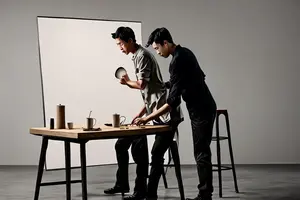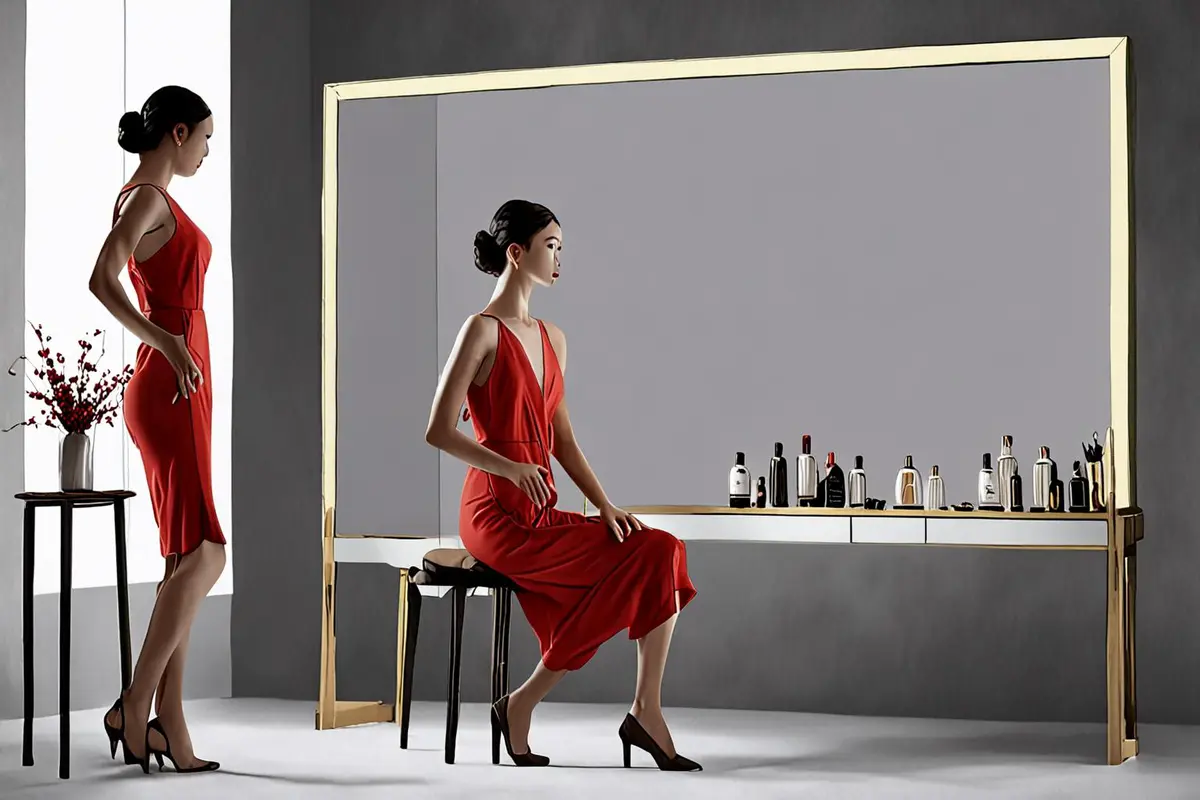
A person stands in front of a mirror, and the camera immediately gains a polished image: face, profile, reflection and depth all in one frame. Yet a mirror becomes useful only when it changes the relationship of looking. The reflection should let a character see a different version of themselves, tell the audience something the character has not said, or make the product part of the movement between reality and self-image. Otherwise, the mirror is simply an expensive backdrop.
Change the point of view before changing the shape of the frame
In an ordinary close-up, a character faces the camera. In a mirror shot, at least three sightlines exist at once: the character looks at the reflected self, the reflection returns that gaze, and the audience stands outside both images to judge the difference. The first directing question is therefore not where to place the mirror. It is who is looking at whom, and what the audience knows that the character does not.
If the real character appears composed while the reflection reveals hesitation, the mirror creates psychological distance. If the character appears only in reflection, the audience meets an indirect image before meeting the person. If the real face and reflected face do exactly the same thing, the composition may remain elegant, but it adds no narrative information.
The storyboard should answer one simple question: what disappears if the reflection is removed? If the answer is only visual depth, the idea is still styling rather than storytelling.
Make the reflection say one thing the direct image cannot
Mirrors work through difference rather than explanation. That difference can concern time, identity, emotion or a character's judgement of themselves.
In Framestore's public production account of Pepsi's 2013 film Mirrors, Beyoncé's earlier performance personas appear in the mirrors while her present-day choreography continues outside them. The team planned the separate performances, motion-control work and compositing relationship from an early stage. The mirror is not retro decoration; it lets several moments in one career occupy the same action space. Framestore's case page also shows why this kind of idea depends on production planning, not only a post-production effect.
ONCE's WENDY STORY case connects portraiture, gaze, reflective surfaces and a white floral environment. Its public description frames the film around self-exploration, so the mirror becomes a question of how the character sees herself rather than a device for duplicating a face. The two films look very different, but they pass the same test: the reflection carries information the direct image cannot deliver alone.
Not every mirror shot needs a dramatic reversal. A small change in eyeline, a smile that arrives late, or a figure visible only in the reflected background may be enough. The difference simply has to belong to the character's situation instead of functioning as an empty puzzle.
Put the product inside the mirror relationship
A common failure in brand films is to let the character and mirror carry all the emotion, then place the product on a table in the final seconds. The result is a beautiful portrait followed by an isolated pack shot, with no causal link between them.
A product enters mirror composition when it changes a relationship. A beauty product may change how closely and from which angle a person examines their skin. A phone or camera can change who records whom. A wearable can provide feedback between movement and self-recognition. A home product can change the reflected light, order or lived state of a room. The product is not an object beside the frame; it is the reason for the character's next action.
A useful test is to remove the product from the scene. If the relationship between character and reflection remains completely intact, the script needs another pass. Product function, use or sensory result should alter the mirror scene itself rather than arrive as a separate close-up.
The hard part is not removing the camera in post
A mirror returns everything that normally stays off-screen: camera, lamps, crew, unfinished set walls and inconsistent light direction. The decisive preparation usually happens during blocking and set design.
First decide whether the audience must see both the person and the reflection, or the reflection alone. The first option requires performance timing, eyelines and focus to work across two planes. The second may allow angle and lens choice to hide the camera. A frontal mirror shot may instead require a substitute reflective surface, a doubled set, separate plates or digital compositing. The choice should not be based only on whether the camera can be painted out. It should account for natural actor alignment, continuous light, credible product geometry and the cost of adapting a complex composite into more versions.
The reflected background also needs to be designed. A clean wall behind the camera may become a cluttered doorway in the mirror. A soft key light on the face may expose its source after reflection. Mirror shots often demand art direction in two directions and separate checks for highlights, skin tone and product material on the real and reflected subjects.
A horizontal two-person relationship can collapse into one face vertically
Mirror composition uses two areas of the frame: the real person and the reflected person. A wide version can give them distance. A direct vertical crop may remove the frame, hand action or product, reducing the original exchange of looks to an ordinary close-up.
Vertical delivery should therefore be designed on set rather than recovered around a crop centre. A closer mirror relationship, a product action near the vertical axis, or an upper-and-lower arrangement may preserve both viewpoints. Platform interfaces can also cover information near the edges, so subtitles, products and crucial eyelines need to be checked in every actual placement.
This is related to turning a visual motif into a durable brand asset: the format may change, but the recognition mechanism must survive. For a mirror motif, the protected element is the relationship between two viewpoints, not a particular frame shape.
AIGC can extend the reflected world, but geometry still has to hold
Generative video can be useful for exploring reflected environments, alternate character states and surreal transitions. It can also extend a reflected space that does not require exact physical interaction. A mirror shot, however, asks identity, left-right orientation, eyelines, hand movement, product shape and environmental state to remain consistent at the same time.
In a September 2026 article on coherent long-form video generation, Google Research describes semantic drift and persistent object and environment states as continuing challenges. For a brand mirror shot, that means a striking still frame is not enough. Reality and reflection must follow the same spatial rules from frame to frame. Concept exploration, reflected-world extensions and transitions can use generative tools boldly. Decisive shots involving product contact, packaging text, functional actions and performance benefit from live action or controlled compositing that preserves evidential detail.
A good mirror makes a choice visible
Return to the character at the mirror. If the direct face and reflection say the same thing, the mirror is styling. If they let the audience see past and present, public image and private judgement, or a credible change before and after product use, the mirror begins to tell the story.
Before choosing a technical method, answer three questions: what does the reflection reveal beyond the direct image, which action does the product change, and do both horizontal and vertical versions preserve the two viewpoints? Once those answers are clear, the production can choose a real mirror, a substitute surface, compositing or an AIGC extension for the right reason.
If your next brand film needs to connect character psychology, product action and multiple formats through one visual system, talk to ONCE VISUAL while the script and storyboard are still open. That is the right moment to decide whether the mirror truly earns its place.