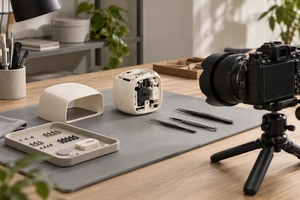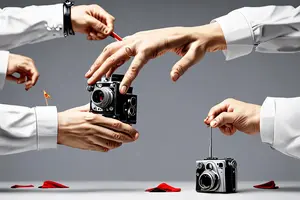
When a horizontal master must become vertical, the subject faces the wrong way for a new layout, or a hand blocks the product opening, flipping the shot can look like the fastest fix. The movement remains intact and the rhythm appears unchanged. Yet this is exactly where a product ad can quietly become untrue: buttons, ports, opening directions, labels, and the performer’s working hand may all switch sides at once.
Mirroring is not a neutral polish. It rewrites spatial facts. For an abstract shot with no text, direction, or continuity, a flip may be no more than a compositional choice. For an action that demonstrates how a product works, it can turn a convincing gesture into something that feels fabricated.
A mirror changes product facts first
Left-right continuity in a product ad has four layers: action, product, information, and character. A full-frame flip is potentially safe only when all four survive unchanged.
The action layer covers how a hand approaches, stabilizes, presses, rotates, or removes the product. The product layer includes buttons, latches, ports, camera modules, handles, and hinges. The information layer includes packaging copy, screens, scales, direction arrows, and logos. The character layer asks whether the same hand keeps the same role across surrounding shots.
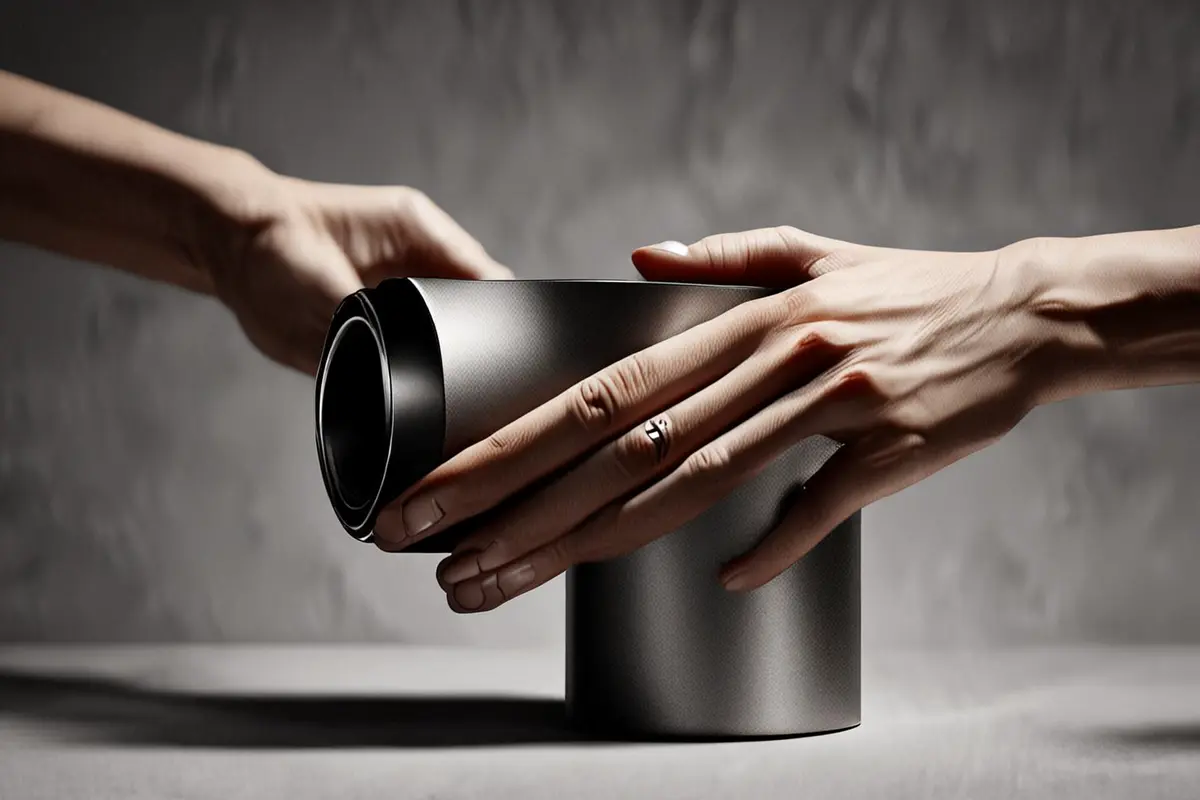
An unmarked, perfectly symmetrical circular container might be mirrorable in an isolated rotation shot. A coffee machine with a latch on its right side is not. After a flip, the latch moves left, small labels reverse, and the next unflipped product close-up restores the real construction. A viewer may not name the mistake, but the action loses weight because the product no longer has a stable shape.
Research also suggests that product orientation is not entirely neutral. In a 2012 Journal of Consumer Research paper, Ryan S. Elder and Aradhna Krishna used several experiments to examine how the orientation of a handle or actionable side can facilitate imagined use when it suits the viewer’s dominant hand. That is not a rule that every product should face right. A 2019 PLOS ONE study by Nicole A. Thomas and colleagues on left- and right-handers further showed that handedness affects attention to and judgments about object affordances. The useful production takeaway is narrower: an orientation invites a particular action, so it cannot always be treated as decoration.
Find the left-right relationship carrying the proposition
Left and right do not have equal importance in every shot. Before deciding whether to flip, ask what the shot is meant to prove.
If the proposition is surface texture and a performer merely supports a symmetrical object, left-right direction may carry little information. If the proposition is one-handed unlocking, an intuitive switch, or immediate access after opening, the operating path is the product value. The entry side of the hand, which hand stabilizes, and the direction of the latch all belong to the claim.
A useful way to diagnose the shot is to write one short causal sentence: which hand acts on which real component, what it does, and what state follows. If mirroring changes any part of that sentence, the flip is not a routine adaptation.
This also prevents a subtler mistake. An editor may mirror a shot to make the gesture look more convenient without noticing that convenience is exactly what the film is supposed to demonstrate. The ease of reaching, holding, or opening is part of how viewers mentally rehearse using the product.
Reframing for vertical does not require mirroring
When a horizontal film becomes vertical, the real problem is usually not whether the subject stands on the left or right. It is which action must remain visible inside the narrower frame. Adobe’s official Premiere documentation defines horizontal flipping as creating a mirrored effect. Its separate Auto Reframe guidance explains that the tool creates a duplicate sequence for the new aspect ratio and tracks action, while noting that shots with several points of interest or rapid motion may need manual keyframe refinement. These tools solve different problems: a flip changes direction; a reframe changes the view.
For product action, a safer order is to move the crop first, then adjust the in and out points. If that still fails, use a wider master, a dedicated product insert, or a vertical take of the same action. Consider mirroring only when product geometry, text, interface, action, and continuity are all genuinely symmetrical.
Production can leave room for these versions. Avoid placing the hand, product, and critical control against the extreme edge of a horizontal frame. Reserve a central region large enough to contain the complete action in vertical. For opening or rotating moves, record one wider safety take. The goal is not a mythical universal asset; it is to preserve the same product fact across formats.
A hypothetical shot: a right-side latch cannot wander left
Imagine an unbranded countertop appliance with a matte latch on its right side. The right hand presses the latch, the left hand stabilizes the body, and the lid releases. The horizontal shot clearly demonstrates component location, force, and result.
Flip it to move the performer across a vertical frame and several errors arrive together. The latch moves from right to left. The hands exchange jobs. A small direction marker reverses. The next unflipped insert puts the latch back on the right. Every individual shot may feel smooth, but the sequence no longer contains the same product.
A stronger adaptation keeps the original direction and lets the vertical crop follow the press and opening. If space is too tight, cut to a dedicated latch insert and return to a wider result shot. If the scene genuinely needs the opposite viewing side, shoot the real reverse angle instead of inventing a product variant. This is an illustrative construction, not a client case or performance result.
AIGC can extend the frame, not redesign the product
Generative reframing and expansion may look more intelligent than a simple mirror, but they can change left-right facts more quietly. A button moves between adjacent shots, the correct number of fingers appears on the wrong operating hand, an open state resets to closed, or a plausible background grows around a drifting product structure.
In 2026, Google Research described long-form video continuity work that tracks characters, spatial structure, and object states as persistent world information. The connection to product advertising is direct: smooth motion is not the same as continuity, and continuity is not the same as product accuracy. Product reference cards should lock front and back views, control positions, open and closed states, the operating hand, and the action before and after each shot.
AIGC is therefore well suited to extending environments, creating breathing room, or generating transitions that do not carry product facts. Buttons, ports, copy, packaging, and operating steps should still rely on real footage, controlled CG, or strict reference constraints. If a generated result makes the object more attractive by changing its construction, it is no longer an adaptation of the same product.
The final question is not “Is the text reversed?”
Reversed lettering is easy to spot. The difficult errors have no text: latches, hinges, ports, levers, handles, the performer’s working hand, and the action relationship already established by the previous shot.
At review, ask the team to say one full sentence before every action shot: who uses which hand, from which side, on which component, and what state follows. If the horizontal, vertical, and international versions produce different sentences, they are not lossless variants of one master.
Left-right continuity is not a cosmetic detail. It is part of how a product enters the viewer’s bodily imagination. Mirroring can balance a frame quickly, but it cannot replace real construction or coherent action. If you are planning horizontal and vertical product films alongside live-action and AIGC versions, explore ONCE brand film production to preserve one credible product from storyboard through delivery.