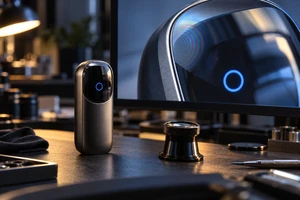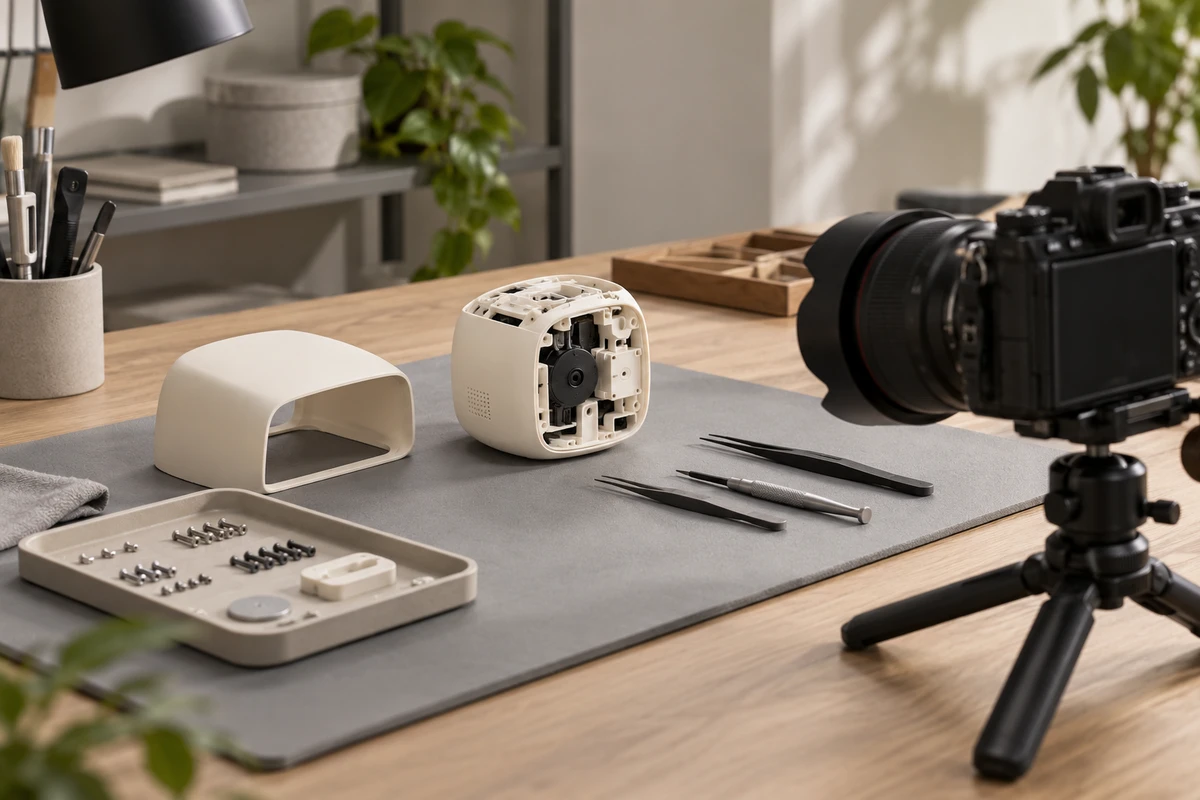
Your China-based supplier has delivered an attractive teardown film. A regional support team now wants to reuse it as a how-to video. Before approving a voice-over and an editing fee, ask for the source footage—not just the campaign export.
An editor can recover information omitted from the final cut. An editor cannot recover an operation that was never recorded. That distinction determines whether this is a recut, a targeted pickup shoot or a separate production.
A view inside is not automatically an instruction
iFixit’s PlayStation 5 Teardown, published on November 5, 2020 and checked on October 25, 2026, explicitly distinguishes the teardown from a repair guide and directs repair needs to a service manual. This is an example of a publisher separating purposes, not proof that every teardown lacks instructional value.
Its current Creating a Repair Guide page, also checked on October 25, calls for warnings, required tools and illustrated steps, and recommends converting repair videos into followable steps. We draw on that distinction here, not its device-specific procedures. This article concerns production procurement, not instructions for repairing a product or a safety certification.
A campaign can establish craftsmanship through a sequence of satisfying moments. A tutorial must help someone who was not on set understand where an action starts, what happens and how to recognise completion. A beautiful shot of a removed panel answers none of those questions by itself.
This does not make the campaign edit defective. It means a new use needs a different review.
Build an action-gap ledger before writing the new script
ONCE proposes an action-gap ledger for this conversion decision. Start with the manufacturer-approved target procedure and work backwards into the footage. Do not invent a procedure by arranging the shots you happen to have.
For each required action, record four things:
- The starting condition: product state, viewing orientation and approved prerequisites.
- The action: the object, contact point, direction and sequence that the viewer must understand.
- The completion cue: a visible correct state, not merely the next shot.
- The stop or referral condition: when to stop and where to obtain appropriate help.
Add the source filename, timecode, relevant technical reference and person confirming each entry. A missing item is a question for the product owner, not an invitation for the post-production team to improvise.
Distinguish missing information from unusable coverage. The action may have happened on camera, but a hand can obscure its contact point, shallow focus can hide the relevant detail, or a change of orientation can make two shots confusing. Technical familiarity does not make those images self-explanatory.
Slow motion, freeze frames and reverse playback can change presentation. They cannot establish an unrecorded physical sequence.
Buy one of three interventions
Recut when the information exists. If approved operations and their essential context are present across the source takes, the work may chiefly involve editorial assembly, annotations, narration and technical review. Commission one complete instructional step as an early review sample before expanding the approach. That is a proposed acceptance method, not a test ONCE claims to have performed.
Commission pickups when specific gaps can be filled. A campaign may show a before-state and an after-state but omit the transition. List that transition as a shoot requirement. Confirm that the available sample matches the hardware revision and approved documentation for the target users; do not quietly insert a new revision’s operation into an older product tutorial.
Retain the campaign use when conversion is unsuitable. A non-reproducible prototype, an unapproved procedure or extensive missing coverage can make a “simple edit” the wrong purchase. Keep the film as a product presentation and direct support needs to approved documentation or a service channel. Commission a separate tutorial if the business case warrants it.
Compare these options against the same target-action list. Include footage inspection, technical confirmation, pickup preparation and filming, post-production, language versions, final review and maintenance. Require each proposal to state what is covered and excluded. Existing running time is not a reliable pricing denominator, and reuse is not automatically cheaper than a fresh shoot.
A hypothetical conversion that should pause
Imagine an ad for a small desktop appliance. A presenter touches its shell; the next shot shows the shell neatly beside the unit. Support wants to add, “Press here to open.” This is a fictional example, not a customer engagement.
Before scripting that line, establish whether the raw footage shows the actual contact point and complete movement, whether the sample matches the audience’s product revision, and whether that audience is permitted to perform the operation. A smooth edit cannot answer an unresolved question.
If the coverage exists, reassemble it. If it is missing, arrange an approved pickup. If the operation is unsuitable for consumers, do not produce that self-service version. AI can help organise footage or create approved annotations; generated hands, latch movements or internal structures must not masquerade as a recovered recording of that sample’s operation.
Review the destination as well as the file
A structural montage on a launch page and the same clip sent by customer support as an answer to “How do I replace this?” carry different expectations. Moving the asset into an instructional destination should trigger a new content review. A disclaimer in the description does not supply missing steps.
For acceptance, ask a reviewer who was not on set, but has the knowledge expected of the intended audience, to locate each step’s beginning, completion cue and stopping point. Record uncertainty and correct it. Any hands-on rehearsal must use appropriate people under product-owner-approved conditions; do not use unqualified consumers’ trial and error as a production test.
For overseas teams buying content from a Chinese manufacturing partner, the useful handover is not simply “the long version of the ad.” It is an explicit account of which approved actions the footage can explain, which require new coverage and which should remain outside the tutorial. Price that account before promising the conversion.