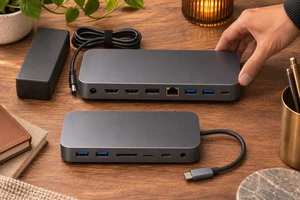
The USB-C dock in your supplier’s footage powers a second display, but the monitor only lights up near the end of the cut. The media report counts a viewable impression. Before briefing a new shoot, find out whether the placement gave that particular moment a chance to do its job.
Viewability qualifies an impression
In its October 5, 2026 announcement, HUMAN Security said its platform suite combines invalid traffic, viewability and brand safety signals, with OpenX as the first platform to adopt it. That is a change in how one supplier can assess inventory. It says nothing about whether a shopper saw your product claim. The January 2024 IAB and MRC retail media guidelines describe a video viewability benchmark of at least half the ad pixels visible for two continuous seconds. Ask which definition applies to your placement; qualifying under that benchmark does not establish that later frames were visible or that anyone paid attention.
Make a proof frame card for each edit
Have your editor mark the beginning and end of the visual proof, then describe what must remain in frame. For the dock, that might be the connection and the resulting display, confirmed against the model that actually ships. Ask the media owner for a placement preview. Play it on the target device, muted and with overlays present. If the second display disappears in the crop, fix the version before assigning blame to the opening line.
In reporting, keep served, measurable and viewable impressions separate, document the invalid traffic treatment, and ask what the progress metric counts. Separate totals for playback and viewability cannot tell you how many of the same impressions reached the proof while visible. Even linked exposure data describe an opportunity to see, not understanding or sales.
Buy a pickup only if the proof is missing
If the existing footage shows the result clearly, ask for a matched edit that places it earlier. Compare within the same placement and keep the offer, product and test window comparable. If both cuts lose the result in the crop, fix framing first. Commission a pickup when the underlying action or outcome was never captured. Keep the original cut as a comparator, record what the report cannot establish, and use ONCE’s guide to isolating creative variables to brief the next test.