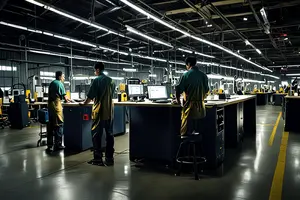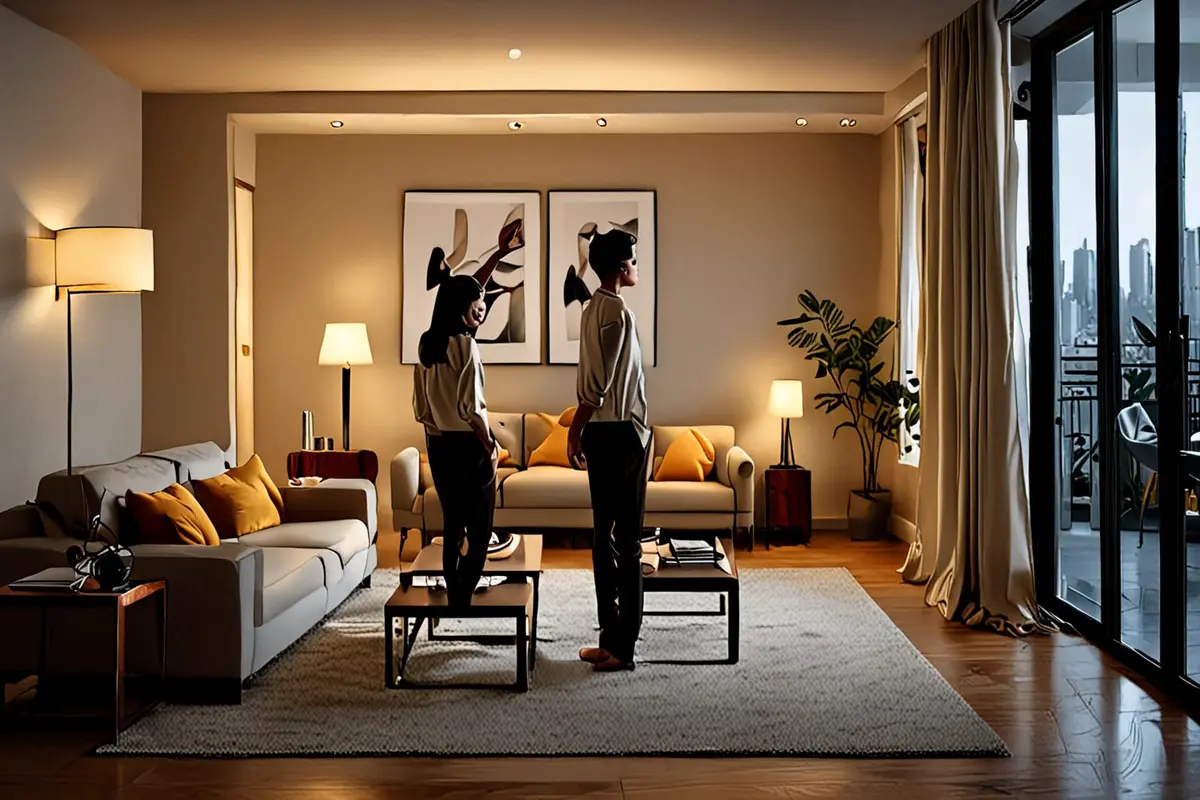
A brand film does not end at the edge of the frame. Keys turning outside a door, a character suddenly looking to screen right, or footsteps continuing after someone exits can make the audience sense another room, a corridor, a street and a relationship still in motion. Used well, offscreen space gives a modest set a complete social world. Used carelessly, it becomes a collection of unmotivated sound effects, unexplained glances and spatially confusing cuts.
Offscreen space is something the audience can infer
A physical location always extends beyond the camera, but that space does not automatically enter the story. The audience needs a directional clue that connects what is visible with what is hidden. That clue may be sound, an eyeline, a change in light, a shadow, or a person or object crossing the frame boundary. Together, these cues answer three questions: what exists outside the frame, where it is, and how it relates to the person or product we can see.
“A noise outside the door” is therefore not enough as a production note. The scene needs to identify who notices it, where it comes from, how the character responds and whether that response changes the next action. An offscreen cue becomes narrative when it redirects attention or choice.
Establish direction before revealing the source
Letting a sound arrive before its source is one of the clearest offscreen cues. A coffee machine is still hidden, but steam is already audible. A door remains closed while footsteps stop beyond it. Before a product lands on a table, a character recognizes the click of its mechanism. The audience begins to search for the source and predicts the next image.
The sound still needs distance and direction. A voice in the next room should carry the filtering of a wall or doorway. Footsteps at the end of a corridor should not sound as if they were recorded beside the lens. If an offscreen speaker later enters from the left, the earlier cue must support that geography. When every sound is equally clear and centered, the result feels like a library track rather than a place.
A sound can lead the cut or survive it
Hearing the next location before seeing it pulls the audience forward. Keeping footsteps or a final line after a character exits allows the previous location to keep existing. Neither transition needs to announce itself. The sound only has to remain attached to the same event as it crosses the edit. Our recent article on sonic memory in brand films examines repetition as identity; offscreen space asks where one sound lives inside one particular scene.
An eyeline turns the frame edge into an invisible door
When a character looks outside the frame, that direction immediately gains meaning. Yet many commercials simply ask the actor to “look over there,” without giving the glance a real object. The result resembles someone waiting for the director's next instruction. A useful offscreen look normally has three beats: a stimulus occurs, attention moves, and a small change follows in the face or body.
The height of the eyeline also supplies information. Looking upward may imply a standing person or a higher level. Looking down may suggest a child, pet or object on the floor. A fast glance and a sustained look express different relationships. For a reaction shot, give the performer a precise object, distance and cue instead of the abstract request to appear more surprised.
The eyeline can work without a reverse shot
An offscreen subject does not always need to be revealed. A restrained brand film may let the audience understand it through a reaction, a sound and the choice that follows. A person hears a child outside the room, stops working and carries the product toward the door. The relationship is clear even if the child never appears. If the reaction changes nothing, withholding the reverse shot merely leaves a gap.
Entrances and exits carry action across the frame boundary
A person leaving, a product being passed into view, or a shadow arriving before its owner all connect visible and invisible space. The force comes from continuity across the edge. If a hand enters from the left with a product, the receiving character's weight, gaze and hand position should already be preparing for it. If someone exits and the next shot continues the action, the direction and timing must still make spatial sense.
This is a natural way for a product to enter a story. It does not have to rise like a display object in the center. It can arrive from a relationship the character is already answering: a colleague passes over a tool, a family member brings a drink from the hallway, or a pet pushes an object into view. Our article on interruptions in brand films explains how an interruption can motivate product entry. Offscreen space addresses the moment before the source is visible.
Doors, windows and corridors are spatial interfaces
A common studio problem is treating every wall as a closed background. A half-open door, a corridor falling into darkness or a window that carries changing exterior light can imply a much larger world. During art direction, decide what each opening leads to. A busy office, a quiet bedroom and an early street require different color, sound, movement speed and carried objects.
Offscreen space does not require a larger build. The area beyond a door may only need a controllable patch of light, a few physical sound sources and enough room for a performer to approach. Preserve the conditions for sound spill, passing shadows and entries. This method differs from visible camera moves that reveal more of a set: it allows the audience to complete the space at the edge of the image.
The camera must sometimes resist following
If the camera pans to every sound immediately, it supplies information. If it remains with the character for another beat, it lets the audience feel attention being redirected. Whether to follow depends on the dramatic subject. When the product reveal is the point, the camera may travel with the action toward it. When a decision matters more, the lens should stay long enough for the offscreen stimulus to register in performance.
Composition can add pressure to the unseen direction. A person on the left looking toward open space on the right gives the eyeline somewhere to land. A character pressed to the edge while looking toward the nearer boundary can feel constrained. Negative space is not a fixed ratio. It works when gaze, movement and direction support one another.
Time the performer, sound cue and camera together
Offscreen acting often fails because the cue changes between takes. Footsteps reach the door at a different moment, an off-camera line changes pace, and the actor can no longer repeat the reaction. Assign a specific person to every offscreen action and write the cue into rehearsal: which step reaches the threshold, which word triggers the look, how long the pause lasts and when the entrance begins.
The camera also needs the timing. If a slow push is underway when the character hears something, focus, composition and the end of the move must anticipate the reaction. Run the complete scene in real time first. Then capture reactions, hands, entrances and exits. A group of attractive reaction close-ups rarely contains enough information to rebuild the geography later.
Record the room instead of relying only on sound libraries
Capture room tone, door movement, footsteps at several distances, product sounds and the change between the two sides of a doorway. The production sound may not enter the final mix directly, but it provides material and distance references. The same step reflects differently on wood, carpet and an empty corridor. Those differences help the audience identify space.
Record changes in perspective as well. As a person approaches from offscreen, the sound does more than become louder. High frequencies, reverberation and obstruction change. A simple volume fade can sound like an effect being pushed toward the listener. The sound designer needs the source route, door state and camera position to reconstruct believable movement.
Protect the geography before deciding when to reveal
Offscreen space permits omission, but not arbitrary teleportation. Before editing, draw a simple plan: where the character faces, where the door stands, how the source moves and from which direction the product enters. The audience never needs to see the plan, but the cuts should respect it. If the creative deliberately reverses direction, sound, action or composition must establish the new orientation.
The same scene can support three reveal patterns. Reveal the source immediately for concise functional information. Stay with the reaction before revealing it to build expectation. Never reveal it, allowing the later action to confirm the relationship, for a more restrained main film. To preserve these options, record the full sound lead, reaction duration and boundary-crossing action.
Vertical and short versions need stronger directional cues
Widescreen can reserve generous space between a character and an unseen direction. Vertical framing compresses that relationship and may turn left-right space into an up-down arrangement. Check whether the eyeline, doorway, moving shadow or entering hand remains readable in the crop. If the crucial source is lateral but the vertical version retains only a frontal face, the glance may look unmotivated.
A short version does not need to remove every offscreen setup. Half a second of sound followed by one clear reaction can be more engaging than cutting directly to the product. Keep the three beats of stimulus, reaction and product while shortening each. If compression destroys cause and effect, film a more direct short-form action rather than asking captions to repair it.
AI and CG can extend the world, not repair wrong direction
AI can previsualize light beyond a doorway, background depth or the composition after an offscreen figure enters. CG can add an exterior environment or a moving shadow. Generated elements still have to inherit the practical light direction, eyeline height, action entrance and sound position. If an actor looks high to the left and the generated subject enters from the right, the image will feel wrong even when every element is polished.
Build one coherent practical space first, then decide what deserves extension. The advantage of offscreen space is that it can work with less visible information. Filling every boundary simply to demonstrate production technology can remove the audience's role in imagining the world.
Write every scene as an onscreen task and an offscreen force
Before the shoot, describe each scene in two lines: the task happening inside the frame and the stimulus arriving from outside it. Then ask whether the stimulus has direction, whether the character reacts, whether the action changes and whether the product earns a place in that chain. If only an attractive sound remains, the offscreen design is incomplete.
If you are planning a brand film, product commercial or AIGC hybrid piece inside a limited set, ONCE can previsualize the spatial relationships, performance cues, production sound and multi-format coverage together. Share your project, location and required versions, and we can decide what the camera should reveal and what becomes more powerful beyond the frame.