Humor in product advertising often splits into two unrelated films. The actor carries the joke, then the product appears at the end like a sponsor card. People remember the face or the line, yet cannot explain why the product belonged in the scene. A stronger visual joke puts the product inside the comic mechanism: it changes an action, breaks an expectation, or exposes a mistaken reading of the situation. By the time the payoff lands, the audience has also understood something useful about the product.
This does not mean every product film should become a comedy, or that a demonstration should exaggerate performance. The practical question is narrower: if humor is part of the idea, can the product become the cause, instrument, witness, or consequence of the joke rather than an object placed beside it?
A joke is a chain of cause and effect before it is a funny line
A filmable product joke usually has three beats. First it establishes a normal expectation. Then a product action creates a deviation. Finally, a result or reaction closes the loop.
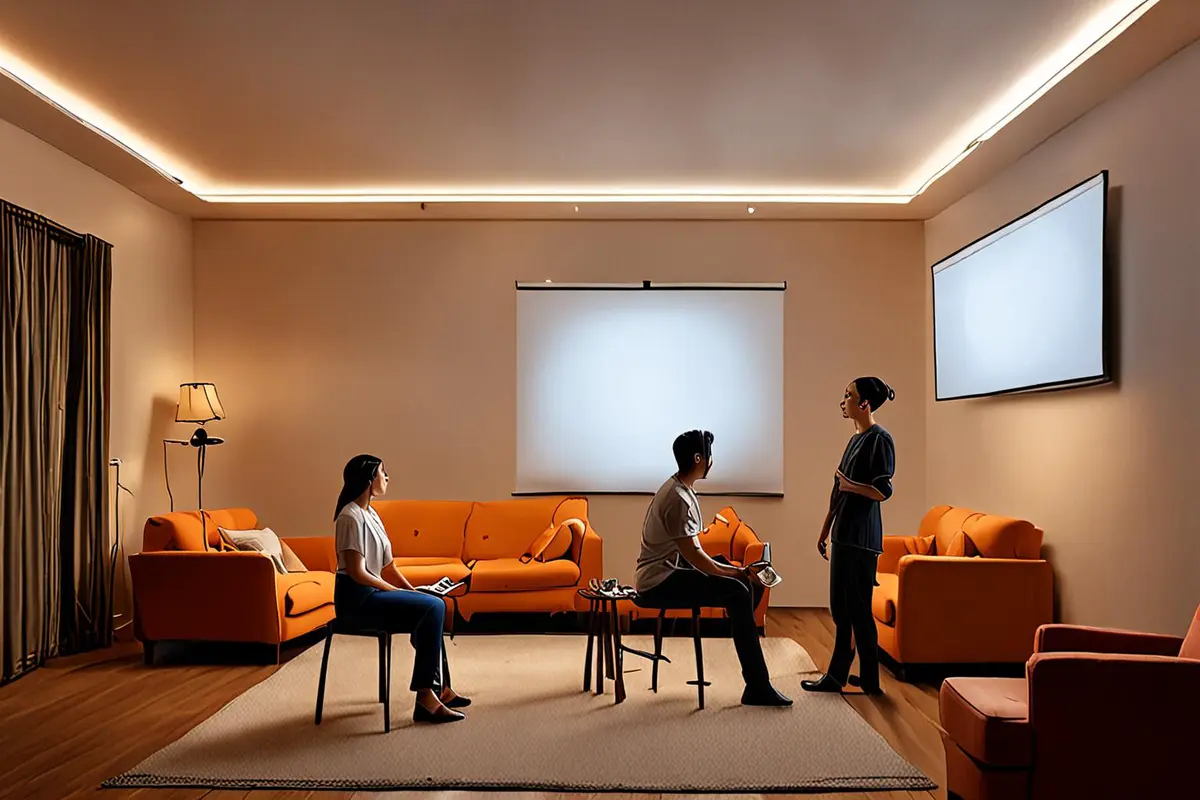
Imagine an ad for a portable projector. Two people carefully prepare a home cinema, so viewers expect them to aim at a blank wall. They discover the only clear surface is the ceiling. The payoff shows them lying side by side, watching above them. Flexible placement is not explained after the joke; it is what makes the joke possible.
If the scene works exactly the same after removing the product, the product is probably just placement. If the humor is removed and viewers can still describe the relevant value, the joke has not buried the information. A concept is worth developing when both tests pass.
Give the product a role inside the comic mechanism
The product does not always need to be the hero, but it needs a clear dramatic function. Four roles help a creative team test whether the punchline truly belongs to the object.
The product is the cause
Once it starts, something changes in the space, sound, or character behavior. Noise-cancelling headphones, for example, might leave a character unaware of a series of small events nearby. The task is to choose a safe, familiar deviation without turning it into an unsupported performance claim.
The product is the instrument
A character uses the product to solve an unusually specific problem. A small desk fan intended for cooling might briefly help a prop painter move to the next setup. The humor comes from a slight shift in use, provided the action is safe and is not presented as an official capability.
The product is the witness
The product stays still while a relationship reveals itself around it. A doorbell, coffee machine, or robot vacuum can quietly witness a misunderstanding. This structure suits brand films because the product can remain involved through position and eyelines without taking over the dialogue.
The product is the victim
A character protects, decorates, or prepares the product far more carefully than necessary. The joke comes from human attitude. Avoid drops, water, impacts, or other actions that could imply durability the product has not been shown to possess.
Actors should believe the situation, not announce the joke
Performance often breaks product humor. Actors know where the punchline is and begin to raise an eyebrow, pause, or glance at the camera before it arrives. They are effectively telling viewers to laugh before the event has happened. Visual comedy works better when the character remains serious about the task.
A director can define three intentions: what the character wants to complete, what they expect to happen, and whether they deal with the situation before showing emotion. The last point matters. A believable response often begins in the body—a hand stops, the eyes return, weight shifts—before the face changes. When every reaction is pushed into facial expression, the product action loses force.
Record three versions: restrained, lightly reactive, and close to the upper edge of the chosen style. Compare them first without sound. This reveals whether the relationship in the frame is funny or the actor is doing all the explanatory work.
Protect the information gap before polishing the composition
Comedy depends on who knows what first. When viewers know before the character, anticipation builds. When the character knows first, the audience waits for a reveal. When both discover the change together, the timing is direct. Camera position controls this information gap.
If the joke depends on a robot vacuum moving behind someone, the opening angle must make it visible to viewers while the character ignores it. If the joke depends on a state change inside the product, showing a reaction first and the product later may feel like a missing shot. A storyboard should mark each beat as visible to the audience, visible to the character, or deliberately hidden.
This is different from simply choosing fast or slow movement. ONCE's video production articles explore how product time and action clarity shape a demonstration. Comedy adds another question: in what order do the character and audience receive those actions? The speed can remain identical while the joke disappears because the reveal order changed.
Sound should land the action, not behave like a laugh button
The most useful sounds in product comedy often come from contact, startup, stopping, and room response. A click can complete a preparation beat. An unusual silence can make a character notice that noise cancellation is active. A repeating mechanical sound can let the audience predict the result before the character does.
If the music stops before every payoff, every joke starts to sound the same. Build a version with location sound first. Can viewers understand the action? Does the result have a clear landing point? Does the pause create real anticipation? Music should then support the rhythm instead of adding a label that says, "This is funny."
Turn the value into a deviation without exaggerating the function
Humor is most useful when it enlarges a small gap between a character's expectation and real use. It is less suitable for enlarging an unverified product result. Three hypothetical scenes show the difference.
- Storage product: a character keeps looking for the perfect place, only to discover that the product already fits in the narrowest gap. The joke communicates compactness without changing its dimensions.
- Kitchen appliance: a character prepares for a complicated procedure, while the real product completes the task in fewer verified steps. The excessive preparation is funny; the steps still have to match the actual sample.
- Smart pet device: the owner solemnly organizes a routine, and the animal takes over the rhythm of the scene. The product must still complete a visible action instead of relying on the pet to carry all the appeal.
ONCE's video marketing work often starts with a specific everyday problem rather than a generic comic tone. The reusable principle is simple: the problem and product should occupy the same action chain. The characters, props, and lines must still be invented for the current brand.
Some risks should not become the center of the joke
Humor needs a narrower range when a film involves health, safety, financial loss, childcare, or major equipment failure. A story can use over-preparation, a domestic misunderstanding, or a communication gap, but it should not make actual harm, unsafe operation, or a critical warning feel disposable.
Humor also struggles when the brand has not decided which value viewers should believe. If one short script tries to prove faster, stronger, cheaper, and safer at once, the joke becomes another signal competing for attention. Choose one value that an action can express, then ask whether comedy makes it clearer.
Test the punchline with a six-second silent prototype
A phone, the sample, and basic props are enough to find out whether the idea can be filmed. Make a six-second version without dialogue:
- Use the first two seconds to establish the task and normal expectation.
- Use the middle two seconds for a product action that creates the deviation.
- Use the final two seconds for the result and one restrained reaction.
Show it to someone outside the creative team and ask three questions: What happened? Why was it funny? What did the product do? If they can answer the first two but not the third, the sketch has overwhelmed the brand. If they understand the function but see no turn, it is only a demonstration. If all three answers come naturally, the idea is ready for proper storyboards, lighting, sound, and aspect-ratio planning.
Visual humor does not make production lighter. It demands tighter control of expectation, action, framing, performance, and sound. When the joke truly belongs to the product, viewers do not need the benefit repeated afterward. The product has already explained itself through the payoff.
If you are developing a light-comedy campaign that must express both brand character and product value, explore ONCE video production solutions and share the product, audience, and action you most want people to remember. We can begin by turning the joke into a cause-and-effect sequence that can actually be filmed.