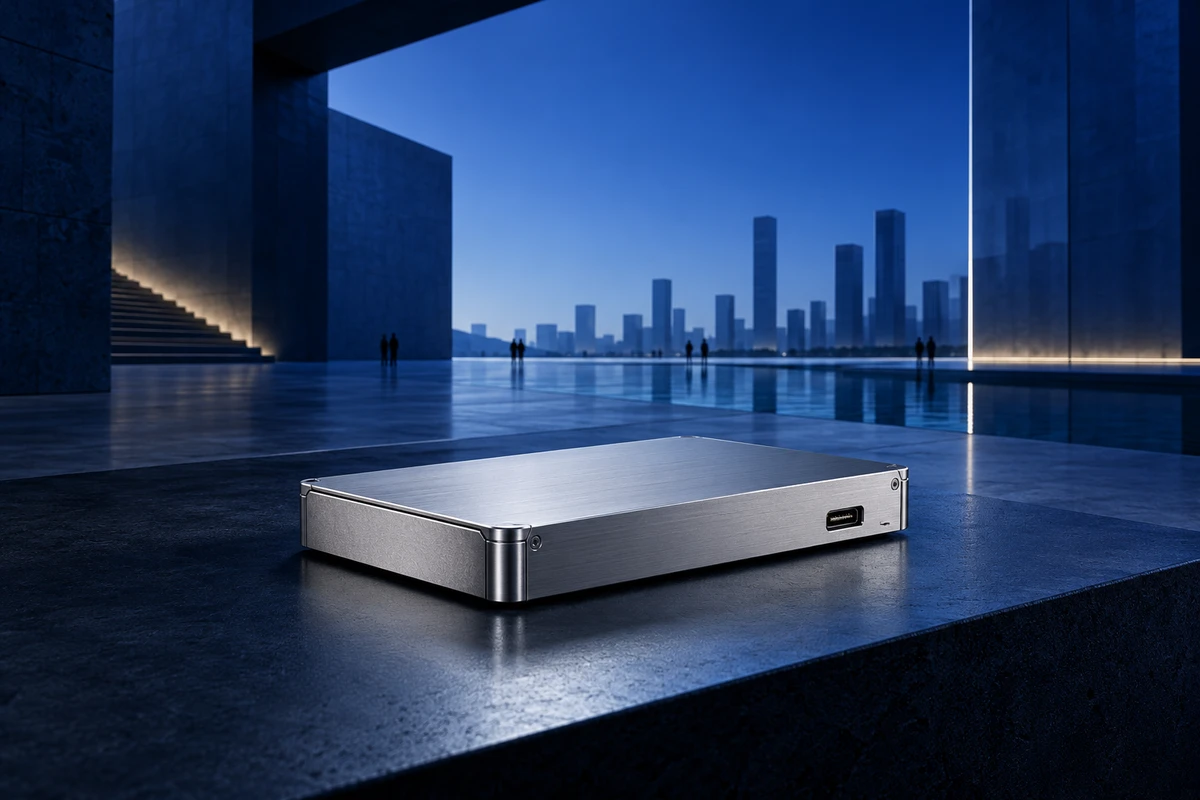
On October 19, 2026, Samsung Electronics announced an expansion of its SSD brand campaign, “Choose the sure thing,” across Times Square in New York, Piccadilly Circus in London, and the Entertainment Building in Central, Hong Kong. The three official location images share a saturated blue field, a short white message, and a clear SSD product image. The central line is: “When you’ve got everything to lose, choose the sure thing.” Samsung positions the campaign around performance, reliability, and trust.
The official release does not disclose campaign results or a complete production breakdown. This article treats the locations, message, published images, channel plan, and disclosure that certain video images were generated with AI as confirmed facts. The interpretation of the visual mechanism and production choices is ONCE’s professional analysis. The question is practical: when reliability is invisible, how can technology brand OOH advertising create an immediate judgment before asking people to study specifications?
A Landmark Screen Is Not a Larger Product Page
Out-of-home viewing often happens in motion. People cross a street, wait for transport, look for directions, or catch only part of a display through traffic and surrounding media. A larger screen does not give a brand permission to add a longer specification sheet. It magnifies competition for attention. Every extra model name, speed figure, or certification icon takes time from the same brief encounter.
The visible system in Samsung’s campaign is restrained. Blue establishes a stable brand field. The white line creates the tone of a decision. The packshot identifies the product category behind that decision. The creative does not try to explain every SSD feature in the street. For technology brand OOH ads, this is the useful division of labor: the landmark placement makes one reason to choose memorable, while the website, retail environment, and deeper content carry detailed comparison.
Reliability Becomes Visible Through a Decision
Speed can be dramatized through timing, motion, and response. Capacity can be expressed through quantity. Reliability is harder because its ideal outcome is that nothing goes wrong. A device working quietly may look dependable, ordinary, or simply undramatic.
The campaign does not turn trust into a generic shield. It places reliability inside a sentence about loss and choice. When the content in your hands matters, the purchase is no longer framed as a neutral comparison between storage tools. The creative move is not to stage a disaster. It is to convert an invisible quality into a decision with consequences. People understand what the product may be trusted with before they consider the product itself.
A brand developing a similar proposition can begin by naming what the product protects: a creator’s footage, an engineering team’s version, or a family record. The more specific the object of trust, the more reliability feels like a lived judgment. When the object remains only “valuable data,” the imagery easily falls back into a generic collage of drives, clouds, and shields.
Immediate Recognition Comes From Three Stable Layers
The first layer is semantic stability: every placement repeats the same reason to choose rather than inventing a different benefit for each city. The second is visual stability: the blue field, white line, and product relationship remain recognizable even when a viewer sees only part of the screen. The third is object stability: the product silhouette, interface, surface, and proportions must stay credible instead of becoming a fictional futuristic object for the sake of impact.
These layers do not require every placement to repeat the same pixels. The corner screens of Times Square, the curved display at Piccadilly Circus, and the vertical Hong Kong facade have different proportions. Cropping, perspective, and product position must adapt. What should travel across cities is the recognition relationship. A global master that supplies only one horizontal key visual forces local teams to scale at the end. A master that defines the color field, copy safe area, minimum product recognition size, and flexible composition logic can preserve the same statement across different architecture.
This differs from our recent analysis of creative localization across languages. That article asks how local markets should rewrite an idiom-driven entry point. This one asks how a single technology judgment can retain its identity across media dimensions. Both require global and local roles, but they stabilize different things.
Do Not Use Disaster to Manufacture Trust
Technology advertising often stages corrupted files, error screens, and panic before the product arrives as the solution. The causal chain is easy to read, but the audience may remember the failure first. It can also imply protection that the product has not publicly promised. For storage, security, medical, or industrial technology, the more specific the fear becomes, the more carefully the claim must be checked.
A more durable approach leaves the risk in the tone and situation while keeping the product as a stable visual anchor. A character might make a deliberate choice before a delivery. The value of creative files can be shown through the work required to make them. A device can remain physically clear within a demanding environment. The image does not need to destroy a file for viewers to understand that this is not a casual choice.
Restraint also gives the brand room to grow. Disaster stories must keep escalating. A choice story can extend to creators, gamers, enterprise teams, and families as long as each situation answers the same question: what deserves to be stored with confidence?
The Product Hero Must Stay True Before It Becomes Monumental
Landmark media can make a small object monumental, but it also enlarges mistakes. An inaccurate label, port, edge, reflection, or thickness becomes architectural visual noise. A technology product hero should therefore begin with a verifiable master view before photography, CG, or generated environments add scale and atmosphere.
For live action, a studio can capture the front, side, ports, material highlights, and clean shadow as separate controlled assets so different placements have room to recompose. For CG, the model version, material nodes, and packaging graphics should match the released product. When generative imagery supports atmosphere, environment, or transitions, teams should separate the product master from the areas that may be generated and state when an image is symbolic. Samsung’s official page notes that certain images in the related video were generated using AI. That disclosure carries a wider lesson: when a technology brand speaks about trust, the origin of the image and the physical truth of the product are part of the message.
For a broader approach to combining live action, CG, and AIGC, see ONCE’s video marketing and brand content work. The goal is not to choose one tool for everything. It is to assign each tool to the part that can be checked and defended.
Build a Path From the OOH Master to Deeper Touchpoints
Samsung says the campaign will extend to Samsung.com, digital channels, and social media. The landmark screen leaves a reason to choose. Later touchpoints can expand the reason: what product design supports reliability, which tasks need the performance, and how a buyer should compare models. If a short film only animates the billboard while the website suddenly becomes a catalog of unrelated specifications, the audience meets two different brand languages.
A more coherent system adds evidence in stages. OOH answers why the product should be trusted. A short film shows what task cannot be lost. The product page explains which specifications support that task. Reviews and use-case content then state the relevant conditions. Brand memory and product understanding become one judgment that gains detail over time.
This Method Does Not Fit Every Technology Product
Compressing an invisible benefit into one reason to choose works when the category is already understood, the value is closely tied to reducing risk, and the brand needs a consistent impression across cities. SSDs are a broadly recognizable storage category, so the landmark creative can skip part of the explanation.
If a product creates an entirely new category, attitude alone may feel empty because people do not yet know what the object does. If purchase depends on a specific workflow, the brand still needs to show the task, interface, and result. If the reliability proposition lacks product evidence, even a beautifully controlled blue landmark cannot substitute for proof. Public imagery can open recognition, but it cannot replace product truth.
Write the Decision Before Designing the Monument
Before the next OOH or brand campaign, a technology team can put the specification sheet aside for a moment and write the decision the audience must make: what is at stake, and why does this product belong in that choice? The visual can then compress the answer into a tone readable at distance, a product object that remains true, and a relationship that can adapt across placements.
If you are shaping an invisible benefit for hardware, smart products, or industrial technology and need to turn it into a filmable, extensible brand system, contact ONCE VISUAL. We can work from the proposition and product hero through to multi-city campaign formats.
Source: Samsung Global Newsroom, “Samsung Electronics Expands SSD Brand Campaign Across Global Landmarks”, October 19, 2026; official New York, London, and Hong Kong location images, reviewed October 29, 2026.