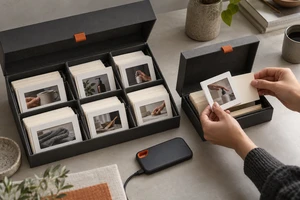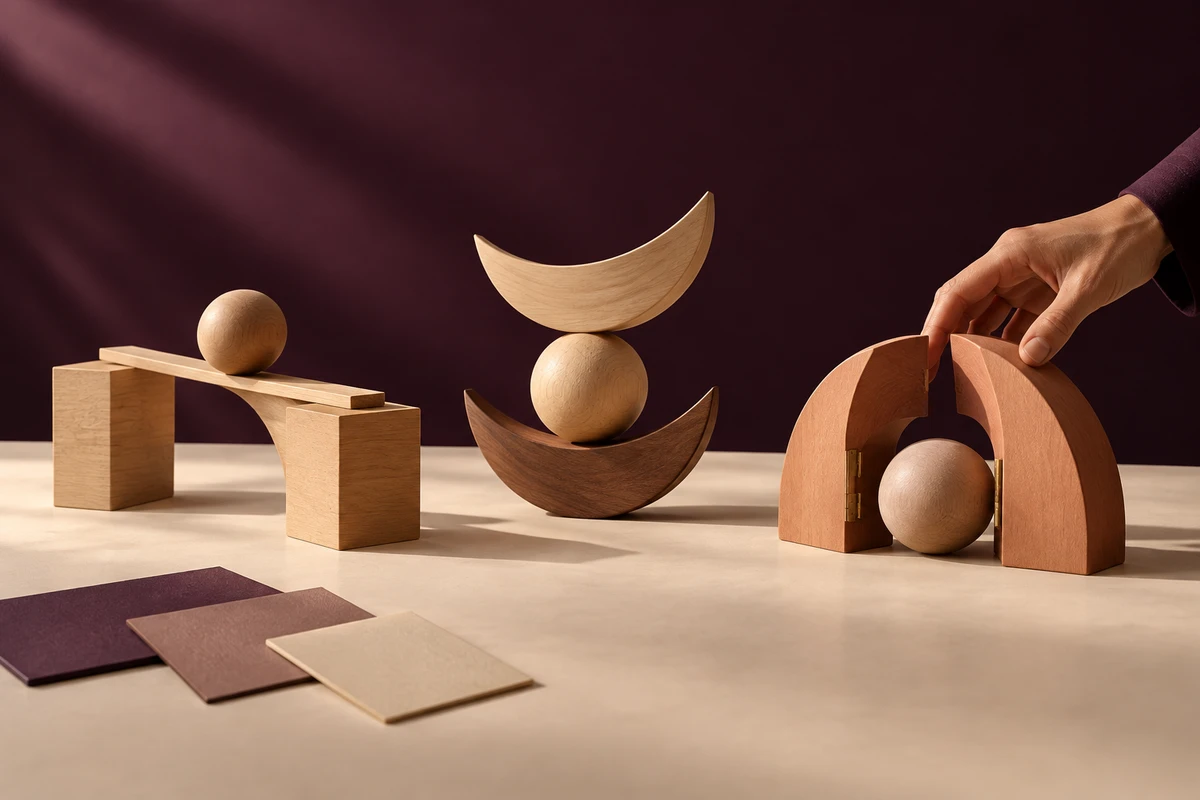
A brand receives four impressive boards: a retro room, a neon city, a space station and a restrained studio. All four show someone struggling until the product arrives. There may be four useful art directions here, but the brand has not necessarily compared four different stories.
For marketing teams developing campaigns with Chinese suppliers and production partners, the distinction affects what to buy. Story development explores how a product changes an event and what that means to an audience. Visual development explores how that event should look. Both have value; image count alone cannot describe the choice offered.
What the research can support
The Bielefeld University preprint Testing Associative Creativity in Humans and Multimodal LLMs with Difficult-to-Name Visual Stimuli, posted October 20, 2026, examines originality and effectiveness in naming abstract visual stimuli. It reports more diverse human associative descriptions than those of the models tested.
Effectiveness here concerns a description’s relationship to an image, not advertising conversion. The findings do not establish that human campaign ideas always sell better, cover every model or predict a particular market’s response. ONCE draws a narrower procurement question: which differences is a set of concepts meant to offer?
Google Research’s 2026 abstract for Human-GenAI Collaboration in Creative Ideation: A Study with Advertising Professionals reports greater idea quantity among participants using GenAI after prompt training in that study. We read the abstract, not the full paper; quantity should not be treated here as evidence of originality, production feasibility or sales.
ONCE’s review: remove the style description
Before commissioning polished boards, rewrite each candidate in three plain sentences:
- What happens to a person, object or environment before the product intervenes?
- How does the product change that event?
- What brand-related understanding should the viewer take away?
Leave out terms such as cinematic, premium, futuristic and spectacular for this pass. Avoid using explanatory voiceover to repair an event the proposed pictures never show. A product-only film can describe resistance, spatial relationships or a change of state.
| What the review finds | How to treat the candidate |
|---|---|
| Same event, intervention and takeaway; different styling | A visual treatment within one story |
| A different product role changes the intended understanding | A separate story candidate to develop |
| Written claims of difference without a different visible action | Request an action sketch or rough demonstration |
| An unusual association with no clear product relationship | Keep as a seed; develop the connection before production |
This is a proposed review method, not a customer-tested score. It does not prescribe problem–solution advertising. Humour, suspense, relationships and visual metaphor can all survive the exercise. The purpose is to see what remains different when the decorative language is removed.
A hypothetical brief from a travel brand
An overseas retailer sourcing packing products in China might receive several scenes of a messy surface becoming organised. Moving that action between a hotel and a space station explores context while retaining a similar mechanism.
A story about two travelling companions finding each other’s belongings changes the relationship at stake. Another candidate could arrange belongings in the order of a journey, making preparation the subject. Neither should invent compartments or functions absent from the real product. These are illustrative seeds, not ONCE projects or predictions of a winning campaign.
The next decision concerns audience comprehension, brand recognition and execution. Difference creates something to compare; it does not establish quality by itself.
Keep the first contributions visible
One workflow worth trying is to have participants record a few associations independently before seeing each other’s answers, then ask AI for additional routes using the same factually resolved brief. Preserve the origins as ideas are grouped, developed and combined.
That sequence is ONCE’s suggestion. The cited studies do not establish its superiority, and a brief may call for another order. The useful requirement is that reviewers can inspect genuinely different story relationships rather than simply count generated options.
AI can flag similar descriptions or missing actions. Its ranking should not be the sole decision. Brand, creative and production leads should explain what they retain and why. “The model preferred it” is not a complete creative recommendation.
Develop an action before polishing every board
For each retained story, request a key-action sketch, the product’s entry into the event and the main execution question. Rough drawings can be enough. If the idea depends on a difficult mechanism, a functional claim or unstable generated detail, expose that dependency before expanding the treatment.
Ask whether the essential change is readable without explanatory copy, whether replacing the product with a competitor leaves the story untouched, and whether the schedule allows its central action to be demonstrated. A broadly applicable story need not be rejected automatically; the team should explain how recognition will be built.
Audience comprehension can be explored with rough materials and open questions about what happened and what the product did. Record the sample, material and questioning limits. Early qualitative feedback is not a controlled effectiveness test or a sales forecast.
Scope story development separately from visual development
A proposal can specify the story candidates to compare, how their actions will be expressed, the visual exploration included and the point at which one route is selected. Agree quantities for the brief rather than presenting an invented industry standard.
Trying colours after selecting a story is visual development. Changing the product’s role may reopen concept work. Agree how those changes affect time and fees. A promotion that only needs an established mechanism adapted can buy that service directly.
For ONCE’s long-term creative capability, useful knowledge includes story relationships, selection reasons and execution findings retained with client permission. A large image folder alone does not supply that judgement. Start the next brief with the three sentences, compare the stories, then invest in the treatment worth developing.
Sources checked October 27, 2026. Research tasks differ from campaign production; the proposed workflow has no claimed customer outcome or guaranteed efficiency gain.