The shipment has arrived from the Chinese supplier. The brand's marketing team wants its previous video ads running again. Before commissioning a replacement film—or restoring the old one—ask whether the advertised product, offer and destination still describe the purchase available today.
Restocking is a commercial event, not an automatic creative approval. Equally, an advertising pause does not make accurate product footage obsolete. ONCE proposes a Relaunch Receipt: four checks that determine whether an existing asset can be reused, needs a limited edit or requires new capture.
A working purchase button is not proof of ready stock
Google Merchant Center's current Availability guidance, checked October 25, 2026, distinguishes stock and order states and requires availability to agree across the product data, landing page and checkout. This is existing guidance, not a new policy announcement.
Shopify's Selling out of stock products, checked the same day, explains that tracked products can be configured to continue selling without stock. An active button alone therefore does not establish immediate availability.
For an overseas brand buying from a Chinese manufacturer, “arrived at the warehouse” is not enough information for an advertising claim. Confirm the exact version, the relevant fulfillment location and the offer available to the target market. Production should not infer an immediate-shipping promise from an inbound-shipment photograph.
Start with the asset you intend to restore
The Relaunch Receipt identifies one asset, its version, market and purchasable variant. It then asks four separate questions:
| Check | What needs confirmation |
|---|---|
| Product | Do the depicted colour, structure, packaging and included items match the current offer? |
| Promise | Are stock, shipping, promotion, gift and expiry statements still accurate? |
| Asset | Are its factual portrayal and permitted time, territory and channel use still applicable? |
| Destination | Does the click reach the advertised product and variant, with consistent page and checkout information? |
Record who confirmed each item and when. An unresolved item remains unresolved. Once all four have been confirmed, the authorised campaign owner decides whether to resume; a production supplier is not being asked to approve the business's readiness to sell.
Add one practical line: the smallest necessary production action. The purpose is to locate the work, not to turn every replenishment into a reshoot.
Three replenishment scenarios, three production decisions
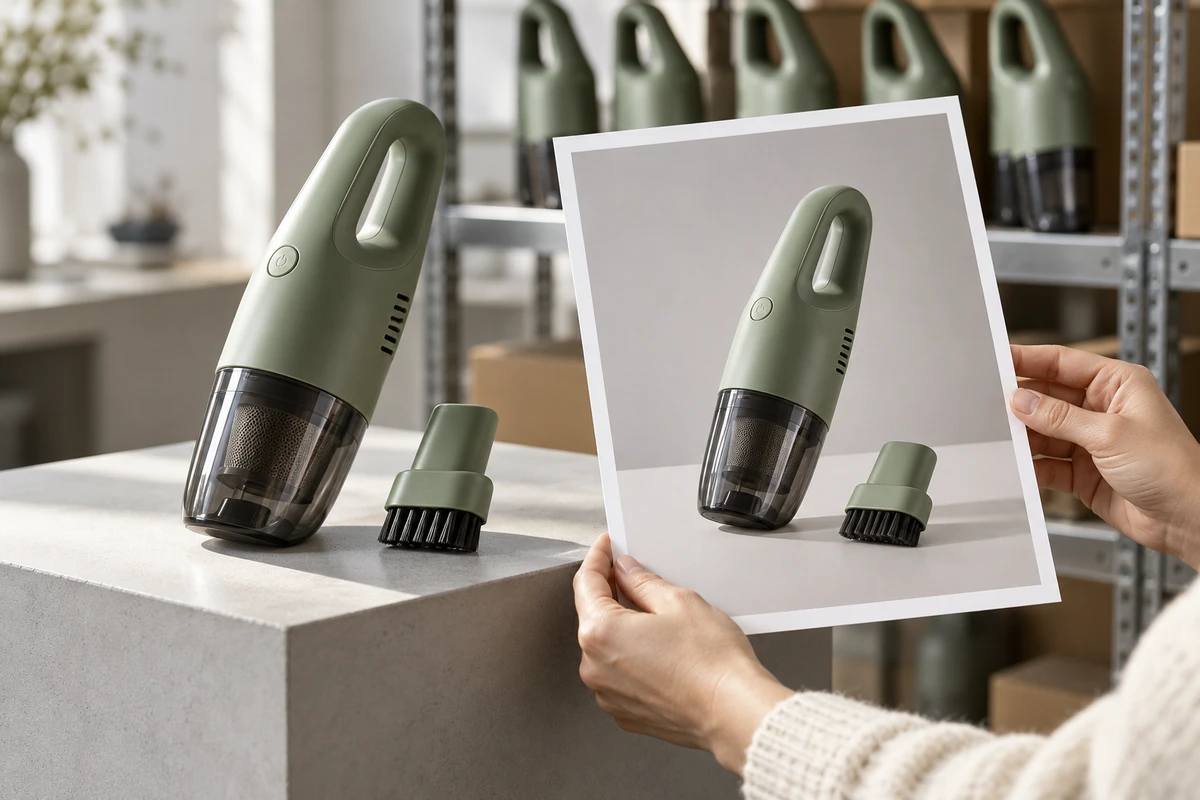
Consider a hypothetical handheld-vacuum campaign. It is not an ONCE client case, and no cost or performance results are implied.
The same variant returns with unchanged accessories and offer. If the demonstration is accurate, the promotion remains valid, the buying path works as intended and usage conditions remain applicable, the original film may be reusable. A stockout alone is not a reason to replace it.
The product is unchanged, but the offer has moved on. An expired event end card or a shipping line that no longer applies needs attention. Identify the affected voice track, captions, end card and thumbnail. Existing clean masters and separate audio tracks may allow a limited edit rather than new photography. Inspect the actual project before promising a turnaround or fee.
The replenished version is different. A redesigned brush head or changed included accessory can invalidate specific demonstrations and contents shots. A new product link does not make the old portrayal accurate. Identify the affected actions and statements, then arrange appropriate capture or renewed substantiation. Review unaffected room footage or product shots separately rather than discarding everything.
If only another colour is available, do not quietly send an unmistakably variant-specific ad to that different purchase. The portrayal, explanation and destination need to be considered together.
Separate purchase unavailability from creative failure
Suppose purchases decline after an ad click while the featured variant cannot be ordered. That observation alone does not establish a weak opening, ineffective casting or creative fatigue.
ONCE's analytical recommendation is to mark the periods when orders were unavailable, delayed orders were accepted and normal fulfillment resumed before interpreting the creative. Stock conditions do not necessarily explain the entire result; audience, budget, offer and page changes may also matter.
Keep the actual restart time and a list of changes. If the product, offer and video all changed, a before-and-after difference is not proof that one creative change caused the result. This is a reasoning discipline, not a measurement result from an ONCE test.
Procurement can consequently separate two tasks: updating assets after a commercial-state change, and producing new creative to answer a defined communication problem. Completing the first does not automatically justify buying the second.
Deliver a usable restart record
The handover should identify the previous file, approved relaunch version, changes, actual destination and reviewers. If nothing needs changing, retain a confirmation that the existing asset remains suitable. A needless new export is not a better substitute for that decision.
Agree who reports another stockout, version change, offer expiry or usage restriction; who handles the commerce page and media; and who revises the asset. This assigns collaboration duties. It does not imply that a platform automatically synchronises every statement in a finished film.
For a brand preparing a product-content brief with ONCE, useful inputs are the existing ad, current market-specific product and offer details, and intended purchase destination. They help distinguish a relaunch review from a creative commission before a crew or edit session is booked.
The practical aim is simple: let accurate footage continue working, fix the promises that have changed and reserve new-production money for differences that actually need to be shown.