A factory can explain exactly how a new appliance works. A brand team can describe the audience it wants to reach. Neither fact establishes why shoppers are hesitating—or whether a new product film will help.
For overseas brands working with Chinese manufacturers, that uncertainty matters before a production order is signed. Commissioning a polished demonstration is sensible when shoppers cannot understand a real benefit. It is a different proposition when the bundle is confusing, delivery is unavailable, or the benefit simply does not justify the price.
ONCE proposes a short diagnostic stage before committing the main production budget: establish the purchase obstacle, identify what remains uncertain, and assign the next action to someone who can actually change it.
What P&G’s latest results can—and cannot—tell a buyer
On October 22, 2026, P&G reported 4% year-on-year organic sales growth for its fiscal 2027 first quarter, covering July–September 2026. Its organic measure excludes foreign exchange and acquisitions and divestitures. That company-level result does not isolate the contribution of video, creators or AI.
The more useful reference for a production buyer is P&G’s published strategy: product performance, packaging, brand communication, retail execution and value sit alongside one another. Its 2026 annual report also describes consumer experience informing decisions across the business and reducing the steps between awareness and purchase.
Those are statements about P&G’s own approach, not evidence that every business now operates this way. ONCE’s inference is narrower: a communication problem should be established before communication is commissioned as the remedy. A smaller brand can adopt that sequence without attempting to copy P&G’s organization or spending.
Inspect five possible causes before prescribing a film
Use these areas as alternative explanations for a specific difficulty, rather than five budget buckets to fill.
| Possible cause | What to establish before production |
|---|---|
| Product performance | Does the supplied product perform the task buyers actually need? The product owner must resolve a functional shortfall. |
| Packaging and selection | Can people identify the right model, bundle and included accessories across the physical pack and local listing? |
| Communication | Is an existing, substantiated benefit difficult to understand, believe or connect to a use case? |
| Retail execution | Is the advertised version available to buy in the target market, with consistent product and delivery information? |
| Value | Does the complete offer justify its total price against the buyer’s alternatives? |
One complaint can fit several explanations. “Too expensive” might mean the shopper missed an included accessory, understood it but did not value it, or encountered unexpected shipping costs. Treating the phrase as proof of weak creative would skip the actual decision.
Video becomes a sound production task when a real viewing experience can address the obstacle and the product and purchase conditions support the promise. A compelling scene cannot make an unavailable item purchasable.
The ONCE diagnostic record: five fields, one obstacle
This is a proposed working method, not a claim about an existing client engagement or a proven sales uplift. Keep one record per obstacle:
- The shopper’s words. Preserve the relevant context, market, date and product version. Identify whether the source is support, a review or an interview, and remove personal identifiers.
- The observed condition. Record what is actually present in the listing, product or buying process. “The brand feels weak” is an interpretation, not a condition.
- The possible explanation. Include a plausible alternative and name the information still missing.
- The smallest informative action. Specify what would help distinguish the explanations before ordering a full campaign.
- The accountable owner. Identify who can implement the action and who can verify its accuracy. A production partner cannot independently authorize specifications, prices or stock promises.
For a brand sourcing from China, this separates two valuable inputs. The manufacturing team can establish what the product and accessories actually do. The local commercial team can establish what shoppers see, misunderstand or reject. The creative team then designs the expression. A factory specification sheet cannot substitute for local purchase context; local feedback cannot rewrite the product facts.
A hypothetical appliance launch
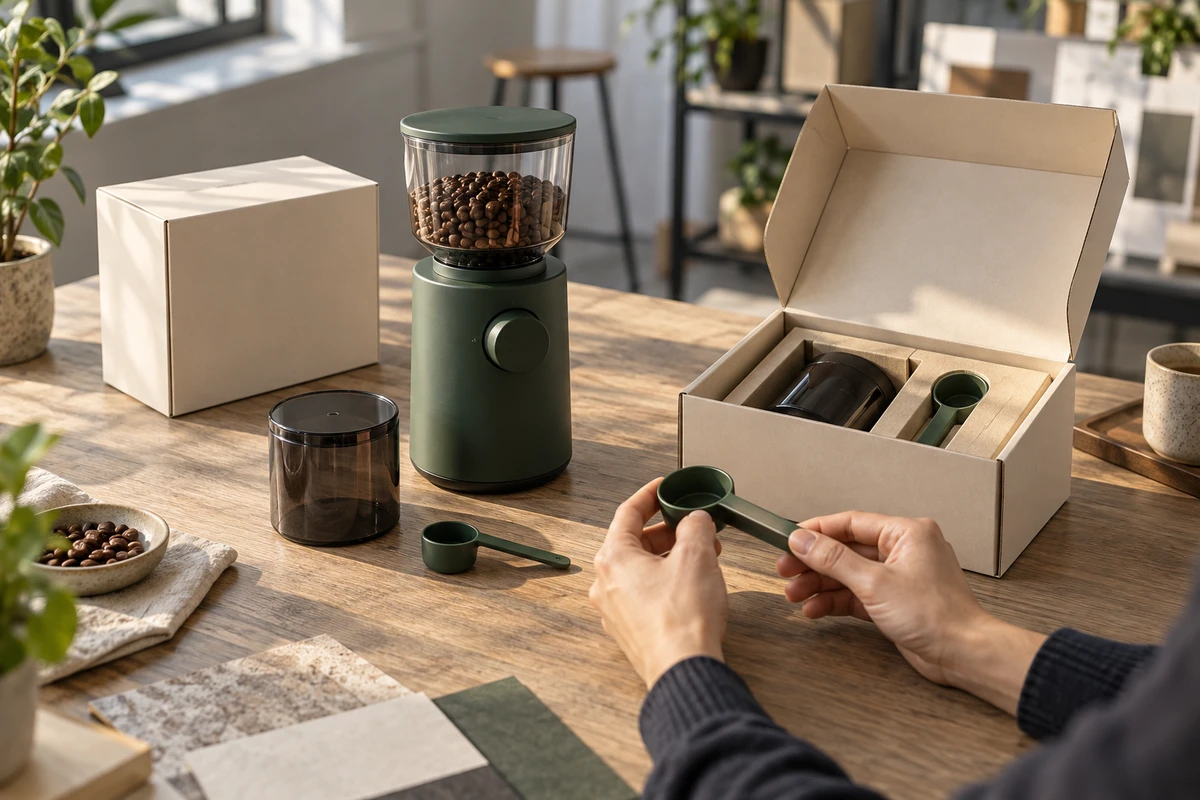
Imagine a brand introducing a coffee grinder in two bundles. Shoppers ask why the version with an additional grounds cup costs more. Both listings show nearly identical machines, and the included accessories are difficult to distinguish.
The first action could be a correct bundle comparison managed by the commerce team, followed by conversations with prospective buyers about what they understand and why they would choose either option. A few conversations can uncover confusion; they cannot establish how prevalent it is across a market or prove a conversion effect.
If people understand what is included but cannot see how the extra cup helps, there is a useful filming assignment: show the actual transfer and cleanup sequence. If they understand the benefit and still reject the premium, the offer owner has a pricing or assortment question to investigate. More footage is not automatically the next purchase.
The distinction also protects a cross-border production brief. “Demonstrate this accessory’s role in the real workflow” gives the China-based crew something concrete to prepare and verify. “Make the premium bundle sell” combines responsibilities the crew does not control.
Release the budget at three decision points
First, commission a bounded diagnosis. Agree on the market, product version and buying situation being examined. The deliverable is the diagnostic record and its unresolved questions. If an external partner performs this work, give it an explicit scope, fee and completion condition. The engagement should permit a recommendation that no new filming is required.
Next, authorize the relevant demonstration or correction. Once the uncertainty is reduced, decide whether the task needs an existing edit, a specific additional shot or a full product film. Acceptance should establish accurate product representation, stated conditions and a clear answer to the assigned question. Sales performance remains a subsequent business assessment involving factors beyond production.
Then, authorize expansion. Extend a useful expression into additional markets or placements after the underlying offer and message are confirmed. Recheck local bundles, availability and purchase terms. Subtitle translation alone does not establish that the same promise applies elsewhere.
For procurement, ONCE suggests separating four cost lines: diagnosis, approved creative changes, commerce or product changes, and follow-up assessment. This is a planning model, with no assumed prices or standard percentages. Its purpose is to expose work that would otherwise fall between a production quote and the brand’s internal teams.
Ask competing suppliers to state what their proposed film can resolve, what they need confirmed, and which changes require someone outside production. That is a more informative comparison than judging a list of deliverables without knowing the underlying assignment.
When to proceed directly—and when to hold the commitment
A well-established brief does not need a ceremonial research stage. If the audience, product task, substantiated claim and purchase conditions are already clear, move into creative development. A brand film can also legitimately aim for awareness, emotion or memory. Its objective should be stated on those terms rather than forced into an immediate sales explanation.
Hold the larger production commitment when teams disagree about the cause of weak sales, the supplied version is changing, or stock and promotional changes obscure the result. With limited evidence, use bounded observation and leave the conclusion open. Absence of a diagnosis is not evidence that the creative is at fault.
When approaching a China-based product video production partner, bring the local buying context alongside the physical sample. The useful starting material is a real shopper question, an accurate account of the current offer and a decision that remains unresolved.
Make ongoing content work accumulate better decisions
An ongoing production relationship can retain more than finished files. Keep a dated record of the market, obstacle, action and what the follow-up did or did not establish. Preserve failed explanations as well as useful ones, so the next launch does not pay to investigate the same issue again. A finding in one market should remain specific to that context until checked elsewhere.
ONCE sees this as a capability worth building across product, commerce, support and creative teams. Monthly output counts alone cannot create it. The commercial value lies in helping the next commissioning decision become better informed: whether to film, what to show, and which work must happen first.
Sources and scope
- P&G Investor Relations, P&G Announces Fiscal Year 2027 First Quarter Results, October 22, 2026. Quarterly period, organic growth and definition.
- P&G Investor Relations, Company Strategy, checked October 23, 2026; no separate publication date stated. The five areas of superiority.
- P&G, 2026 Annual Report: Four Interventions, checked October 23, 2026. Consumer experience and the route from awareness to purchase.
The diagnostic record, procurement stages and hypothetical grinder example are ONCE’s analysis, not a P&G methodology or reported ONCE client results. The original AI-generated cover is conceptual and does not depict a P&G product or a client shoot.