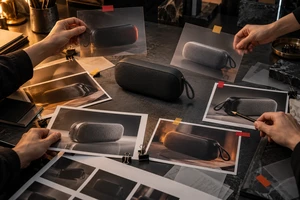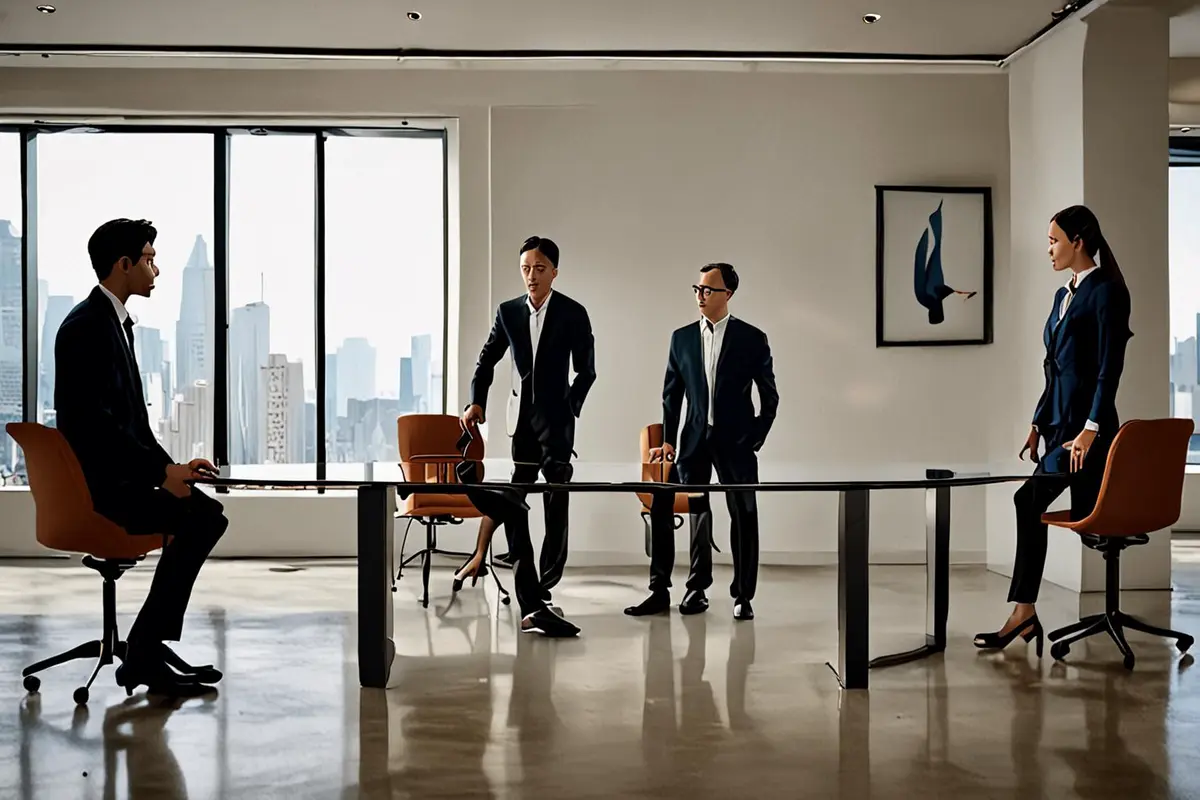
A boardroom can look immaculate in a generated video. The glass walls are clean, the table texture is consistent, and none of the five faces visibly drift. Yet the scene still does not feel like a real meeting. The problem is often not any single face. It is the absence of relationships: nobody prepares to take the floor, a challenge does not redirect anyone's gaze, and a product sample returns to its original position after someone has picked it up.
A multiperson meeting is not five characters performing separate actions. It is a changing network of attention, evidence, resistance, and authority. In an AIGC corporate film, the first question should therefore be who affects whom. Only then should the production decide what can be generated and what needs live action.
Meeting Realism Comes From the Floor Moving Between People
In a real conversation, the current speaker, the person evaluating the claim, and the person preparing to respond do not occupy the same state. One person gives the next speaker a look. Another checks a document. Someone else leans forward without speaking yet.
A 2023 study in Philosophical Transactions of the Royal Society B found that face-to-face turn transitions are coordinated not only by possible linguistic completion points but also by gaze and manual gesture. The study mainly examined dyadic interaction, so it is not a formula for a five-person board meeting. It does, however, establish a useful creative principle: turn-taking has a visible component.
A 2026 study of social gaze in teams also treats gaze as a distinct feature of multiparty collaboration. For filmmakers, that means having everyone look attentively at the speaker is not automatically more realistic. Uniform attention can erase differences in position. A supporter may nod before a sentence ends. A skeptic may look from the data to the decision-maker. The next speaker may show a change in breath and posture before taking the floor.
A prompt such as "a professional team discussing a project" tends to distribute professionalism evenly. A stronger scene design describes the relationship change in one beat: the product lead has just made a proposal; finance shifts attention from the screen to the sample; the decision-maker withholds a response; engineering prepares to add evidence. The shot now has direction, not merely a headcount.
Draw the Relationship Map Before the Seating Plan
Boardroom scenes often begin with the shape of the table, the glass walls, and the wardrobe palette. Seating only becomes meaningful after the roles are clear. Even a short scene needs to identify who makes the claim, who creates resistance, who supplies evidence, and who makes the decision consequential.
Not everyone needs a line. Silence can carry a function. One person turns to a specific page in a report. Another slides the sample toward the middle of the table. The decision-maker closes a laptop only after the evidence arrives. The audience reads power and causality between those actions. If five people simply alternate between note-taking, nodding, and smiling, everyone is moving but the relationship is static.
ScreenSkills describes a director's blocking work as choreographing where actors are positioned, how they move, and how they deliver dialogue. In an AIGC workflow, the relationship map is the blocking that must exist before generation. It does not need to be a complex diagram, but it must state what each person knows before the beat and what changes afterward.
Faces Are Not the First Continuity Problem
The first risk is eyeline continuity. If a speaker throws a question to a colleague on the left and the next shot looks off-screen in another direction, the audience loses the geography of the table. In a group scene, eyelines are not individual eye directions. They are a network created by seating, the camera axis, and the order of speech.
The second risk is shared-object continuity. Screens, whiteboards, documents, prototypes, and notebooks are anchors of joint attention. A sample moves from person A to person B, then appears in front of A again. The whiteboard changes, but the reactions still refer to the old version. These breaks can reveal a stitched-together scene faster than a minor facial inconsistency.
The third risk is causal continuity. When someone raises a risk, the next shot should contain a visible response: another person stops writing, checks a number, turns the sample, or changes tone. If only the composition changes, the meeting becomes office décor.
A script supervisor traditionally records dialogue, actions, eyelines, and prop states so shots filmed out of order can still cut together. ScreenSkills' script supervisor profile makes that responsibility explicit. Generative production needs the same discipline, with more specific state records: the speaker, the gaze target, the object position, and the change produced by each beat. This is not paperwork for its own sake. It gives the next shot a memory of the previous one.
Live Action, Screen Replacement, and Generation Carry Different Risks
When the value of a shot comes from immediate reactions between several people, live action is usually the most reliable choice. A held breath before an interruption, a hand hesitating over a sample, or a quick glance toward the person with authority is difficult to obtain consistently from a broad instruction such as "natural team interaction." If the product passes between people, colleagues interrupt one another, or the scene must accurately represent a business process, the relationship is the content. It should not depend on unpredictable generation.
Screen content can be replaced in post. Adobe's official documentation explains motion-tracking workflows and notes that tools such as corner pinning can support screen replacement. Perspective tracking is also suited to flat surfaces such as screens, signs, and walls. This is useful for confidential interfaces, localized content, and late product updates. It still requires a readable plane, trackable detail, and planned occlusion. A hand crossing the display, complex glass reflections, or defocus can create manual repair work. Trackable does not mean automatic.
Generation is better suited to shots with a lower relationship burden: an exterior, the room before the meeting starts, background figures without precise interaction, spatial extensions, or a stylized transition. Current vendors claim stronger reference-based character, object, and world consistency. For example, Runway describes Gen-4 as maintaining subjects and locations across scenes. That is a vendor capability claim, not independent proof that a model can sustain multiperson gaze, speech order, and shared-object state through a dramatic exchange.
The goal of hybrid production is therefore not to give every difficult shot to AI. It is to separate risks. Generate the environment where appropriate, replace confidential displays in post, and preserve live action for relationship-critical behavior. A shared approach to production design, lighting, and camera movement can make those methods feel like one film without pretending they have identical strengths.
Do Not Ask Everyone to Perform Professionalism at Once
One of the fastest ways to make a corporate scene artificial is to have everyone nod, write, and smile at the same moment. Professional collaboration is layered attention. One person can be actively presenting, one processing information, and one withholding judgment. The others do not need to provide continuous visible reactions.
Directing becomes more useful when emotional adjectives become tasks. Instead of "look confident," ask the speaker to slide the sample across the table after the final claim. Instead of "listen carefully," ask the colleague to check a number, then look at the speaker when the cost changes. Tasks generate editable actions and give live performers and generative references the same causal line.
Space also carries the relationship. Our article on spatial storytelling in brand films explains how thresholds and work areas can shift the audience's reading of a character. A meeting table works the same way. Distance determines who can touch the prototype. Screen position determines who controls information. An empty chair can imply that someone has not yet joined the decision. Clarify those relationships before polishing reflections and neutral-grey décor.
A Decision Must Leave a Trace
To test a meeting scene, mute the dialogue and compare the beginning with the end. Has the prototype moved from the edge of the table to the center? Has someone turned the discussion document to the approval page? Has one of two options been removed from the whiteboard? Do people leave with different tasks?
These changes can be small, but they prove that the meeting was not a pose assembled for the camera. They also give the editor a clear endpoint. The audience sees not only that people talked, but that a judgment changed what happens next.
If your corporate film needs live action, screen compositing, and generated imagery in one visual system, ONCE can start with the relationship map, shared objects, and consequences before assigning technologies. Explore ONCE video production insights and keep the moments that need human truth in front of the camera.