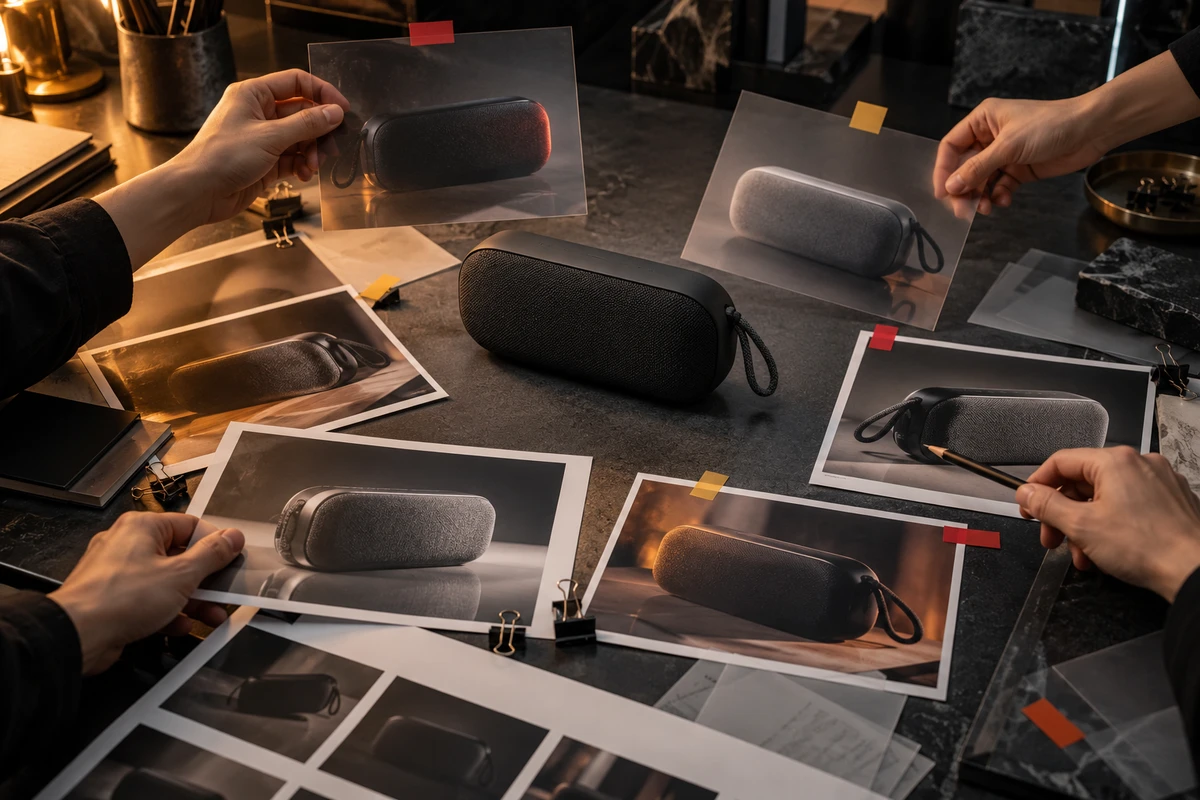
An AI product-video session produces forty versions, but only three reach the final edit. The easiest way to close the job is to download the winners and clear the rest, as if the other thirty-seven attempts never happened. A few weeks later, another market asks for the same product in a new setting. The team may repeat the same failures: ports move, materials change, hands cover the selling point, or the frame looks beautiful but no longer feels like the brand.
A failed generation is not automatically waste, and it is not automatically an asset. Its long-term value depends on what it taught the team and whether that learning changes the next creative decision.
Files are not the asset. Decisions are.
Generative platforms increasingly behave like creative workspaces rather than one-shot output buttons. Runway describes Sessions as both a generation history and an organizing structure, while Assets stores uploaded and generated media. Adobe Firefly's 2026 guidance similarly treats generation history as a library where teams can open, favorite, download, organize, or permanently delete an item.
Those features answer, “Can we find this generation again?” A brand content system must answer a harder question: “Why would we need to?”
If a rejected version has only a filename and a prompt, it may explain very little three months later. The team will not know whether the problem came from the product structure, the brand direction, a model's continuity limits, or an issue that post-production could have solved. Keeping every output produces an expensive archive of uncertainty.
The useful unit of retention is therefore not the file. It is the decision the file revealed. The image or clip is evidence; the decision is the reusable asset.
Four kinds of failure, and only some deserve long-term memory
Brand drift: the frame works, but it belongs to another brand
These outputs are easy to dismiss with “make it feel more premium.” Composition, lighting, and casting may all look competent, yet the expressive direction has shifted. A restrained brand becomes saturated and aggressive. A product built around warmth appears in an empty, clinical lab. A familiar gentle movement is replaced by a violent whip pan.
The team does not need to retain an entire batch of similar rejects. One or two representative examples can define a negative boundary, with a short note explaining why the result does not belong to the brand. Terms such as restrained, warm, or precise then become visible relationships rather than floating adjectives.
That is different from building positive prompt anchors. ONCE's AIGC Insights hub covers systems for controlling imagery; failure memory focuses on the opposite boundary—what looks plausible but should not be repeated.
Product-fact errors: beauty can make the risk harder to notice
Button counts, port positions, package text, opening direction, material response, and usage behavior are product facts. Once a model rewrites them, visual fluency does not make the result suitable for publication.
These failures can be retained internally as counterexamples, but not as inspiration. Their purpose is to trigger a different production decision. If a structural error keeps recurring, the next round may require stronger product references, a shorter shot, controlled keyframes, or a move to live action and supervised CG. A note that merely says “the model sometimes gets this wrong” does not change the workflow and therefore has little memory value.
Continuity failures: a correct frame can still break the story
A character changes clothes between shots. The product jumps from the left hand to the right. A tabletop object disappears. A lid opened in one shot is closed in the next. These errors may not dominate a thumbnail, but they break causality in motion.
The CVPR 2025 ShotAdapter research starts from the limitation that existing text-to-video methods struggle with multi-shot generation, discrete transitions, and consistent characters across activities and backgrounds. The paper does not represent the quality of every tool available in 2026. It does show that cross-shot identity and background consistency are technical problems requiring additional model and data design—not details that a longer prompt automatically solves.
Multi-shot failures should therefore be stored as broken relationships: who is present, which object is involved, what state it is in, and what should happen next. A single screenshot labeled “bad hand” can shrink a continuity problem into a cosmetic defect.
Useful forks: wrong for this shot, promising for another purpose
Some generations fail their current assignment but reveal a useful lighting approach, spatial idea, transition, or performance beat. A product may be structurally inaccurate and unusable as a product shot, while the rhythm of reflections in the background could inspire an opening transition.
Such a result can be kept only if its reusable and unusable parts are separated in the note. Otherwise, the next creator may treat a simple “keep” label as approval of the entire asset. A useful fork is not a half-approved deliverable; it is a creative lead with a defined scope.
The worst image is rarely the most valuable one
The more spectacular the failure, the less it may teach. A six-fingered hand proves that the frame cannot be used; ten similar examples add little. A failure deserves long-term retention when it changes one future decision: which reference to use, whether to shorten a shot, whether the product must be filmed, which brand constraint needs definition, or whether a visual direction deserves its own content branch.
One question is enough to filter the pile: If we delete this example, which mistake is the next team most likely to repeat? If the team cannot answer, “maybe it will be useful someday” is not a reason for indefinite storage.
Adobe notes that Firefly generation history consumes cloud storage. Runway's official tagging guidance explicitly suggests quality labels such as Best, Needs work, and Delete. Platform features do not create a brand method, but they make one thing clear: teams must distinguish retention, investigation, and deletion. A complete history is not automatically a useful history.
Turn each retained failure into an executable judgment
A useful failure record does not need the full prompt or the tone of an incident report. It needs four connected facts: what the shot was meant to do, how the result deviated, which layer caused the rejection, and what the next round should change.
Consider a hypothetical portable speaker campaign that needs an outdoor scene to communicate durability. One generation moves a protective cover to the wrong side. That is a product-fact error, so the next round should lock the real structure or use live action. A second output preserves the product but turns the world into a neon gaming aesthetic. That is brand drift, so the team should adjust its color and movement rules. A third output gets the speaker wrong but creates an excellent rhythm of rain moving past the lens. That may be retained as a useful environmental transition.
All three results are “unsuccessful,” but they should not receive the same note. The first changes the production route, the second sharpens the brand boundary, and the third preserves a creative possibility.
The speaker example is hypothetical. It is not a client case and does not claim a specific model will behave in a predictable way.
Review the system, not the person
Failure libraries easily become blame libraries: who wrote the prompt, who chose the reference, and who failed to catch the problem. When records are used mainly to assign fault, people learn to hide uncertainty and share only polished winners.
Google SRE's public chapter on blameless postmortems argues that a review should identify contributing causes without indicting an individual, then turn what was learned into clear action. Site reliability is not advertising research, but the operating principle transfers well to generative creative work: assume people made reasonable choices with the information they had, then inspect where the brand definition, reference set, tool capability, or review process made the failure likely.
This shifts the note from “someone did this badly” to “how do we see this earlier next time?” Teams are then more willing to retain near-successes that expose a real weakness.
Not everything belongs in a failure library
Generation history can preserve product photography, faces, scene documents, and text that were used as inputs. The NIST Generative AI Profile recommends considering privacy and security alongside provenance records, including anonymizing human-subject data and removing personally identifiable information. The C2PA specification defines provenance around the source and history of digital media, but traceability does not create new usage rights.
A failure library should not become a permanent shelter for sensitive material. Unapproved faces, confidential client documents, outdated packaging, interfaces containing account details, and third-party assets with limited terms need explicit retention periods and access rules. Platform history is not automatically the brand's permanent archive either. Firefly supports permanent deletion, and shared Runway projects can expose content to other workspace members. Teams still need to decide what may be downloaded, transferred, shared, or removed.
Creative review and content provenance should also remain distinct. C2PA can help record where an asset came from and how it was edited. A failure note explains why the asset was rejected and what the next creative attempt should change. They can be connected, but they do not replace one another.
A small memory system beats a warehouse of rejects
Brands do not need a giant database for every generation. For each important shot, a few representative failures are enough: one brand drift, one product-fact error, one continuity failure, and—when it genuinely exists—one useful fork. Each should carry one executable judgment and point back to the approved brand reference or product fact it violated.
At the start of the next round, review these failure memories before looking at the final winners. The winners show what the team has achieved. The failures show which nearby roads should not be taken again. Together, they turn generation from repeated refreshing into a brand content system that accumulates creative judgment.
If your brand is building a sustainable AI content operation, bring one real SKU, the approved visual anchors, and one round of generation history to ONCE. Our AIGC video and commercial production work can help separate reusable creative forks from product facts that must be locked—and identify the shots that belong in live action or controlled post-production instead.