Corporate brand films often represent “R&D capability” with spotless labs, orderly equipment, and a grand voice-over. The images look controlled, yet they rarely show what the team has actually solved. Prototypes, test articles, and debugging sessions can carry far more information because they turn abstract innovation into observable judgment. They also invite a dangerous misreading: an exposed wire, a failed start, or a temporary fixture can make an audience see “unfinished product” where the team sees “question under test.”
The answer is not to make development look like a product launch. It is to build a visible chain of cause and effect: what the team is testing, what they notice, what they change, and what happens afterward. Once the process contains a question and a response, the prototype becomes evidence of thinking rather than a rough object waiting to be hidden.
Start by stating the question the prototype must answer
A prototype is not a cheaper substitute for a finished product. The GOV.UK guide on prototyping describes it as a way to explore, share, and test designs. Stanford d.school treats prototypes as tools for investigating ideas, gathering feedback, and making choices. NASA places prototypes, test articles, and test equipment within a continuous practice of design, fabrication, and validation. For a brand film, these sources suggest a practical rule: every prototype shot should correspond to a specific question.
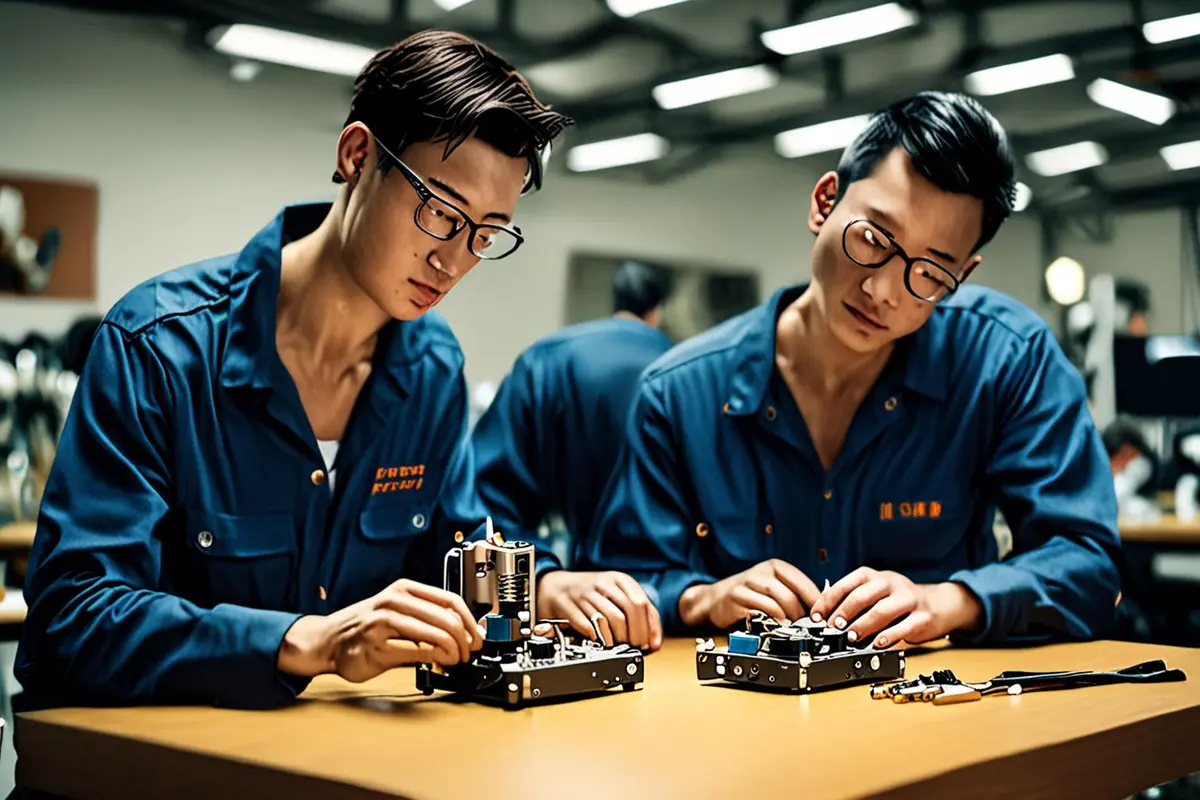
An interaction rig with exposed wiring may exist only to test button placement and feedback timing. An engineering unit with mismatched panels may be evaluating thermal behavior. A robot repeating the same pick may be comparing paths and grip force. If the film shows only what looks incomplete, viewers will study the gaps. If it first explains what the object is helping the team learn, those gaps become part of the evidence.
Edit development as a problem, judgment, and revision
The strongest debugging footage is driven by causality rather than generalized busyness. A concise sequence can begin with an observable deviation: the mechanism misses its target, a trace changes unexpectedly, or a test user hesitates at one step. The next shot shows how the team interprets that signal. Then the audience sees one concrete adjustment. The final shot does not need to declare the entire problem solved; it only needs to show that the test produced a different result or a clearer next decision.
Make the starting condition observable
“The system is not good enough” cannot be filmed directly. A repeated accidental input, a position outside tolerance, or an operation that requires extra force can. The more specific the starting condition, the more credible the revision will feel.
Put judgment back into the people
Do not photograph screens, instruments, and hands alone. Keep the pauses, comparisons, retests, and exchanges through which data becomes a decision. Eyelines, pointing, and a colleague’s response organize technical material into a path of attention the audience can follow.
Return to the same form for the result
If the sequence begins with a pick that lands off-center, return to the same camera position, action, or metric after the adjustment. Cutting to a wide factory view or a polished hero shot may look impressive, but it breaks the validation relationship. Similar before-and-after structure makes the change legible.
Give unfinished states a consistent visual grammar
Temporary materials, test markings, and opened assemblies can remain in frame, but the image must help viewers distinguish deliberate experimentation from loss of control. Use stable cues for each state: keep test articles on one bench, mark the area under evaluation with a consistent color, and move the finished-product demonstration to a separate lighting setup and background. Labels do not need to dominate the frame, but the change of state should be immediately readable.
Production design should remove unrelated packaging, outdated notes, and boards containing sensitive information while preserving tools, sketches, and replacement parts that belong to the current test. The space remains commercially legible without becoming a showroom that no engineer appears to use.
Film how the team decides, not just that it is working
Many corporate films reduce development to fast typing, crowded meetings, and people walking through frame. Those actions provide rhythm but reveal little capability. More useful shots capture a decision point: why the team changes a material, moves a sensor, or repeats the test under the same conditions.
Before filming, ask the engineer to complete one plain-language sentence: “What we need to confirm now is…” The sentence may never enter the final cut, but it helps the director find the real action. If the answer remains “improve performance” or “enhance experience,” keep asking until there is a visible object, condition, and change. Specificity creates professional credibility more reliably than technical vocabulary.
Use light and sound to preserve the scale of the experiment
Prototype footage does not need blue light, haze, and a science-fiction treatment. When the test happens at bench scale, soft working light, selective fill, and moderate background separation preserve the texture of materials, scratches, and temporary connections. To emphasize observation, make the relevant surface brighter, keep faces readable, and lower unrelated areas instead of illuminating every machine.
Sound can clarify the logic of a test as well. A relay click, a change in motor startup, or a subtle difference under load can become an audible before-and-after marker. If the production sound is unusable, recreate an accurate sound from the same type of device. Avoid dramatic effects that imply performance the equipment does not have.
Know when a prototype should stay out of the film
Unfinished does not automatically mean publishable. Unfiled inventions, confidential supplier parts, personal data, unapproved interfaces, and tests that could be mistaken for safety failures should be excluded or represented through alternative shots. Other scenes need a clear qualification such as “engineering prototype,” “test environment,” or “simulated conditions” so that viewers do not treat a test as a market claim.
It also helps to separate showing learning from consuming failure as drama. A failed attempt gains narrative value only when the film follows it with judgment and action. A montage of breakdowns, frowns, and arguments can turn development into staged adversity. A brand film may acknowledge uncertainty, but it should show how the team works with it.
Capture several development stories in one filming day
The same debugging session can support a complete causal sequence for a corporate film, isolated actions and details for social edits, and clean prototype-to-product comparisons for a website or trade show. Capture the problem, judgment, revision, and retest before adding horizontal, vertical, and close-up coverage. Each format does not need a new performance.
If the process cannot be repeated, protect the decisive observation and result first. Empty rooms, hands, and environmental details can be added later; an authentic decision is much harder to reconstruct. For broader planning, see ONCE’s video production solutions and the latest video production insights.
Turn innovation from a claim into visible reasoning
Prototypes and debugging do not have to remain behind-the-scenes material. They can carry the main story of how an organization thinks. When the film identifies the question, preserves human judgment, aligns the before and after, and separates test states from finished states, unfinished work can make R&D capability more concrete.
If you are planning a corporate brand film and want to show prototypes, testing, and development without confusing the audience, send ONCE your current workflow, disclosure limits, and target viewers. We can shape them into a production-ready visual narrative.
Sources and scope
The discussion of prototyping is based on the GOV.UK Service Manual, NASA’s Prototype Development Laboratory and Orion testing overview, and Stanford d.school’s No-Build Hack and Experiment Expedition. These sources explain how prototypes support testing and learning; they do not establish that a particular film technique improves sales or campaign performance. The camera and editing recommendations in this article are creative-method analysis.