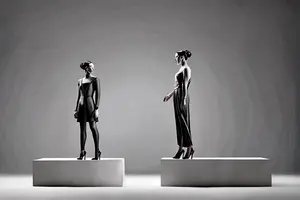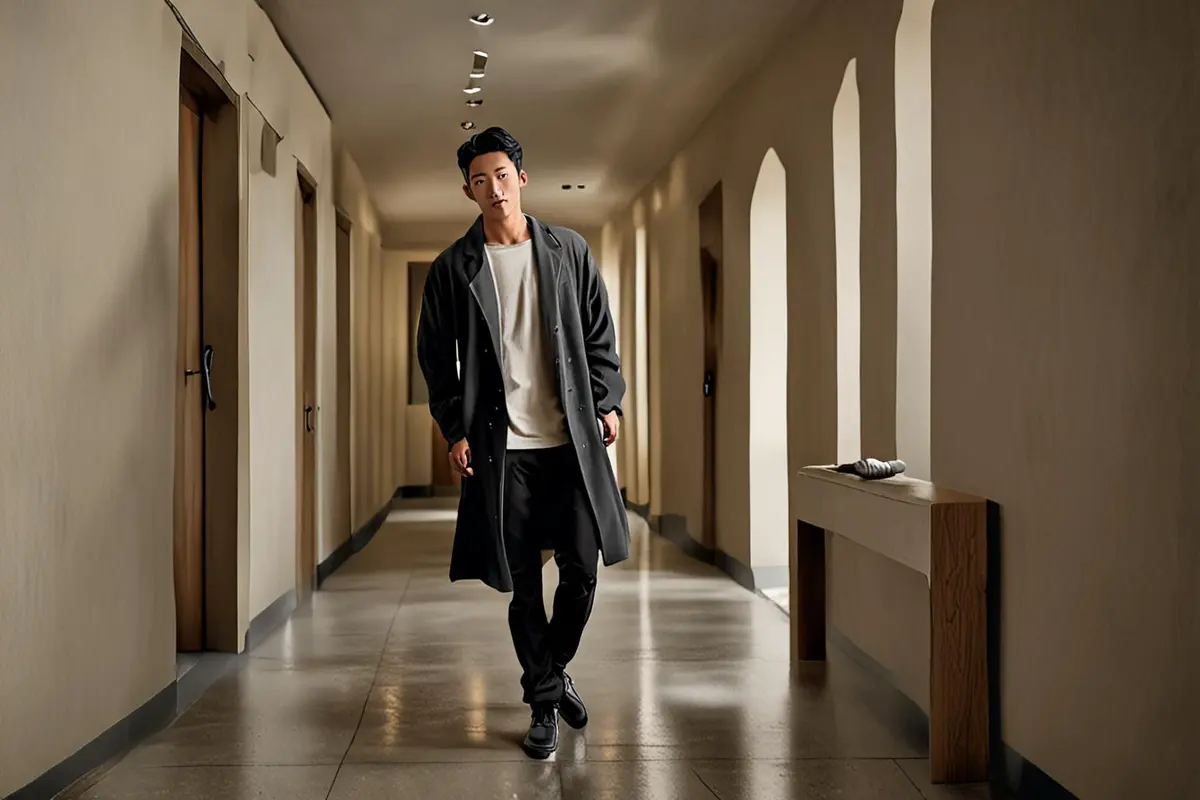
On a location recce, a doorway is easy to treat as dead travel time between two scenes: the performer walks in, the camera follows, and the edit moves on. Pull the camera back a little and the doorway becomes more useful. Its frame divides the performer into a before and an after. Pace, light, sound, gaze and even the object in their hands can change within a single step. A brand film can therefore communicate where someone has arrived, what role they now occupy and why their mood has shifted without stopping for explanatory voiceover.
A doorway is an event decision, not just production design
People naturally divide continuous activity into meaningful events. Research on event segmentation suggests that viewers are more likely to perceive a new event when sensory features, a character's goal or the causal structure changes. Experiments involving movement through doorways also show that spatial boundaries can change how people organise information from before and after a crossing.
That does not mean a door in an advertisement automatically improves memory. Radvansky and Copeland studied specific memory tasks, and later work by Logie and Donaldson found that temporal gaps can create segmentation benefits without a physical doorway. The useful creative principle is narrower: a spatial boundary becomes story information when it coincides with a change in goal, sensation or behaviour.
The creative question is therefore more precise than “Can we add a stylish transition?” After the performer crosses, what does the audience understand about the person, the space and the brand promise that they did not understand before?
One crossing should change at least two layers of information
A new place should redraw the viewer's mental map
The two sides of a doorway do not need to be different worlds, but they need at least one legible spatial contrast: scale, light direction, material, movement path or crowd density. A narrow corridor can open into a broad workbench area. Flat public-area lighting can give way to a side light that reveals the product. The audience does not need an architectural plan to understand that the performer has entered a space with a different function.
If the walls, colour temperature, shot size and speed are almost identical on both sides, the frame becomes temporary occlusion. Even an elegant match cut will struggle to make the change meaningful.
A new role should appear in behaviour
Brand films often use entrances to express a role change: a customer enters an experience area, an engineer enters a lab, or a founder moves from backstage to a launch. Wardrobe and props can signal status, but behaviour is more persuasive.
For example, someone may answer messages while walking outside, then pocket the phone, slow down and look at the equipment before addressing a colleague. No caption has to announce the role; attention, posture and the person's relationship with the environment do the work. Our article on eyeline handoffs and product reveals explains how gaze can pass a cut to the product. At a doorway, gaze can also become the first beat of a role change.
A mood shift needs a visible or audible landing point
Mood should not depend on a grade suddenly becoming warmer. A pause at the handle, the force used to push the door, or the first breath after crossing makes the change tangible. An energetic entrance can carry one unbroken movement through the frame. A cautious entrance can let the hand arrive before the body. A ceremonial entrance may hold for a beat after the door opens, allowing the new space to receive the performer.
Camera position decides which side the audience occupies
Where the camera stands is already a narrative choice.
- Looking in from outside lets the audience discover the space with the performer. It suits invitation, exploration and first experience.
- Looking out from inside makes the space appear to be waiting. It suits welcome, recognition and entry into expertise.
- A profile view through the frame emphasises the act of crossing. It makes a role change more explicit.
- Following the performer across preserves the strongest continuity. It makes the change feel lived rather than manufactured by the edit.
Screen direction should support the same intention. If the performer moves right outside and abruptly moves left inside without a new visual target, the audience first has to resolve the reversal. That disruption can be useful when the scene should feel uneasy. When the brand experience should feel fluid, the doorway, an eyeline or a sound cue should reorient the viewer clearly.
Light separates the spaces; sound stitches them together
A common problem in doorway sequences is that the image changes dramatically while the sound remains flat. Another is a music track that switches exactly on the cut, making the transition feel like a preset.
A more natural division of labour is to let light tell the audience that the place has changed while sound confirms that this is still one action. Before the performer enters, we might hear a machine's low tone, voices from a showroom or a rhythm from inside. After the crossing, that sound gains clarity and direction. The reverse also works: exterior sound can fall away quickly inside to communicate focus or insulation.
The goal is not to stack effects. Choose one sound that belongs to the destination and let it evolve across the threshold. A latch, shoe contact, room tone and a change in reverberation reveal more about the material space than a generic whoosh.
When to show the full crossing and when to cut
Show the complete approach, opening, crossing and continuation when entering is itself the promise: a first product experience, entry into a high-stakes meeting, or arrival at the place where the work happens. The audience needs to see the performer choose to cross.
When the doorway only compresses time, cut as the hand reaches the handle and land on the result inside. Preserve one continuous cue: the same hand movement, a consistent push direction, sound heard before the cut, or a stable eyeline height. A fast cut does not have to remove meaning. The problem begins when the two shots share no cause.
There are also scenes that do not need a doorway at all. If the character's goal, behaviour and sensory environment remain unchanged, the frame is merely a shape in the middle of the image. The time may be better spent on a product action, a relationship or a piece of brand information.
Doorway behaviour does not travel unchanged across markets
An open entrance, removing shoes, the position of a host, or the meaning of a glass door can carry different associations with hospitality, privacy, hierarchy and safety. A cross-border version may not need a new building, but it should test whether the spatial behaviour matches the audience's everyday experience.
Start by naming the relationship the entrance must express: invitation, permission, belonging, professional access or entry into private space. Then ask local collaborators or target viewers whether the proposed action communicates that relationship. Choosing an “international” lobby first and forcing the performer to serve the architecture usually produces generic images.
Put the threshold in the storyboard, not in the transition menu
An executable doorway sequence should answer four questions in the storyboard: which side the performer approaches from; which two layers of information change; which visual or sound cue remains continuous; and whether the audience is outside, inside or following behind. Those answers align camera, lighting, production design, performance and sound around one narrative action.
In video production, choosing a space is never only a search for attractive architecture. The location has to support blocking, product visibility, light control and editorial rhythm at the same time. Doorways deserve careful design because they can compress all of those decisions into a few seconds.
A doorway is not a universal symbol. A spatial transition works when, after the crossing, the viewer can say where the character is, what role they now perform and why the mood has changed. Then the frame is more than an edge that hides a cut. It becomes a verb in the brand film.
If you are developing a brand film and need to connect space, performance and a product reveal, contact ONCE to turn the idea into shootable blocking, lighting and sound decisions.
Research references
- Gabriel A. Radvansky and David E. Copeland, Walking through doorways causes forgetting: Situation models and experienced space, 2006, DOI: 10.3758/BF03193261.
- Jeffrey M. Zacks et al., Event perception: A mind-brain perspective, 2007, DOI: 10.1037/0033-2909.133.2.273.
- Matthew R. Logie and David I. Donaldson, Do doorways really matter: Investigating memory benefits of event segmentation in a virtual learning environment, 2021, DOI: 10.1016/j.cognition.2020.104578.