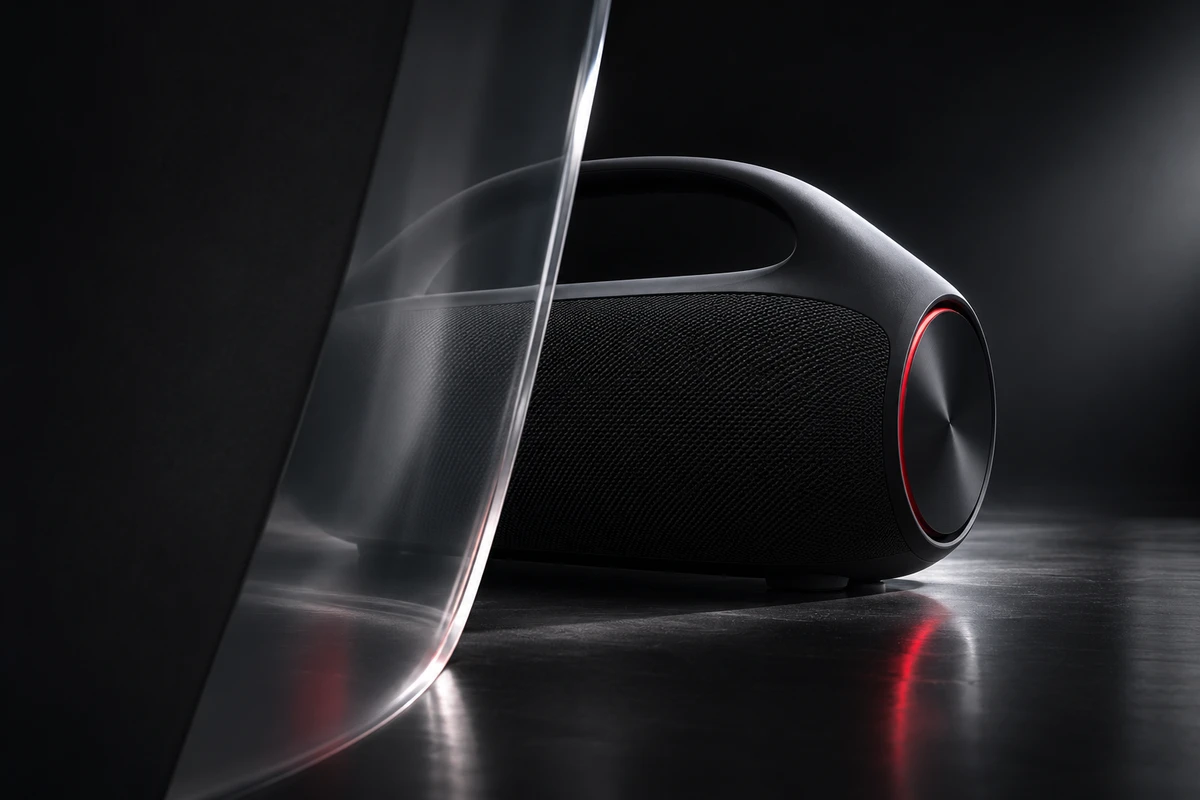
Many product ads treat complete visibility as the default: place the product in the center, show a clean silhouette, light every surface, and explain everything at once. That is useful for description, but it does not always create anticipation. Another approach lets the product enter in fragments—a curved edge, a moving reflection, or a silhouette interrupted by foreground objects—before camera movement, product movement, or light completes the reveal.
The creative value of occlusion is not simply hiding the product. It keeps the viewer for a moment between “I can almost identify this” and “I want to confirm what it is.” When that moment is designed well, the full appearance becomes an event. When it is not, the frame merely looks dark, the selling point becomes hard to read, and the audience may miss the product entirely.
Why partial visibility can build anticipation
The visual system does not necessarily interpret an occluded object as a collection of unrelated fragments. Perception research uses the term “amodal completion” for the way people infer a whole object from visible contours. In priming experiments, Emmanouil and Ro found that occluded shapes could be processed as complete forms rather than matched only through the local features that remained visible. Separate work on visual pattern completion found that people retained some ability to recognise objects with limited visible information, although performance declined as visibility fell and processing was interrupted.
This suggests a useful but limited lesson for product advertising: viewers will help complete an image, but they cannot solve every information problem for the creative team. Occlusion needs to leave stable clues that support a reasonably specific expectation. The reveal then needs to offer a more concrete payoff.
The strongest clues are often not logos. They are distinctive relationships in the product’s form: the connection between an ear cup and headband, the proportion of a bottle shoulder to its body, the combination of a device frame and dial, or the curve between a shoe upper and sole. If the visible fragment has no identifying character, a longer delay does not create stronger suspense. It simply postpones explanation.
Decide what must remain visible before deciding how much to hide
Start an occlusion shot with one question: before the complete product appears, which two kinds of information must the audience receive?
The first is an identity cue. It tells the viewer that the image contains a legible object rather than an arbitrary dark shape. The cue might be a contour, a material reflection, a distinctive construction detail, or an expected use action.
The second is a directional cue. It tells the viewer that the frame is moving toward an answer. Parallax from a sliding foreground, a camera path that gradually clears the object, or a widening pool of light can all promise that more will soon become visible. If the visible proportion stays constant and the composition does not develop, waiting quickly turns into stagnation.
This is why a good reveal is usually more than a transition from dark to bright. It moves from an incomplete relationship to a complete one. The audience first sees a curved edge and a narrow highlight, then discovers that both belong to one product. It hears the damped click of a mechanism, then sees the dial and interface respond together. The two stages share a traceable cause, which gives the reveal its force.
Three natural ways to reveal a product
Use foreground objects to create depth
Place a real object between the camera and the product: packaging, translucent material, a display structure, or furniture from the scene. With a small lateral camera move, the near foreground travels faster across the frame and exposes different parts of the product in sequence. This parallax gives the product a believable spatial setting and usually preserves more natural light interaction than a flat black mask added in post.
The foreground needs a reason to belong. Outdoor equipment might emerge from behind a vehicle door, tent fabric, or a rock edge. A home appliance can be partly framed by a cabinet, worktop, or a person’s shoulder. An unrelated panel may look cinematic, but it says little about the life the product belongs to.
Let the product’s own movement complete the reveal
Folding, rotating, sliding, opening, and closing naturally change how much of a product is visible. Occlusion then becomes a result of the construction rather than an added effect. A shot might begin on the slim edge of a closed device and reveal its interior through opening, or begin with a silhouette and rotate the ports, controls, and material finish into the key light.
This approach is valuable for structural selling points, but the movement should do more than create a polished transition. The final angle needs to answer a product question: how thin it is, how it opens, which surface carries the function, or how its components connect.
Use light and focus to change information priority
Low-key lighting can preserve a contour before a key light travels across the surface. A focus pull can move attention from foreground material to a product detail. Neither method changes whether the object exists, but both change which layer the viewer reads first.
These tools are easy to overuse. A narrow highlight in a black environment can emphasise edges and finish, but it cannot carry a complicated demonstration. Shallow depth of field is not a substitute for composition either. If the essential structure remains out of focus, information is being delayed without a corresponding gain.
A reveal needs to give the viewer a visible payoff
Complete visibility alone is not a payoff. The reveal should give the earlier fragment a new meaning or make the product value clear for the first time. It might connect a silhouette to real scale, connect a material highlight to a use environment, or move directly from full appearance into an action that proves a feature.
The reveal point should ideally accomplish three things at once: make the subject sufficiently complete, change the relationships in the frame, and start the selling point. When the camera clears a foreground object, the audience should not merely see the whole coffee machine; it might also see the cup enter the dispensing position. When a device turns out of shadow, the result should not be only an illuminated logo; the ports and connection action can appear together.
Sound can help this moment register. Friction from a moving foreground, the tactile click of a latch, or a startup tone can turn a visual change into an event. The sound should stay connected to an action that is visible. A large impact cannot compensate for a shot with no meaningful change.
What should not become a suspense device
Perception research also shows that more occlusion is not automatically better. Neural work on partially occluded shapes found that shape selectivity declined as occlusion increased. Rapid scene experiments likewise found that higher levels of occlusion impaired detection. These studies are not formulas for advertising performance, but they make the cost of recognition clear.
In product advertising, several kinds of information should rarely remain hidden for long:
- the basic structure that determines the product category;
- safety-related operation and warnings;
- the critical contact point or causal step in a feature demonstration;
- ports, scale relationships, or interface feedback that viewers need to verify;
- edge information already at risk in a vertical crop.
Occlusion can serve mood and entrance, but it should not break the evidence. One practical approach is to design reveal shots and functional shots separately. The former earns attention; the latter keeps the action, result, and limits visible. For short-form versions, shorten the reveal around the first frame and safe areas instead of simply cropping a widescreen shot.
Test the idea with two freeze frames
You do not need to wait for a final edit to judge whether the occlusion works. During storyboarding or previs, capture two stills: the last frame before the reveal and the first frame after it.
For the first frame, ask which contour, material, or action lets the audience form an expectation. If the answer depends on product knowledge that only the brand team has, the clue is too weak.
For the second frame, ask what new understanding has appeared. If the image changes only from “part of the product” to “all of the product,” with no added sense of scale, construction, use, or emotion, the payoff is too thin.
Then review both frames muted, reduced in size, and within a vertical crop. A robust reveal should not work only on a large screen with music and the full horizontal composition.
Make the product appearance a narrative action
Occlusion in a product ad is ultimately about controlling the order in which understanding happens. Give the viewer enough identity information, advance the answer through space, motion, light, or focus, and connect the full reveal to real product value. The product’s appearance then becomes more than a standard beauty shot. It becomes a narrative action that the audience helps complete.
If you are planning a hero film, feature cutdowns, or international ecommerce assets, explore ONCE’s ecommerce product video production work to see how different structures and settings organise product information. To turn occlusion, reveal timing, and feature coverage into a storyboard and production plan, contact ONCE with the product, target platforms, and existing visual materials.
Research references
- Emmanouil, T. A., and Ro, T. (2014). Amodal completion of unconsciously presented objects.
- Tang, H. et al. (2018). Recurrent computations for visual pattern completion.
- Bushnell, B. N. et al. (2014). The role of visual area V4 in the discrimination of partially occluded shapes.