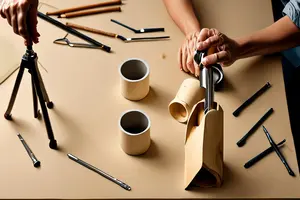
Online viewers cannot touch a product or feel its mass directly. They still form a quick judgment from the way a hand approaches it, the fingers tighten, the object leaves a surface, and the movement settles. Those visible actions can make a product feel portable, substantial, or stable before a specification appears on screen.
Weight in a product film is therefore more than a slow-motion style or a heavy sound effect. It is a readable relationship between the hand, the object, gravity, and its support. A truthful one-handed lift can express portability. A controlled two-handed placement can express stability. A badly staged lift can make a solid product look like an empty prop.
Viewers cannot feel the grams, but they can read a lift
A 2023 Journal of Retailing study by Jha, Balaji and Peck examined how hands affect product-weight judgments in digital media. Across a series of experiments, a hand shown supporting a product without another surface increased people's confidence in judging its weight. A hand resting beside a supported product did not produce the same pattern. The study used product imagery rather than moving commercials, so it does not establish a universal video or conversion effect. Its useful production implication is narrower: a hand can simulate missing haptic information when its support role is visible.
Motor research helps locate the decisive moment. In experiments with visually similar objects of different weights, Eastough and Edwards found that the reaching phase before contact changed little. Weight-related differences appeared mainly after the fingers touched the object and before lift-off. A cut that jumps from an approaching hand to a product already in the air removes the very interval that makes mass readable.
Decide which weight value the film needs to express
Making a product look light is not always an advantage. A portable lamp should feel easy to move. A desktop speaker, stand, or workshop tool may need to feel planted and dependable. The script should define the benefit before deciding whether the actor uses one hand, two hands, fingertips, or the whole palm.
Portability reduces the cost of moving
A single-hand lift, a relaxed wrist, and no visible preparation can make portability tangible. Give the movement a real destination: a bag, a wall mount, another room, or an outdoor setup. Holding a product in front of the camera only says that it can be lifted. A destination shows why that matters.
Stability continues after the hand lets go
To show stability, keep the placement intact. The base meets the surface, the fingers release, and the product stays where it was placed. If a lock, magnet, hinge, or stand creates stability, let the real mechanism complete the action. An actor who continues to steady the product off camera weakens the claim.
Substance can support material value
Some metal tools, speakers, and coffee equipment benefit from a controlled sense of mass. Two hands, a supporting forearm, and slight deceleration before placement can express substance. The performance should not become a struggle. Otherwise, viewers may read inconvenience where the brand intended durability or quality.
A useful lift contains four readable moments
Break the action into approach, contact, loading, and lift-off. Approach establishes intent. Contact shows where the hand meets the product. During loading, the fingers begin to apply force while the object is still supported. Lift-off completes the weight cue. The loading interval may last only a few frames, but it separates a physical lift from an edited appearance.
Do not perform the weight before contact
Before touching the object, an actor can only predict its mass from size, material, and prior experience. A raised shoulder or theatrical slowdown while the hand is still far away announces the director's idea rather than the product's real response. Let the change occur after contact.
Let the loading phase show resistance
After the fingers close, the product may tilt slightly, friction at the base may change, or the wrist may begin to take vertical load. Preserve enough of this transition for viewers to see that the product has weight. Fast pacing can shorten it, but contact and lift-off should not become an unexplained jump cut.
Use the movement path to confirm the judgment
Research on observed lifting has found that movement kinematics and visible object size can independently affect perceived weight, with fuller views providing the strongest information. A close shot of fingertips may look elegant, but one wider angle should show the wrist, forearm, and product moving together.
Support position changes the meaning of the same product
A product resting on a table, supported on a palm, pinched by fingertips, or hanging beside the body will not communicate the same mass. When the table carries the load, the hand mainly explains size or operation. When the product is fully unsupported, arm movement begins to provide stronger weight information.
Fingertips can suit a genuinely light, small object when that grip matches real use. A large product casually lifted by two fingers can resemble a hollow prototype. For a stability message, an actor can place the product with two hands, remove one, confirm the position briefly, and then release it completely.
Hands also act as scale references. Product size, the performer's hand, and the intended user should be reviewed together. A small hand can enlarge the product; a large hand can make the same object appear unusually compact and light.
Frame the force relationship, not only an attractive hand
A weight shot needs the support surface, the contact point, and some arm movement. Extreme shallow focus can erase the line where product meets table. A very wide lens close to the hand can exaggerate the palm and distort product size. Choose a position that explains the relationship before refining the beauty angle.
Camera movement also affects the reading. If the camera rises quickly with the product, viewers may not know whether the object is easy to lift or whether the shot is creating speed. Capture one clear fixed or gently following version first. When adapting to vertical, preserve part of the forearm and the support surface; a crop that retains only the product removes much of the weight evidence.
Sound and surface complete the tactile impression
The weight judgment often finishes when the product is put down. A light plastic or fabric object produces a short, restrained contact. A metal device may create a lower impact and a more noticeable surface response. Use sound from the real product or a physically comparable event. An exaggerated impact cannot truthfully turn a thin structure into a substantial one.
The art department's surface choice matters too. Soft padding absorbs placement feedback. A hollow tabletop exaggerates resonance. Glass can make the same action feel fragile or risky. Test the final sample on candidate surfaces before choosing by colour alone. Record placement, latch, friction, and room tone separately so the mix can preserve the real sequence.
A lightweight claim should not look like a magic trick
When portability is a selling point, use a production sample or a prop with the same mass and balance. Removing internal parts, substituting foam, or using hidden support changes the actor's motion. Speed ramps, frame removal, and reversed footage can also alter the apparent weight, especially around lift-off and placement.
A stronger sequence connects the honest lift to a useful situation: take the product from a vehicle with one hand, carry it a meaningful distance, unfold it, and then show an approved weight specification. Action lets viewers feel the benefit. The number tells them what the product actually weighs. Neither should replace the other.
Build a complete weight story in twelve seconds
A portable-light film might use two seconds to establish the product on a real surface, three seconds for contact, loading, and lift-off, three seconds to follow a one-handed move into another space, two seconds for a stable placement and activation, and two seconds for the final product in use. The timing is an example, not a platform rule. Its value lies in connecting portability, movement, and stability in one causal line.
Capture three reusable versions on the same set: a fixed side view of the complete action, a medium shot that includes the body-product relationship, and a close sound take of the placement. These can support product-page explanation, social edits, and a feature proof without asking the actor to recreate weight from scratch later.
Use a silent retelling to find conflicting cues
Mute the cut and ask someone outside the production: does the product feel light or heavy, which moment created that judgment, and what user benefit follows from the weight? If the answer comes only from subtitles or sound, the image has not established mass. If viewers give opposite answers, support position, motion speed, and scale reference may be working against one another.
These studies explain how people infer weight from hands and movement. They do not prove a product is portable, stable, or safe. Actual mass, load limits, and operating conditions still require product documentation and appropriate testing. Explore more of ONCE's video production insights, or send the sample, real weight, use cases, and required formats to ONCE VISUAL. We can turn the intended weight benefit into shootable action, framing, sound, and reusable versions.