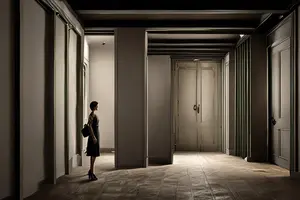
Suspense in a brand film does not always come from hiding the answer until the end. A more useful structure can let viewers see something the character does not: someone is already behind the door, a device is working under the table, or a product has changed the state of another room. The audience begins to predict when the character will notice, how they will react, and whether the product will alter what happens next.
This knowledge gap can turn a short product demonstration into a story. It can also become empty mystery. The objective is not to give viewers more information for its own sake. The one thing they know first must make the product's role clearer.
A knowledge gap is different from hiding the product
Dramatic irony depends on a difference between what the audience knows and what a character knows. In a 2023 proof-of-concept study using silent comedy clips, Cabañas, Senju and Smith found that viewers who received critical information unavailable to the character referred more often to cognitive states such as knowing and believing. The study concerns film comprehension, not advertising performance. Its useful creative implication is narrower: a clear knowledge gap can prompt viewers to track what a character does and does not know.
If neither the audience nor the character knows what is happening, the structure behaves like a mystery. If viewers see the product before the character understands its effect, attention shifts from “what is it?” to “when will they realise?” The second structure suits a benefit that is simple enough to understand visually but gains meaning through a human response.
Write three separate states of knowledge
Before storyboarding, write down what the viewer knows, what the character believes, and what the product changes. When these are merged into one note, dramatic irony can look like an editing mistake.
The viewer knows one verifiable fact
The fact should be established directly by image or sound: a smart lock has recognised a visitor, headphones have changed listening mode, or an automatic device is completing a task in another room. A vague light or an unidentifiable tone cannot carry a specific feature. If the setup is abstract, the eventual reaction feels like the writer answering a question the audience was never able to ask.
The character has a credible reason not to know
The character may lack a sightline, miss a sound, or act on an outdated assumption. The cause must exist in the space and performance: an obstruction, a turned back, masking environmental sound, or physical distance. When a performer ignores an obvious fact only to keep the plot moving, viewers question the acting before they anticipate the product.
The product changes the next action
The product cannot merely be recognised at the end. It should already be changing the event: preventing a mistake, revealing an opportunity, connecting two people, or allowing an interrupted task to continue. Remove the product from the scene. If the story still resolves in the same way, the knowledge gap is decorative.
Install the critical information in one readable shot
For viewers to know first, they must actually see the fact. The installation shot usually needs to answer three questions: where the critical object is, what has changed, and why the character has not noticed. A foreground-background composition can reveal an action behind the character. A close shot of product state can also be followed by a character who continues to act on old information.
Do not make this shot explain every selling point. A smart-home film might establish that the room has already adjusted automatically without also explaining sensors, protocols, energy data, and the app interface. Suspense needs a stable expectation. A stack of features turns it back into a manual.
Three knowledge gaps give the product three roles
The viewer sees a risk and the product prevents it
A character is about to make a mistake that the viewer can already identify. The product provides a warning or protective action. This can suit monitoring and safety features, but every trigger must match the approved product conditions. Editing must not imply a response speed or level of awareness the product does not have.
The viewer sees an opportunity and the product connects it
Someone in another room needs help, a useful message is about to be missed, or a space is ready before the character knows it. The product connects both sides. The emotion is anticipation rather than danger. Viewers see the other end first, then wait for the notification, turn, and connection.
The viewer understands the mistake and the product reveals it
Comedy often gives a character the wrong explanation while the audience knows the real cause. A product record, feedback signal, or automatic function can expose the mistake. Keep the joke on the human assumption rather than on a user who cannot operate the product. Otherwise, the feature may be memorable while the brand feels condescending.
Camera position decides whose knowledge viewers share
A camera that stays with the character limits what viewers can know. A camera that briefly enters another space can give them privileged information. Each shift in viewpoint needs a purpose. An unmotivated omniscient shot may reveal too much, while a strict character viewpoint may never install the fact.
Capture three kinds of coverage for the same event: an objective view of what the character cannot see, a close shot of product state, and a reaction shot in which the character still acts on the old belief. The editor can then control the strength and duration of the gap without adding explanatory voice-over. Recheck every crop: a clue at the edge of a 16:9 frame may disappear completely in a vertical cut.
Sound can reveal information or keep it private
Viewers may hear a product signal that the character misses because of distance, headphones, or environmental noise. The reverse is also possible: the character hears something while the audience does not yet know its source. The first makes viewers wait for discovery; the second makes them search for an explanation.
The cue must match the real product state. A success tone played before an operation is complete changes the meaning of the feature. The mix must also explain why the character does not hear it. Distance, doors, masking sound, and spatial placement are stronger reasons than simply treating the performer as inattentive.
The reveal must complete a product cause-and-effect chain
Reveal too early and the knowledge gap disappears before it generates anticipation. Wait too long and the character seems slow. A practical edit often introduces product feedback just before the character acts on old information, then preserves one complete reaction and the next action. The audience sees not only that the character has noticed, but how the product changes behaviour.
Mark four timecodes: when viewers receive the critical fact, when the character continues under the old belief, when the product intervenes, and when the belief changes. If all four occur together, no suspense has formed. If the middle lasts too long, check whether action, risk, or emotion is still developing. The same timing problem appears in broader brand-film time compression: duration matters only when it changes what viewers can understand or feel.
A short cut still needs the installation
When a main film becomes a fifteen- or six-second version, the installation shot is often the first thing removed. The character then reacts without a readable cause and the product appears as a sudden insert. Compress the period in which the character acts on old information, but retain installation, intervention, and update.
If the platform requires earlier category recognition, show the product in the installation shot and shift the open question from “what is it?” to “what will it change?” Brand recognition and suspense can coexist when product appearance still leaves an unfinished event.
Test the knowledge gap with a silent retelling
Watch without sound and ask someone outside the production to answer three questions: what does the viewer know, what does the character know, and what does the product change? Identical answers suggest that the gap is missing. If the reason for the character's ignorance is unclear, the spatial or performance logic has failed. If the only answer is “the product appears,” its causal role needs work.
Restore the sound and check whether music is manufacturing tension that the scene does not contain. Research on advance knowledge and enjoyment is mixed. Leavitt and Christenfeld's short-story experiments found that advance information could increase enjoyment, while later audiovisual research reported effects that varied with genre, involvement, and individual differences. A brand should therefore treat knowledge asymmetry as a creative choice to test with a specific audience and cut, not as a universal “spoilers work” rule.
For more production methods, explore ONCE's video production insights. If your brand film needs to connect a product feature with character relationships and a real story turn, send the script, trigger conditions, and planned versions to ONCE VISUAL. We can map what viewers, characters, and the product each know, then turn viewpoint, performance, sound, and edit points into shootable coverage.