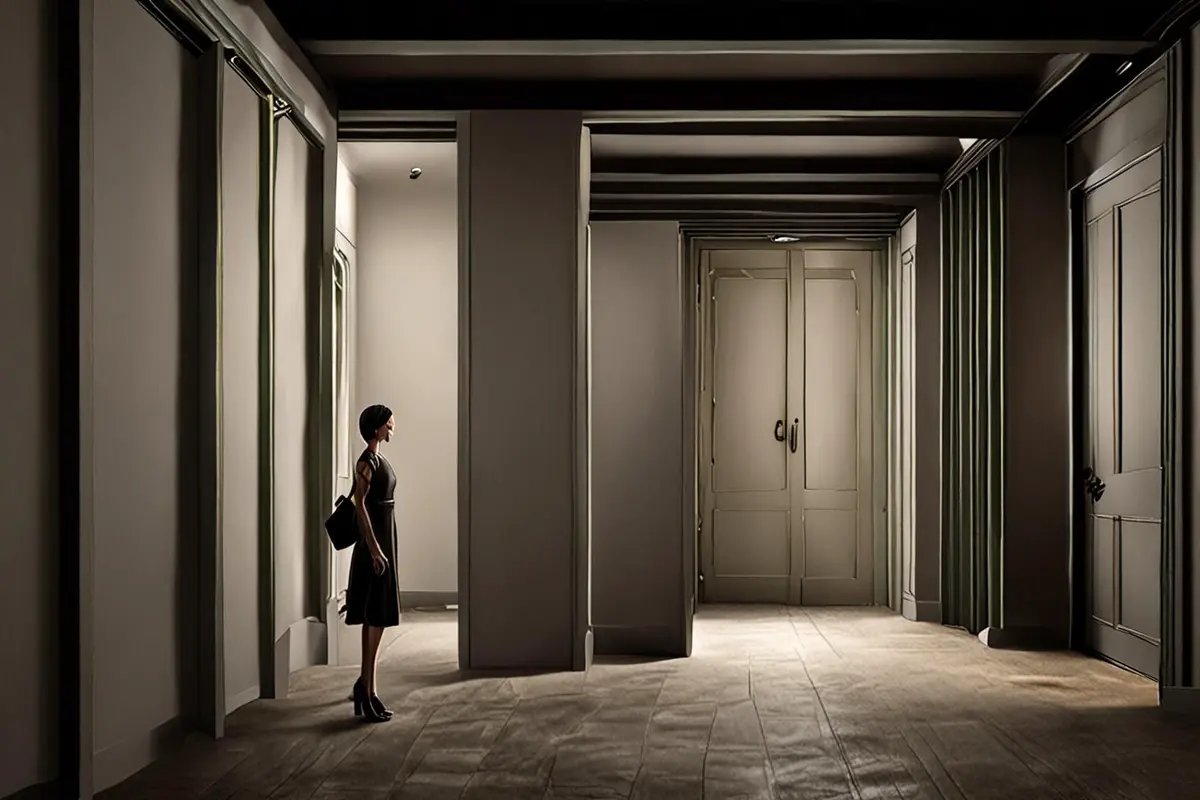
In brand films, a doorway is often treated as ordinary set dressing: a character opens it, walks through, and the camera follows into the next room. When the crossing is designed as a real story beat, however, it can do three jobs at once. It can tell viewers that the space has changed, rearrange the relationship between characters, and move a product from being introduced to being used.
This does not mean every transition needs a door. A doorway is useful because it naturally divides inside from outside, known from unknown, and action before from action after. The director's real decision is what changes once the character crosses that line.
A doorway is an event boundary before it is decoration
In cognitive research, people update their understanding of the current situation when they cross into another room. Radvansky and Copeland's virtual-space experiments found that spatial shifts made recently carried information less accessible. Later work on event segmentation and film editing also shows that changes in location, time, and action affect how viewers divide continuous footage into meaningful events.
These experiments do not prove that a doorway improves ad memory or conversion. They offer a useful creative inference: a threshold is a moment when viewers are ready to rebuild the situation. A brand film can use that moment to introduce a new problem, a new relationship, or a new product state.
First define what changes on the other side
If only the location changes, a doorway scene is usually just visual transportation. Strong doorway storytelling requires at least one relationship to change, and the image must make that change readable.
The location changes while the action continues
A character picks up a prototype in an office, crosses a corridor, and continues the test in a lab. The location changes, but the hand action, eyeline, or sound rhythm remains continuous. Viewers can understand the spaces as two stages of the same task. This works well in corporate films, R&D stories, and manufacturing narratives because it compresses travel without breaking cause and effect.
Position changes, and so does the relationship
One person waits outside while another appears inside. Or team members cross the same frame in sequence, but their positions change each time. A doorway can show who controls the space, who is invited in, and who remains outside. Foreground depth, stopping distance, and the simple act of making room can communicate more than explanatory dialogue.
The product state changes, so the story advances
The product may still be packaged outside the room and operating once it enters. A character can carry a problem in and return with a visible result. The crossing then becomes a state change on one continuous line of action. That change must come from a real product capability; a transition should never imply an unsubstantiated result.
Three doorway patterns serve three story tasks
A complete crossing confirms a major turn
The audience sees the approach, the threshold, and the arrival in the new space. This is the clearest form of transition and suits important beats, such as moving from a household problem to a product solution or from a design sketch to a production floor. Give the action enough time to read. Cutting the approach, opening, and entry into fragments can erase the very boundary the shot is meant to establish.
A partial reveal lets light or sound arrive first
Before the person appears, light through the gap, a machine sound, or a line of dialogue reaches the viewer. The door then opens and completes the information. This works when the product should feel discovered rather than displayed. A sound bridge can also hold two spaces together so the new room does not feel like the beginning of another film.
Framing through the doorway explains two spaces at once
The camera does not have to cross with the character. A frame within the frame can keep one person in the foreground while showing another character or product action inside. Before shooting, check the doorway width, blocking, and the product's readable size. If the subject inside becomes too small, the composition may be sophisticated while the selling point disappears.
Camera position decides which side the viewer belongs to
When the camera stays outside, the viewer feels like an observer waiting to enter. When it is already inside and the character approaches, the viewer seems to belong to that space. When camera and character cross together, the emphasis shifts to experience and discovery. None is universally better; each should match the relationship the brand wants at that beat.
Lens choice changes the doorway's role. A wide lens can retain both rooms but exaggerate edges and distance. A longer lens compresses the spaces and is useful when the doorway hides the subject before a reveal. Review ONCE's broader video production insights when mapping real room dimensions, camera distance, and performer movement before deciding whether walls or extensions are needed.
Let light and sound hand the scene from one room to another
If both sides have identical colour temperature, brightness, and reverberation, the spatial change loses force. If everything changes, the scenes may feel unrelated. A controlled approach keeps one element continuous and changes one main variable. Skin-light direction might stay consistent while the background moves from a cool lab to a warm home. Or footsteps may keep their rhythm while the new room tone gradually takes over.
The physical sound of the door also carries story information. A handle dropping, a latch releasing, hinge friction, and the panel closing suggest different materials and moods. Record the real actions cleanly, then decide their level in the mix. One exaggerated stock door effect cannot represent every product and space.
Cutting before, on, or after the threshold changes the meaning
A cut before the character touches the door creates anticipation. Cutting when the panel fills the frame can hide a location join. Waiting until the character has fully entered lets the viewer confirm the new setting and relationship. Research on continuity editing distinguishes boundaries by continuity in space, time, and action. The practical lesson for a brand film is simple: the location may jump, but the action needs a handhold.
That handhold can be a hand pushing, an eyeline turning, a step in the same direction, or a shared sound peak. For a long time jump, the crossing can connect different ages, seasons, or business stages, a method related to time compression in brand films. If several people enter together, the shot needs the same role clarity used in ensemble blocking.
The product must change what happens beyond the door
A common failure is to have a character carry a product through a beautiful doorway, enter another beautiful room, and continue doing something unrelated. The transition works, but the selling point does not advance. Ask whether the crossing would still work if the product were removed. If it would, the product may be no more than a prop.
A stronger design lets the product determine the next action. Noise-cancelling headphones shift a character from a busy corridor into a focused state. Portable lighting makes a dark area workable. A smart lock can be the trigger for the crossing itself. Every function, state, and interface must match the sample and approved product information; a visual metaphor cannot replace evidence.
Rehearse the crossing before the shoot
A doorway shot looks simple but combines swing direction, handle height, reflections, focus transfer, performer speed, space for the operator, and sound. Before principal photography, record one complete pass on a phone or test camera, beginning before the character enters frame and ending after the first meaningful action in the next room.
On playback, check four things: whether the turn is readable, whether the product remains identifiable, whether the editor has a usable action match, and whether sound hands the scene from one room to the other. If two of those fail, change the blocking or camera position instead of hoping faster editing will conceal the problem.
Research limits and creative judgement
This article draws on Radvansky and Copeland's doorway experiments, Magliano and colleagues' work on continuity editing and event segmentation, Buckley and colleagues' study of doorway layout and event memory, and Cutting's analysis of narrative discontinuities in popular films. These sources help explain event boundaries and viewing mechanisms; they do not establish results for any specific advertisement.
If your brand film needs to move among a home, office, lab, or factory, send the script, location plan, and product actions to ONCE VISUAL. We can define what changes before and after each threshold, then plan the live-action blocking and editorial transition.