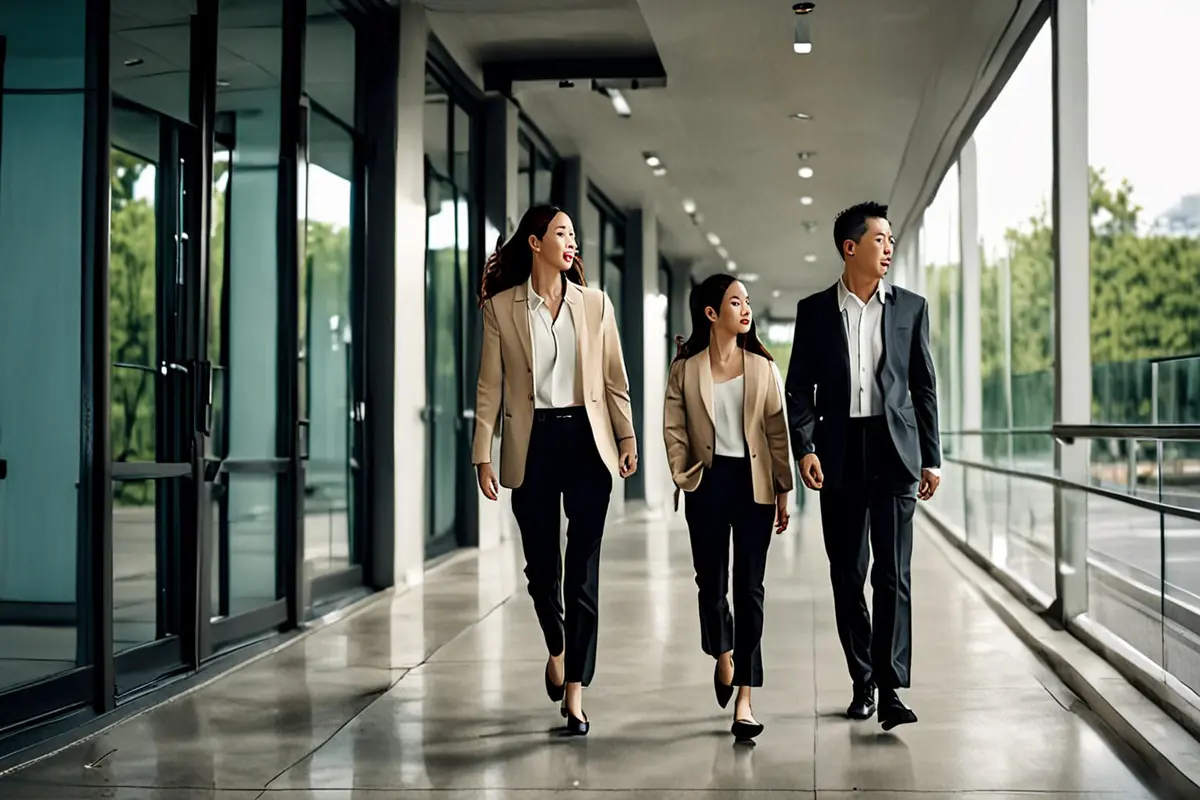
Walking is often the most visibly staged action in a corporate film. An employee starts at one end of a corridor, the camera moves alongside, and everyone maintains a purposeful expression and an even pace. The shot is smooth, yet the viewer immediately senses that the people are walking only for the camera. The problem is not always weak acting. The movement has no destination, no change in rhythm, and no meaningful relationship with the space.
Audiences know walking extremely well. Pace, preparation before the first step, whether one person waits for another, who gives way at a corner, and what the group looks at when it stops all reveal working relationships. When corporate film production treats walking as generic transition footage, it discards a useful storytelling cue. When movement is tied to a task, the same corridor can communicate efficiency, collaboration, care, authority, or openness.
Choose the destination before choosing the pace
“Walk faster and look energetic” is a common direction, but it usually produces uniform and empty performance. Speed should come from the task. Someone moving toward a production problem will look ahead before the turn. Someone guiding a client will regulate pace and monitor the other person. Someone returning from a completed inspection may move steadily and with less tension. Fast walking without a destination simply looks like stock corporate footage.
The director can give the performer one executable action: take the visitor to the sample, reach the next test cycle, confirm the data while moving, or finish the conclusion before reaching the door. These verbs naturally alter eyeline, body orientation, and pace. Authenticity does not require employees to improvise. It requires a specific event behind the movement.
The first three steps determine whether movement feels lived in
Much of the staged feeling begins at the starting mark. People wait for the cue, then switch from complete stillness into a polished walking posture at exactly the same moment. In normal work, a person often looks toward the destination, puts something away, shifts weight, and then starts moving. Keeping these preparations creates cause and effect.
If the shot needs someone to enter from a fixed position, begin the action outside the composition or give the person a small task before departure. They might close a sample box, put down a tool, acknowledge a colleague, and then turn. The final edit does not need every preparatory step, but the performer should experience the full action so the editor has natural points of entry.
Side by side does not automatically mean equal
When two people walk together, their relationship is built from constant small adjustments. Who chooses direction? Who waits? Who stands closer to the door or machine? Who makes room at a corner? If both people maintain identical stride length and distance throughout the shot, the movement can look more like a rehearsed formation than collaboration.
To express equal participation, give both people a shared visual target and allow the leading position to change naturally during conversation. In a guided visit, the leader does not have to remain ahead. Slowing at a key point so the visitor sees the product first can communicate attention and confidence. Authority also does not require a manager to lead every step. The way others respond and stop together may be a stronger signal.
Stops and turns are punctuation within a walking shot
A continuous walk at one speed contains little information. Real work routes include deceleration, observation, giving way, stopping, looking back, and moving again. These actions function like punctuation. They tell the viewer that attention has changed. Corporate films often remove them in pursuit of smooth movement, and the result loses its sense of place.
The stop should happen where the information changes. Slowing beside a machine redirects attention to the equipment. A brief pause at a doorway clarifies the transition between spaces. Stopping at the key conclusion gives the words more weight. For another example of small actions creating professional credibility, see our article on correction actions in corporate films.
Space should reveal a business relationship
The same corridor can be attractive architecture or useful business information. A route from a laboratory to a test area shows how stages connect. Moving from a production line into a discussion zone shows how a floor issue enters a decision process. Guiding a visitor from reception to the sample area explains how the company receives customers. If the route cannot answer why the people move from one place to another, the space is only decoration.
Before filming, walk through the location in the order that work actually happens. Notice doors, corners, glass, changes in light, and places where people meet. The camera does not always need the prettiest path. It needs a route that connects meaningful business points and lets the audience understand how the organization works.
Camera speed needs a relationship with human pace
A tracking camera does not need to maintain one fixed distance. Falling slightly behind can create a sense of pursuit and task progression. Moving parallel is useful for observing conversation. Reaching the destination first and waiting for the person to enter can emphasize the space and the result. The choice depends on whether the audience should follow a person, a process, or a destination.
A wide lens used close to the subject enlarges steps and spatial change. It can energize movement, but it can also make ordinary work look anxious. A longer lens compresses distance and may make a group feel more unified, although it can remove useful spatial information. Stabilization should also serve the scene. Completely frictionless camera movement can make real employees look as if the background is pushing them. A small, controlled sense of human rhythm often feels more convincing.
Footsteps, clothing, and carried objects expose false movement
Viewers do not judge pace from legs alone. Badges, clothing, folders, tools, and cups all respond after the body moves. If someone walks quickly while every carried object remains perfectly still, the action separates from the environment. The same happens when an urgent image is paired with evenly spaced, delicate footsteps. Location sound and foley should reflect the actual floor, shoes, and task instead of using one generic business-walking effect.
What a person carries also changes the role. Someone holding a newly inspected component will direct attention toward it. Someone discussing information on a tablet will alternate between the object and a colleague. Empty-handed fast walking is more easily read as an attempt to manufacture busyness. Props should carry part of the purpose rather than simply fill the composition.
Employees need tasks, while actors need business logic
Real employees understand the space and process, but they may change their normal pace in front of a camera. Actors can control rhythm, but they may not understand how the equipment and workflow connect. Both need a task before they receive performance notes. With an employee, watch one normal pass and then adjust composition and timing. With an actor, explain where the character came from, what information is in hand, and what happens next.
Speed should never replace safety. Narrow passages, steps, production areas, and moving equipment require a safe pace first. Camera position, editing, and sound can then strengthen progression. A reliable organization rarely looks like everyone is running. It looks like each movement matches a real responsibility.
Editing should preserve changes in pace
If every walking shot begins on a step and cuts before the turn, the entire film develops one mechanical rhythm. Different sequences can preserve different phases. One can begin with preparation, another can enter during movement, and another can wait until the person comes to rest. Walking then becomes part of the narrative instead of a transition template.
Screen direction also matters across connected spaces. If a person exits from right to left and appears in the next shot moving in the opposite direction at a similar scale, the audience may assume the person turned back. Record movement direction, leading position, and pace during production, especially when the same person crosses several locations. Eyelines affect the same continuity; our article on eyelines in corporate interviews develops that topic further.
For every walking sequence, write down four elements: destination, task, change of pace, and stopping point. These notes are more useful than asking people to walk naturally, and they help the brand decide whether the scene communicates confusion, efficiency, collaboration, or calm control. If you are planning a corporate film, factory video, or team story, explore ONCE video production solutions, or contact ONCE to connect people, work, and space through credible movement.