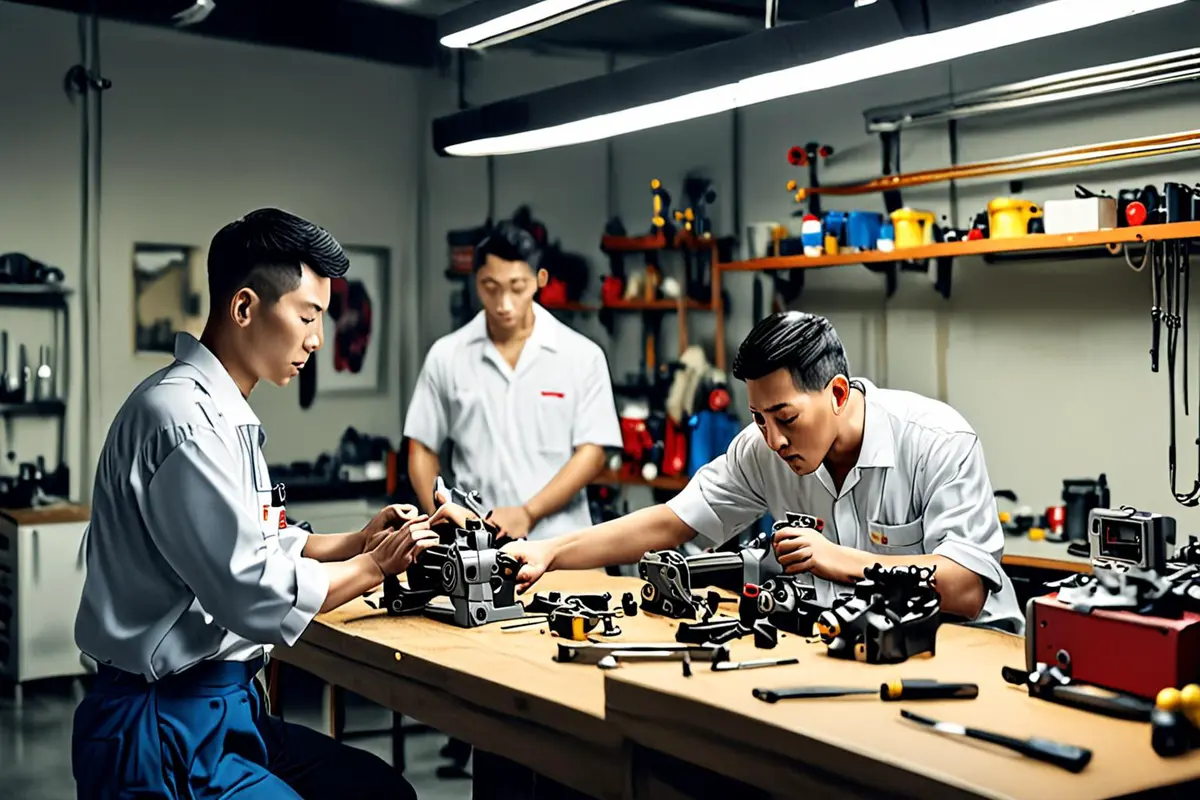
Many corporate films present work as a straight line that never pauses. Machines run smoothly, documents pass on the first attempt, employees perform every action correctly, and meetings contain no disagreement. The images look professional, but they often remove something essential: judgment. Viewers can see people working, yet they cannot see how the team detects a deviation, makes a decision, and brings the result back on course.
A quality culture does not mean that the world never produces errors. It means that small problems are noticed early, can be spoken about, and are corrected before they travel into the next stage. In a corporate film, one restrained correction can sometimes explain how a team works better than ten flawless close-ups.
Why Uninterrupted Perfection Can Feel Like a Demonstration
Real work includes comparison, hesitation, verification, and adjustment. A technician realigns a component. A designer places two versions beside each other. A chef tastes before changing the heat. A director records another take because the rhythm of one sentence is wrong. When a corporate film removes every one of these moments and keeps only completed actions, work begins to look like performance without thought.
The problem is not that the images are too polished. It is that the polish does not show where judgment takes place. Fast machinery may communicate scale without showing when people intervene. An employee holding a measuring tool does not automatically communicate a quality decision. Our earlier article on visible nodes in a production-line video explains how orders, materials, processes, inspection, and shipping form a business chain. This article moves closer: within one node, how can detection and correction become readable actions?
Film the Judgment, Not the Mistake
Useful corrections are usually small and ordinary. A part is checked for orientation before assembly. A position is adjusted after measurement. Dust is found on a surface, cleaned, and photographed again. An interview answer feels too fast, so the speaker reorganizes it. An AI content team rejects one of three generated environments because its light does not match the product. The audience does not need a disaster. It needs to see a standard enter the action.
A clear correction has three linked stages: a perceptible deviation, an intervention, and a verification of the result. A deviation alone makes the organization look disorderly. An adjustment without context gives viewers no reason for the movement. Without verification, no one knows whether the issue was resolved. The complete action is not the error. It is the path from noticing to confirmation.
The Deviation Should Be Small and Reversible
Suitable moments are controlled, reversible variations that belong to normal work and do not harm a client: alignment, color comparison, sample selection, speech rhythm, or tool calibration. Serious quality incidents, unsafe practices, customer returns, privacy breaches, and unverified product defects should not be repackaged as authenticity. They require real handling, not creative treatment.
Who Notices the Problem Reveals the Culture
If a manager enters every scene to point out an error, the film may communicate obedience. If a frontline employee can pause, raise a question, and confirm the answer with a colleague, it communicates responsibility and collaboration. Correction shows technical skill, but it also reveals how an organization distributes the right to judge.
The scene does not need conflict, and no individual needs to be embarrassed. Keep attention on the shared object. Two people look at the same sample. A finger traces the same edge. A technician offers a measurement and a colleague adjusts in response. The story is not about one person catching another. It is about people bringing the work back to a standard together.
Corporate interviews can use the same principle. A speaker who pauses to replace one word, or adds a more accurate qualification after an answer, does not automatically lose authority. If the correction improves the meaning, viewers can see thought happening. Our article on eyelines and credibility in corporate interviews considers the relationship between subject and camera. Here, credibility comes from taking responsibility for one's own expression.
Keep the Object, Standard, and Change in the Same Sequence
A close-up of a hand turning a knob does not tell viewers whether this is a normal operation or a correction. A more useful sequence keeps at least two of three elements visible: the object, the reference, and the change. A medium shot can establish the technician and workstation, a close-up can show the gauge or aligned edge, and a result shot can confirm the new state. The sequence can be short, but its causality should remain intact.
The camera should also resist turning a correction into a thriller. Extreme facial close-ups, sudden push-ins, or alarm-like sound can inflate an ordinary check into a crisis. Stable composition, clear eyelines, and enough duration to understand the movement usually fit corporate content better. The audience can read what happened without seeing the team as a group constantly fighting fires.
Data May Stay Obscured, but the Decision Must Stay Clear
Real work often involves drawings, dashboards, customer files, and internal data that should not be public. Approved test prints, production-only interfaces, gestures, or reflections can communicate comparison, selection, and confirmation without exposing sensitive fields. Confidentiality may reduce the amount of information in the image, but it should not break the logic of the action.
Sound Turns a Pause into a Meaningful Transition
When a correction happens, sound often changes before anyone explains it. A machine stops. A pen lifts from the page. Conversation leaves a brief gap. A latch closes again with a cleaner click. These sounds move the scene from execution into judgment and then back into motion.
If music maintains the same speed throughout and the edit compresses every pause, the correction loses its weight. Let production sound appear for a moment: the slight resistance in the first action, the quiet of adjustment, and the stable rhythm after verification. The sound does not need exaggeration. It only needs to distinguish the three stages.
Do Not Pretend to Discover a Problem or Restage Danger
The strongest material comes from checks that already exist in the workflow: first-piece approval, sample comparison, calibration, peer review, playback, or version review. The director should learn when these actions happen and place the camera and lighting where they do not interrupt the process.
If no natural adjustment appears on the filming day, a technical lead can approve a demonstration with a test piece or production-only material. The film does not need to claim that a real failure occurred; it needs to show the method accurately. Our article on filming production-line changeovers stresses technical accuracy and on-set supervision. The principle matters even more here: never ask an employee to violate procedure or recreate a dangerous action just to obtain a dramatic before-and-after.
Knowledge Work Can Show Correction Without Another Screen Meeting
Service, design, and AI content teams do not have an obvious production line, but their judgments can still be made visible. A strategist replaces a broad claim with a specific use situation. A designer compares two proportions of negative space. An editor moves a reaction a few frames earlier. An AIGC team notices that the product reflection conflicts with the background light, keeps the live-action product, and rebuilds the environment. These changes explain professional value better than a group of people nodding around a computer.
Let the difference between versions enter the image through marked paper, printed samples, physical models, before-and-after movement, or a non-sensitive portion of an audio waveform. The point is not to feature software. It is to help viewers understand why the team rejected one version and accepted the next.
The Film Must Carry the Problem Back to a Result
A correction should not end when everyone notices the problem. It should return to product, process, or client value. The adjusted part enters the next workstation smoothly. The revised sentence is delivered naturally. A rebuilt environment restores consistent highlights on the product. The result does not need a loud caption, but viewers should see that the work has become stable again.
A corporate film does not need many correction scenes. One or two moments that represent how the team judges are enough. Too many problems obscure the main story; no judgment at all makes expertise feel abstract. The goal is to show that standards are not slogans on a wall. They become active when an action begins to drift.
Move from Looking Busy to Showing Judgment
Before filming, ask frontline staff three practical questions. What small deviation is normally caught early? Who can pause or raise a concern? How does the team confirm that work may continue? The answers are often closer to the organization's real operating culture than its brand lines, and they translate more naturally into scenes.
A strong corporate film does not present a company as a machine that never makes an error. It helps viewers trust that the team knows what deserves a pause, how to correct it, and when to move forward. If you are planning a film for a manufacturing, technology, professional-service, or AI content team, ONCE can begin with process research and storyboarding for corporate and product video production, turning real judgment into clear, restrained images without exposing sensitive information. Contact us to identify the action that best represents your team's quality culture.