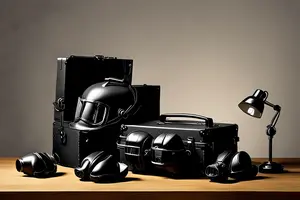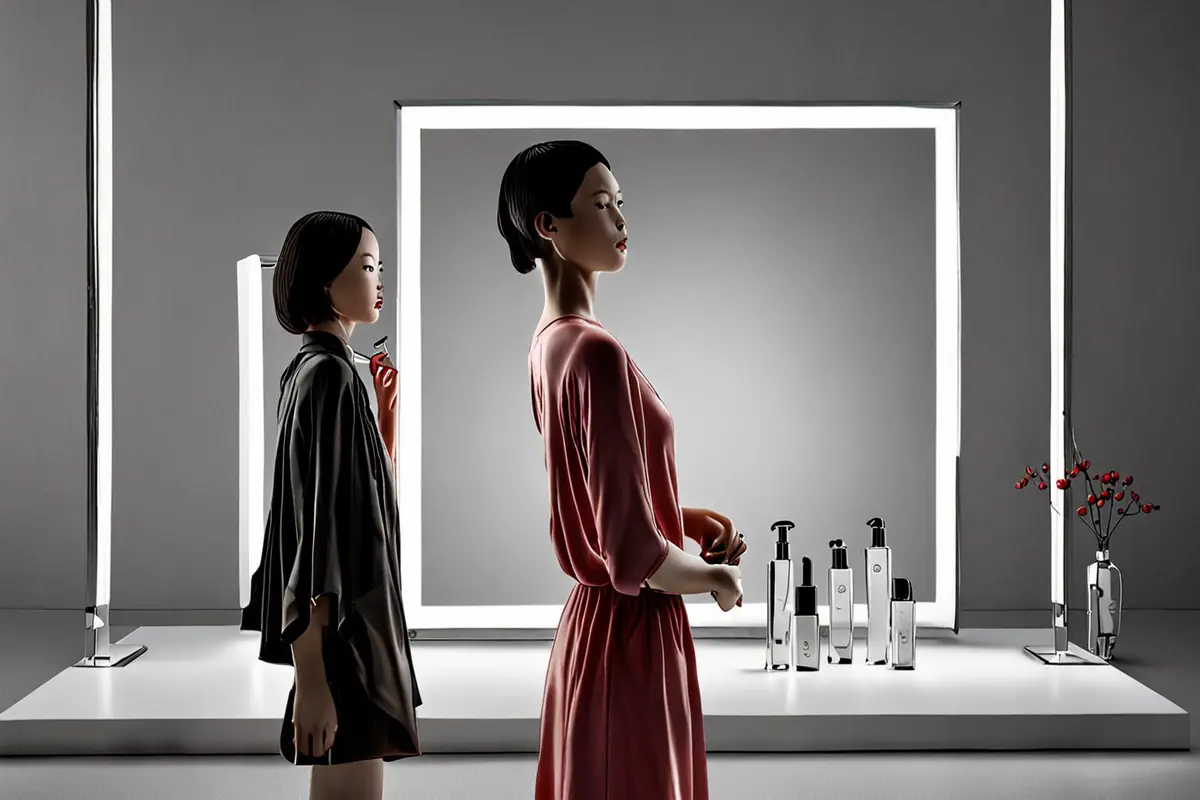
Mirrors, glass doors, polished metal and black screens create a second image inside a brand film. They can reveal a space the character has not turned to see, or show the front and side of a product at once. But a small change in camera position can also reveal the lens, softbox, crew or studio ceiling.
Mirror reflections therefore belong in the storyboard, not in a post-production cleanup list. The first question is simple: should the audience notice the physical subject or the reflection first? Is the reflection adding information, creating a relationship, or only describing material? The answer changes the camera, performance, lighting and edit.
A reflection is a second frame with a physical source
A foreground object can be placed freely. A reflection is constrained by the subject, the reflective surface and the camera viewpoint. The person in a mirror is not behind the glass, and a highlight on a product is not an arbitrary graphic. Each comes from a real position outside the reflected frame.
Treat the reflective surface as a second viewfinder before the shoot. Mark how much space it occupies, who must appear inside it, and whether it reveals information before or after the physical subject. This keeps art direction from placing mirrors for decoration while the camera team searches for a workable angle on set.
Give the reflection one clear story function
Show a side the physical subject cannot reveal
A mirrored tabletop can reveal the underside, side profile or opening action of a product. A character in front of glass can keep a readable facial expression while the body continues an action. When reflection carries information, its placement and focus must be legible.
Bring two spaces into one shot
A mirror can pull a person behind the camera, movement beyond a doorway or light from another direction into the composition. This differs from building off-screen space with sound and eyelines: off-screen space asks the viewer to imagine, while a mirror compresses another direction into the visible frame.
Delay the reveal instead of duplicating the subject
Seeing the reflection before the physical subject can turn an entrance, a product activation or a change in space into a small discovery. If subject and reflection overlap completely from the first frame, the mirror often becomes decoration. A delayed movement, a focus change or a brief obstruction can give the second image its own rhythm.
Design the viewpoint instead of merely hiding the camera
Moving the camera outside the reflected area is the easiest safety move, but it may remove the frontal viewpoint the scene needs. A better test uses a stand-in camera and an empty frame: check whether the mirror edge cuts the character, whether the reflected horizon conflicts with the main composition, and how a higher or lower lens changes the viewer's relationship to the subject.
A longer lens can compress the apparent distance between subject and reflection, making both layers feel more graphic. A wider view emphasizes mirror edges, environmental lines and camera movement. Lens choice should express whether the viewer is observing, accompanying or actively searching for information.
Performance must work in both images
Looking at one's own eyes, a person near the mirror edge or a product outside the mirror creates different relationships. If the direction is only “look into the mirror,” the action easily becomes grooming. The actor needs to know what is being confirmed, who is being awaited and whether another person is approaching.
Movement appears twice. A turn, raised hand or opening door can make the frame busy when played too broadly. Small changes in the eyes, shoulders and breathing often let the audience read emotion in the reflection before returning to the physical character.
Lighting must shape the subject and the shape of the set
A mirror records the shape of a light. A softbox may create the right face light while becoming a blunt white rectangle in glass. A black flag may control spill but leave an unnatural dark block across a polished product. From the camera position, inspect the outline of every source, not just its brightness.
Start with practical and background lights off. Keep the key light, find the strongest reflected patch, then add environmental sources one at a time. This is more controlled than trying to suppress every reflection later, and it preserves the highlights that describe material.
Separate product reflections from scenic mirrors
Phone screens, metal edges, glass bottles and mirrored tabletops all reflect, but they do different jobs. Product reflections usually explain form, material and precision. Scenic mirrors more often explain space and relationships. When both demand attention, the frame fills with unstable highlights.
For a product shot, establish one primary highlight that follows the form before adding environmental reflections. For a scenic mirror, preserve the person or spatial information and avoid cutting the product into unreadable fragments. Hybrid productions also need to verify that the product surface responds to the same environment as the background.
Check edges, movement and cleanup complexity
- Mirror edges: the camera may be absent from the center but visible in a narrow strip near the frame.
- Movement: a safe static test may fail when the actor walks, the camera pans or the dolly advances.
- Crew color: black clothing does not disappear; on a bright surface it can become a moving dark patch.
- Cleanup paths: removing equipment becomes harder when the reflected area crosses hair, fingers, transparent objects or complex texture.
Record a clean plate without performers and run the full camera move once. The plate does not replace careful set control, but it gives post-production a reliable source for limited repairs.
Editing must preserve reflected direction and time
Across camera angles, the reflected left-right relationship, entrance timing and eyeline can change. Each shot may look correct alone while the sequence makes a character seem to jump position. Continuity notes should record mirror orientation, subject distance, door angle and whether the key action happens in the physical image or reflection.
Do not hold a reflection just to signal sophistication. Once the second layer has been read, the shot should advance: cut to the subject, let the character leave, or allow the mirror to be obscured. Extra duration often adds no meaning and only exposes more set detail.
Horizontal and vertical frames need different reflection centers
A horizontal frame can place subject and reflection side by side. A vertical frame often relies on front-back or upper-lower layers. Cropping the horizontal master can sever the relationship between the mirror edge and the physical subject, leaving an unexplained bright surface.
Multi-format work should inspect both compositions on set. A small team can still build convincing mirror shots by assigning clear responsibility across camera, lighting, performance and art direction. As with showing small-team capability through space, credibility comes from precise choices rather than a larger set.
A practical mirror storyboard
Write four lines for every reflective shot: what the physical subject is; what the reflection adds; which layer the audience reads first; and what changes by the end of the shot. Rehearse from the real angle with a phone, then mark safe movement for camera, key light and performers before building the final lighting setup.
During review, mute the sound and ask whether subject and reflection explain the space. Then cover the reflective area and ask whether the scene loses information or emotion. If both answers are no, the mirror may be style without function and can be simplified.
A reflection is most useful when it does more than duplicate a frame. It lets the audience see two directions, two relationships or two stages of an action at once. If your brand film involves mirrors, glass or highly reflective products, contact ONCE to discuss storyboards, lighting and production.