When a corporate film needs to communicate company strength, the easiest shortcut is to make the space look larger than it is. An ultra-wide lens stretches a corridor, a few people reappear in different positions, or employees filmed at separate times are cut into one apparently large workforce. The images may feel busy, but people who know the company can sense the exaggeration. Once the space becomes unreliable, the brand promise begins to feel unreliable too.
A small team does not lack organizational capability by definition. R&D groups, creative companies, and professional-service firms often create value because information moves quickly, disciplines sit close together, and important decisions reach execution directly. A corporate film should reveal those relationships. Spatial scale is not the number of square meters in the office. It is whether viewers can understand how one task moves among people, equipment, information, and decisions.
Spatial scale begins with relationships
The same compact studio can feel cramped or closely coordinated. The difference is not how far the lens pushes the walls apart. It is whether the frame establishes clear relationships: who identifies the problem, who verifies it, who receives the result, and how tools or information move between roles.
A wide shot of empty floor, rows of desks, and interior decoration communicates area. A sequence in which a designer hands a proposal to an engineer, the engineer turns toward a prototype, and the result returns to a decision-maker communicates organization. Even when those actions happen across three adjacent workstations, they create more meaningful scale than a row of unused desks.
Define what capability means in this film
A small company should not use a camera to invent departments that do not exist. The better question before filming is what clients genuinely need to believe. Is it engineering judgement, response speed, collaboration across disciplines, or reliable execution? Each answer requires a different use of space.
Show the decision chain in an R&D team
Engineering capability rarely comes from filling a room with people. It appears when a problem is noticed, a response is discussed, a prototype is adjusted, and the result is recorded. The number of people can be small, but the decision chain must remain intact. A question raised in one area needs a visible response in the next.
Show handoffs in service and creative teams
In a service company, organization often lives in the way a brief becomes action. How does client information enter the team? Who translates it into a task? Who makes the final quality decision? These handoffs say more than a generic meeting around a laptop. Each person only needs one accurate action for viewers to understand how the group works.
Connect the space with one real task
Without a task, a workspace becomes a tour. Choose one real, public, filmable piece of work as the thread, and viewers will follow the movement naturally. A sequence might begin with a marked-up drawing, move through a prototype adjustment and local test, then return the confirmed result to the project lead. The camera enters different areas, but every move has a reason.
The thread does not need to represent the entire business. It only needs to make one collaboration understandable. When the sequence includes equipment operation, professional gestures in corporate films can help the behavior carry real expertise. Authentic action gives the spatial relationship an anchor.
A real room can still have depth
Use thresholds, glass, and foreground layers
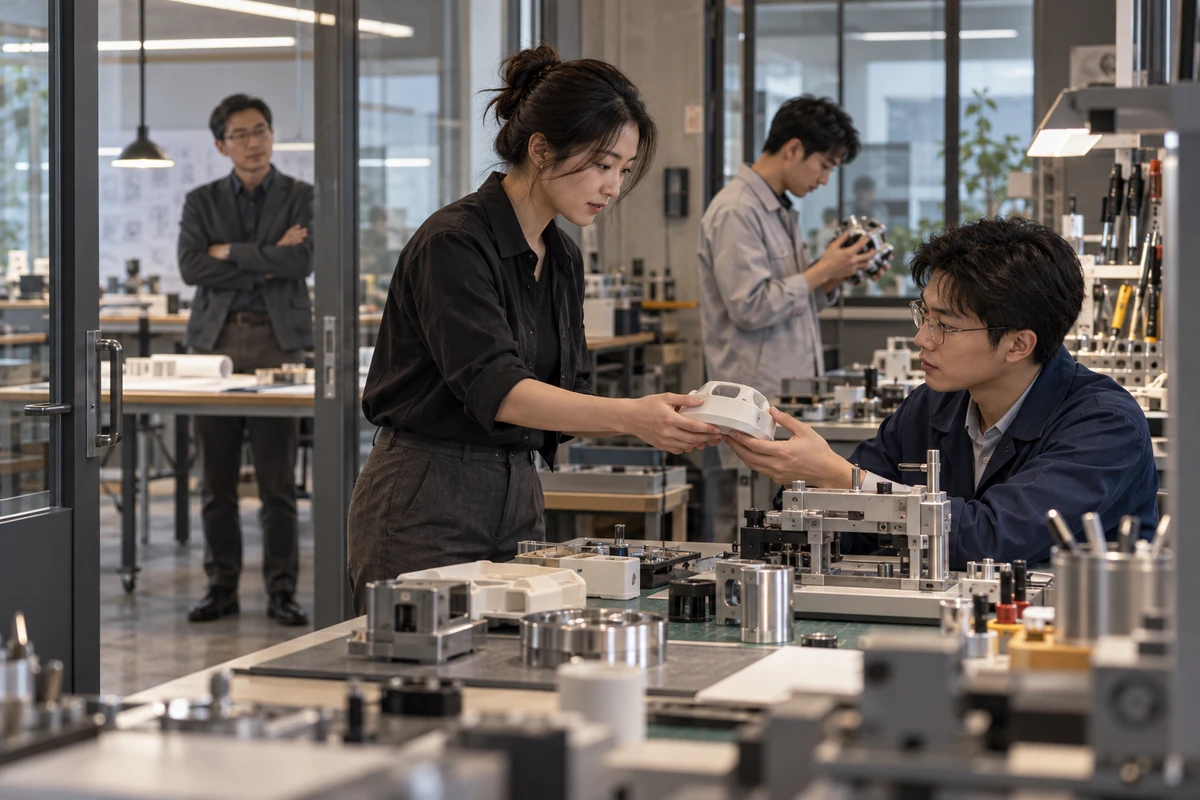
A small room does not force the camera against a wall. Door frames, glass partitions, equipment edges, shelves, and work surfaces can create foreground layers, allowing the audience to see a nearby action, a person in the middle distance, and the wider environment at once. Depth comes from layers, not from pretending the room is wider.
The foreground should carry meaning. Looking past test equipment toward an engineer describes the relationship between person and tool. Watching two people review a sample through a meeting-room doorway places the discussion inside a workflow. When a foreground object only hides a tight room or imitates a cinematic look, the frame becomes crowded.
Use wide lenses without breaking real proportions
A wide lens can establish the relationship between people and environment, but moving too close stretches work surfaces and distorts people near the edge. A later medium shot then exposes the real size of the room. Choose a position that preserves lines and human proportions, then create change through entrances, exits, turns, and task movement. The camera should follow the work rather than orbit the room to prove that it is large.
When headcount is small, make roles clearer
Reusing the same employees as background figures in different shots may create an impression of headcount for a moment, but it destroys role consistency. One person appears to be a designer and then, in the same clothes, turns up on an assembly line. The result is not scale. It is confusion.
A small team benefits from giving each person a legible role. Even with four people on screen, viewers should be able to distinguish who sets direction, who handles detail, who verifies the result, and who decides. Consistent clothing, position, props, and behavior turn a limited cast into a clear organizational map.
Handoffs turn separate rooms into one system
Organizational capability often becomes visible at the point of transfer. A marked drawing moves from a meeting table to a test bench. A sample travels from a studio set to the review station. Client feedback passes from the project lead to the person executing the change. These transfers give cause and effect to spaces that would otherwise feel separate.
A handoff does not have to be a literal handshake or document pass. One person can finish a test and look toward another area, followed by a shot of someone receiving the result. The same sample or marking color can continue across rooms. What matters is that information introduced in one shot is used in the next, rather than becoming a decorative match cut.
Sound can extend space without inventing scale
Footsteps approaching through a corridor, a machine starting out of frame, or a colleague responding from the next room can keep work alive beyond the image. Sound can connect real adjacent areas without requiring a wide establishing shot every time. The related method is explored in off-screen space built with sound and eyelines.
Sound should not fabricate a production line, call center, or workforce that does not exist. The soundscape needs to match the actual structure and capability of the company. A quiet expert team can use precise keyboard taps, tool contact, paper movement, and brief exchanges. The more specific the sound, the more credible the space.
Empty areas can concentrate expertise
Small teams often fear an empty frame, so every desk is filled and someone is always crossing the background. Each shot then tries to announce that everyone is busy, while the important judgement disappears. Leaving space around an action helps viewers see how a hand operates, how two people align their attention, and how a result is confirmed.
An empty shot does not have to prove the size of a building. It can show evidence of a task: tools reset on a test bench, one important revision left on a whiteboard, or a sample waiting on an otherwise clear table. The trace of work can describe an organization more accurately than decorative activity.
Do not manufacture a scale the company cannot support
Borrowing another company's factory, presenting shared offices as a private headquarters, or casting performers as technical staff creates avoidable risk. Even without an explicit claim, editing can imply the wrong conclusion. The spatial claims in a corporate film should remain consistent with the real team, ownership of the location, and the service capacity being presented.
If important work genuinely happens at a client site, partner factory, or external laboratory, name the relationship and let the location represent a collaborative network. It does not need to be disguised as an owned asset. Transparency can make a small organization appear more capable because viewers can see how it connects resources.
The real scale of a small team is dense collaboration
A corporate film does not need to apologize for a small team or disguise it as a large company. Film one real task completely and connect roles, tools, spaces, and outcomes. A limited headcount can mean short decision paths. A compact workspace can mean fast information flow. The film needs to make those advantages visible through behavior.
If your team is small but highly specialized, ONCE can design camera positions, blocking, sound, and editing around your real workspace and real work. Share your corporate-film brief with ONCE to discuss a production approach that shows capability without overstating scale.