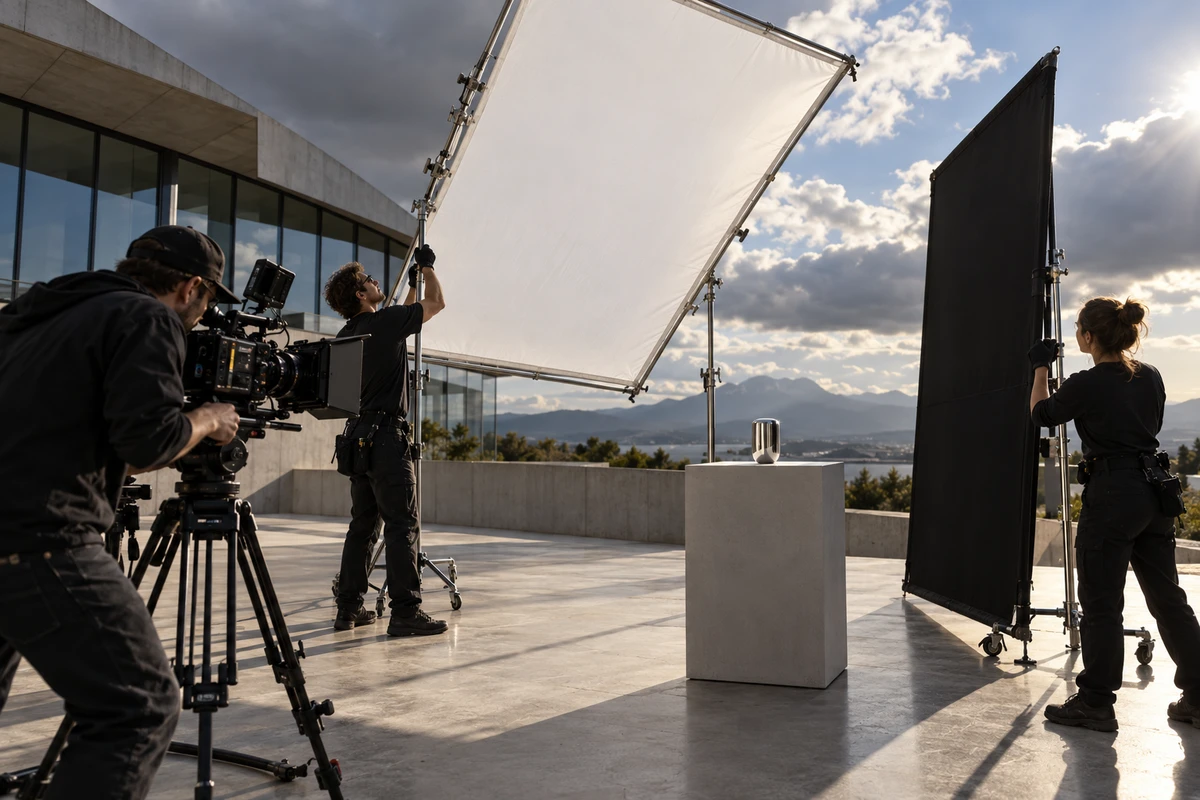
Exterior shoots rarely get an entire day of identical skies. One setup may have hard direct sun; by the next, cloud cover has lowered the contrast. Dry pavement can become reflective after a brief shower. For a brand film, the useful question is not simply whether filming can continue. It is whether the change alters how viewers understand time, character state, and product material.
Weather continuity does not mean forcing every shot to the same brightness. It protects the causal flow of a scene: why a person is here, whether an action still connects, whether the product remains visually consistent, and whether the mood suddenly feels like another day. When those relationships are clear, changing weather can carry the story. When they are not, it becomes a costly reason to reshoot.
Decide whether the weather changes in the story or only on set
When shots show the same place, action, and moment, viewers assume only seconds or minutes have passed. A sudden change in light direction, shadow edge, squinting, or ground condition can break that assumption. If the sequence is meant to span time, however, moving cloud, stronger wind, or wet pavement can make that passage visible.
Continuous action needs restrained variation
An action such as lifting a product, turning, or walking through a doorway may be split across several angles. Protect its light logic. If a strong rim light appears behind the performer in the wide shot and vanishes completely in the reverse, viewers may not name the problem, but the moment will feel disconnected.
Between sequences, weather can carry time
A progression from morning preparation to an evening finish does not need perfectly matched weather. Changes in ambient brightness, window color, and environmental sound can communicate elapsed time more naturally than a caption. The key is to place the change between sections, not inside an unfinished action.
Four details reveal continuity problems first
Shadow direction and hardness
Direct sun creates directional shadows with clearer edges. Cloud cover softens or removes them. Shadows often expose a mismatch faster than the sky because they sit directly beside the performer and product. Record the key-light direction and check the floor, walls, and tabletop before changing angles.
Reflections on the product
Metal, glass, and glossy plastic carry the sky and surrounding set in their surfaces. Overcast light produces broader, softer reflections; direct sun creates smaller, harder highlights. Exposure correction alone cannot make them identical. When the product is the subject, monitor highlight shape, black density, and environmental reflections, then rebuild a stable reflective environment with diffusion, negative fill, or flags when needed.
The body reacting to weather
Hard light makes people squint, tighten their faces, or turn toward shade. Wind changes hair, wardrobe, and even speech rhythm. Weather changes performance as well as exposure. A relaxed reaction shot following a setup where the performer was fighting direct sun can feel more discontinuous than a small brightness shift.
Ground, foliage, and atmosphere
Wet reflections, moving leaves, and distant haze can be harder to fix than the sky. When a wide shot establishes the full environment, later close-ups need to respect the weather state it created. Related creative approaches include building off-screen space with sound and eyelines and using gait to shape brand personality.
Plan switchable scene logic, not just a forecast
A forecast helps schedule the day but cannot guarantee stable light by the hour. In the storyboard and call sheet, mark three groups: continuous actions that must share one light state, independent shots that tolerate soft variation, and transitions that can actively use a weather change.
Shoot the hardest-to-match action group first instead of following shot numbers mechanically. A move from outside through a doorway should treat the exterior, threshold, and interior reverse as one continuity unit. A tabletop product demonstration should finish all critical angles before the light changes. Independent cutaways and environment details can wait for unstable periods.
Overcast and direct sun do not need to imitate each other
Many on-set problems begin with an unrealistic goal: making overcast conditions look sunny, or turning hard midday light into a soft morning. Local lighting can reshape a face or product, but it cannot simultaneously change the entire sky, distant architecture, ground reflections, and wind.
There are three practical choices. Finish the action group inside a stable weather window. Reframe to remove the unstable sky and control the main subject. Or accept that the weather begins a new section, place the change at a scene turn, and add a transition that makes elapsed time legible.
Editing can bridge a change, but it cannot make every decision
Close-ups, reaction shots, sound bridges, and brief environmental images can carry viewers across a weather shift. A look out of frame, a cut to leaves moving in the wind, and then a darker next section can read as the world progressing. The same principle appears in the use of off-screen space in brand films.
If two shots directly continue the same action while product highlights, shadow direction, and performance all contradict one another, grading can only reduce the mismatch. The most efficient solution is to reconsider the story connection: choose a different edit point, establish believable elapsed time, or reshoot the essential action.
Grade for a shared viewing experience, not identical weather
Color grading can align white balance, skin tone, black levels, and overall contrast so different weather states belong to one visual system. It should not turn every overcast layer into false sunlight or flatten direct sun until it loses direction. Preserve each condition while keeping brand colors, skin, and product materials from drifting without meaning.
Review the action group once without music. If behavior and information lead while the weather remains background, the change can usually stay. If attention jumps first to a disappearing shadow, a bright sky, or a shifting product color, the edit, local correction, or key shot needs more work.
Let weather express brand character
Soft overcast conditions can support intimacy and everyday realism. Hard sun can emphasize energy, outline, and speed. Reflections after rain can add depth to an urban setting. These are not fixed formulas. Weather works when it speaks the same language as performance, product use, and sound.
The final test is not whether every shot appears to happen on the same afternoon. It is whether viewers believe the shots belong to one experience. Light may change, time may pass, and the environment may feel alive. When the change appears in the right narrative position, it stops looking like a mistake.
Put weather decisions into the production plan
If your brand film includes exteriors, reflective products, or filming across several parts of the day, define continuous action groups, acceptable weather states, and alternate angles before the shoot. ONCE can connect storyboards, lighting strategy, on-set scheduling, and post-production transitions into one production approach. Share your brand-film brief with ONCE to discuss the creative and production plan.