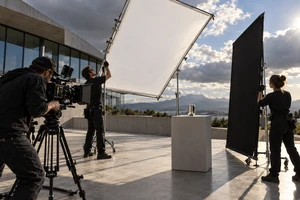
In a corporate film interview, an employee hears a question, stays quiet for a second, takes a breath, and then answers. People on set often worry that this blank space feels inefficient, and editors can remove it almost automatically. Yet when every answer starts at the exact instant a question ends, the speaker can sound rehearsed. Keep every pause at full length, however, and the film loses momentum.
Interview pauses are not one thing. A pause can signal memory, judgement, emotion, uncertainty, a forgotten term or a wait for direction. The editing task is not to eliminate silence. It is to identify which silence helps viewers understand the person and which simply consumes time.
First understand what the pause is expressing
A memory pause gives the answer a source
When an employee answers a question such as “What happened at the hardest point of the project?”, their gaze may drift briefly and their breathing may slow. They are searching for a particular experience. The pause tells the viewer that the answer comes from memory rather than a brand handbook. It does not have to remain at full length, but deleting it completely can remove the feeling of remembering.
A judgement pause lets the speaker own a view
Before answering “Why did you decide to reject the first version?”, the speaker may need to weigh the wording and decide how directly to state the judgement. Half a beat before the conclusion makes it feel considered. Joining the two sentences without space can reduce a complex decision to a slogan.
An emotional pause needs restraint
Discussions of failure, pressure, client trust or team change may bring swallowing, blinking or altered breathing. Do not extend this silence merely to make the film more moving, and do not rush to let music explain the emotion. The test is whether the pause still belongs to the speaker's voluntary expression or has entered discomfort. The interview team should protect the person instead of treating vulnerability as usable footage.
A correction pause can usually be compressed
Restarting a sentence, searching for a technical term or reacting to a noise is usually an expression fault. Removing it often preserves meaning. But breath and body continuity still matter. If the edit deletes silence while leaving a sudden head movement, half an inhale or a jumping hand gesture, viewers still feel the cut speaking on the person's behalf.
The interview must first allow an answer to slow down
Many unnatural pauses do not happen because the employee cannot speak. They happen because the crew fills the silence too quickly. The interviewer adds an explanation, or the director says “take your time” after half a second. Before the speaker can enter a memory, their attention has already returned to the set.
A better interviewer finishes the question and maintains a listening posture without nodding urgently or looking down at the next prompt. When the speaker knows the interviewer is still present, a second of thought feels permitted. Camera placement also affects pressure. Looking into the lens feels like a direct address; looking toward an interviewer feels like conversation. Both can work, but they create different kinds of silence.
Specific questions create pauses with content
“Tell us about our culture” invites a polished line that requires little thought. “The last time the team disagreed, who changed their mind and why?” sends the speaker back to a time, an action and a relationship. The resulting pause carries content because the person is selecting an experience.
Follow-up questions can trace what the speaker first noticed, what they did and why their judgement changed. Do not pack five brand values into one prompt or hide the desired answer at the end. Our video production guidance treats employee stories as evidence of how work actually happens. Pause design focuses on how one person moves from that evidence to a conclusion.
Edit the intention, not necessarily the original duration
A two-second thinking pause can become half a second in the finished film while preserving the structure of thought before speech. What matters is whether action and meaning remain continuous. Editors should hear the full answer first, then mark the end of the question, the first inhale, the true beginning of the answer and the final conclusion. A pause only reveals its function inside the whole statement.
Mid-sentence pauses also deserve individual judgement. In “We planned to continue the launch ... but the test results did not support it,” the space carries the turn. Closing it completely weakens the decision. By contrast, fragmented gaps around repeated filler words can be shortened when they add no expression or new information.
B-roll should carry thought instead of hiding every cut
Work footage often covers interview jump cuts, but cutting away whenever a pause appears prevents the speaker from ever fully occupying the scene. A stronger rhythm lets the viewer see the beginning of recall, then moves to the workplace when the answer becomes specific. B-roll becomes evidence for the answer rather than a patch for the edit.
If the speaker describes an equipment test, the film can enter that footage as the operation begins and return to the face when the conclusion arrives. Off-screen information can also expand the scene without erasing the speaker; our article on sound, eyelines and off-screen space explains that wider relationship. Leaving the face does not mean deleting breath or sentence structure from the soundtrack.
Sound should not be denoised into a vacuum
Interview pauses usually contain air conditioning, machinery, distant voices and clothing movement. Heavy noise reduction can make the gap absolutely silent before the room suddenly returns with the next sentence. The sound cut then becomes more obvious than the picture cut. Record stable room tone on location and use it to connect answers while keeping breath at a natural proportion.
Audible breath is not automatically more truthful. A lavalier close to the mouth may make every inhale sound anxious. A boom microphone preserves more space but also more environment. The mix should make the person feel continuous in one room, not make each breath perform. Music should also avoid rising automatically in every pause, which makes emotion feel directed from outside.
Bilingual versions must preserve the same path of thought
A short pause may separate two ideas in Chinese, while English subtitles need a different line break because the syntax changes. If the subtitle reveals the conclusion before the speaker says it, the viewer reads past the pause. Translation should preserve the order of question, thought and conclusion without copying every millisecond mechanically.
Dubbing can make every sentence complete and evenly paced. When the value of the original comes from a real employee thinking, keep the original voice with subtitles whenever possible. When dubbing is necessary, let pauses follow semantic turns rather than filling every second of the source. The timing may change across languages, but the character's reasoning must not.
Compare two edits to judge whether a pause works
During the rough cut, keep two versions of the same answer. Make one tighter, retaining only half a beat before the conclusion. Make one looser, preserving recall, breath and expression. Compare more than runtime. Ask whether viewers can tell that the person thought, where the conclusion came from and whether the film still moves forward.
If the tight version sounds memorised, the edit removed the relationship between thought and speech. If the loose version makes viewers forget the question, it preserves too much process. The best pause does not announce that a second of silence exists. It makes the answer feel owned by this particular person.
Design corporate interviews around real expression
If your corporate film includes employees, founders or clients on camera, ONCE can connect questions, camera position, interview direction, B-roll and bilingual editing into one clear rhythm. Explore our corporate video production work, or send ONCE your interview brief.