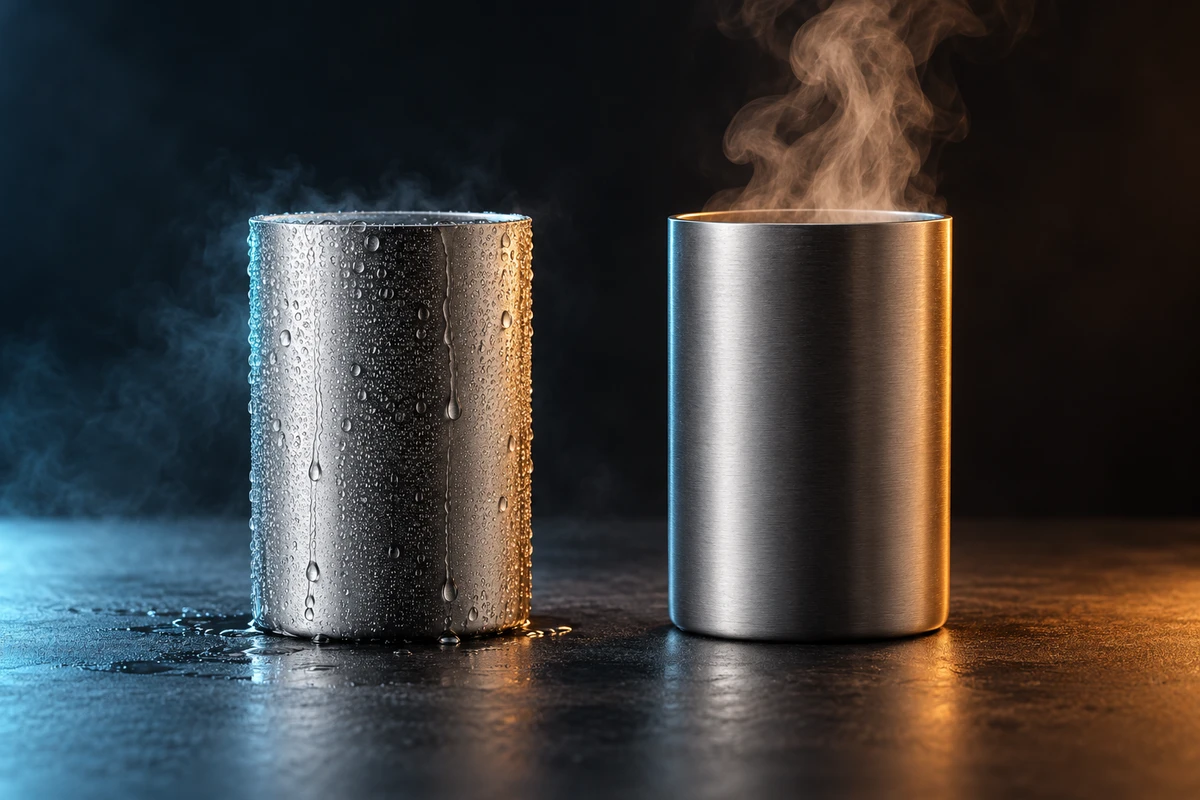
A bottle covered with uniformly sprayed droplets may look freshly washed rather than cold. Steam that appears everywhere around an appliance may read as an effect rather than heat. Temperature in product advertising is not a color grade. It is a causal chain: the product enters a state, the environment reacts, a person responds, and the state changes over time.
When that chain holds, viewers can feel temperature before a caption tells them what to feel. It also sets a useful production boundary: atmosphere may clarify an experience, but it must not invent product performance.
Temperature is a relationship, not a palette
Blue can suggest coolness and amber can suggest warmth, but color only points in a direction. It does not prove that a product is cold or hot. A 2023 study in the Journal of Business Research found that cold-associated background imagery influenced the perceived newness of modern products. A 2024 review of temperature and consumer behavior likewise describes crossmodal associations between color, lightness, and thermal sensation, while stressing that effects depend on product type, comfort, and context.
For production, a more useful model is a four-part temperature chain:
- source state: what is actually cooled or heated: the product, liquid, container, or surrounding air;
- environmental reaction: condensation forms, vapor disperses, material softens, or light changes;
- human action: touch, grip, distance, breath, and timing acknowledge the temperature;
- temporal continuity: droplets grow and move; vapor forms, drifts, and dissipates instead of holding one beautiful shape in every frame.
Break one link and the audience sees an effect before it feels the product.
To photograph cold, ask where the droplets came from
Condensation does not leak out of a cold bottle. NOAA explains that when air contacts a surface below its dew point, water vapor from the air condenses on that surface; humidity affects how much water is available to condense. That mechanism should shape the details of a cold product shot.
Droplets should relate to temperature difference, material, humidity, and exposure time. Tiny beads merge, gravity pulls irregular tracks downward, and labels, seams, grooves, or touched areas interrupt the pattern. A styling mixture may extend a shooting window, but scale, direction, and change still need to resemble one physical process.
This is why “wetter means colder” often fails. Large perfect beads can look like styling fluid. Uniform frost without a plausible condition can turn a chilled drink into a frozen product. A more convincing shot can begin with a clean surface, let fine condensation appear in side or back light, then use a hand, a wiped patch, and moving droplets to carry coldness into action.
To photograph heat, keep vapor attached to its source
Vapor first needs to answer a simple question: where does it come from? Heat above a drink should originate at the liquid surface. A garment steamer should connect vapor to its outlet and operating direction. Kitchen-appliance moisture must respect the product structure and airflow.
Lighting should separate vapor from the background, not merely turn it white. Side-back or back light can give fine droplets an edge, while the background controls whether they remain legible. Flags and cutters keep that light from washing over the product face. Godox's published product-ad case study similarly shows focused light, white diffusion, black flags, and bounced fill working together to control the beam and define product edges.
Heat does not always require more steam. Melting rate, viscosity, packaging response, and the distance a person keeps from a source can all be quieter thermal cues. The standard remains the same: source, reaction, action, and time must agree.
Human action and sound bring temperature into the body
Products do not have skin; people do. A pause before touch, a change of grip, distance from vapor, or altered breath can turn an abstract state into embodied experience. Too much reaction looks like acting hot. No reaction at all removes the tactile cue.
Sound can complete the inference: ice striking glass, a wipe across condensation, layered simmering, or airflow at a vapor outlet. But sound design should stay attached to its visual source. Our guide to product-video sound production distinguishes operating recordings, separately recorded or licensed effects, and the final ad mix. Temperature footage needs the same identity discipline; designed sound is not a product test.
What live action, CG, and AIGC should each handle
Live action is strongest when product contact, real surfaces, and human response matter. It forces light, moisture, hands, and the product to coexist in one physical environment. A short cold, room-temperature, and hot-state test can reveal each usable shooting window before the full set is built.
CG is useful for repeatable fluids, cutaways, and thermal diagrams, or for shots that would be unsafe to capture. But simulated vapor still needs an outlet, airflow, depth, and a coherent camera model. Control does not excuse floating effects.
AIGC is better suited to atmosphere studies, distant backgrounds, and elements that do not directly touch the hero product. Video-generation research continues to treat temporal consistency as a central problem: a strong still frame does not guarantee that droplet positions, vapor origins, and product geometry will remain coherent over time. Review the formation, change, and dissipation of an effect as a sequence. Reserve critical product claims for verifiable live action or constrained CG.
This is adjacent to our article on product shadows and spatial credibility, but it answers a different question. Shadows explain the spatial relationship between light, product, and support. Temperature cues explain how a product state causes environmental and bodily reactions.
A vertical cut should preserve cause, not just the prettiest vapor
A landscape hero shot may take three seconds to establish temperature: product first, condensation or vapor second, human response third. In a six-second vertical cut, keeping only the densest cloud removes both source and result. The shorter the edit, the more important the smallest complete causal unit becomes.
For cold, preserve “clean surface, fine beads, pickup and moving tracks.” For heat, preserve “outlet activates, vapor rises, material changes.” A cutdown does not need every feature, but it should show where temperature comes from and what it affects.
Atmosphere can amplify a feeling, not replace performance evidence
Thermal imagery can imply product performance even without words. Water boiling in seconds, fabric flattening instantly, or a container staying frosted for an extended scene may communicate objective claims. China's State Administration for Market Regulation stated on March 6, 2026 that limits, scope, and conditions behind technical-performance claims must not be weakened into unreadable disclaimers. The U.S. FTC likewise says advertisers need a reasonable basis, before dissemination, for objective express and implied claims.
Creative temperature imagery and performance evidence can coexist, but their jobs should remain distinct. The first may express crispness, warmth, freshness, or comfort. The second, when it concerns degrees, heating or cooling time, insulation duration, or a specific result, should be tied to a model, environment, operating method, and reviewable support. A caption cannot repair a misleading image.
Let viewers feel the temperature before they read the claim
Convincing temperature comes from a complete relationship, not more effects. Condensation needs a surface and surrounding air. Vapor needs an outlet and airflow. Performance needs a source of sensation. Editing needs change over time. Color can set direction, sound can reinforce it, and CG or AIGC can extend it, but all of them must serve the same causal chain.
If you are developing an ad for a beverage, small appliance, personal-care product, food brand, or any product with a thermal experience, share the sample states, key claims, use environment, and delivery ratios with ONCE. Through our brand film and product-video production work, we can put temperature tests, lighting, action, sound, live action, and generated imagery into one storyboard instead of adding a cloud in post.
Sources
- NOAA, “Learning Lesson: Sweatin' to the Coldies.” Accessed October 26, 2026.
- State Administration for Market Regulation, notice on qualifying language in advertising. March 6, 2026.
- Federal Trade Commission, Policy Statement Regarding Advertising Substantiation. Accessed October 26, 2026.
- Togawa et al., “The temperature of newness.”Journal of Business Research, May 2023.
- Wu et al., “How Temperature Affects Consumer Behavior.”Foreign Economics and Management, 2024.
- Yan et al., “Temporally Consistent Transformers for Video Generation.” ICML 2023.
- Godox, product-ad lighting case study. Accessed October 26, 2026.