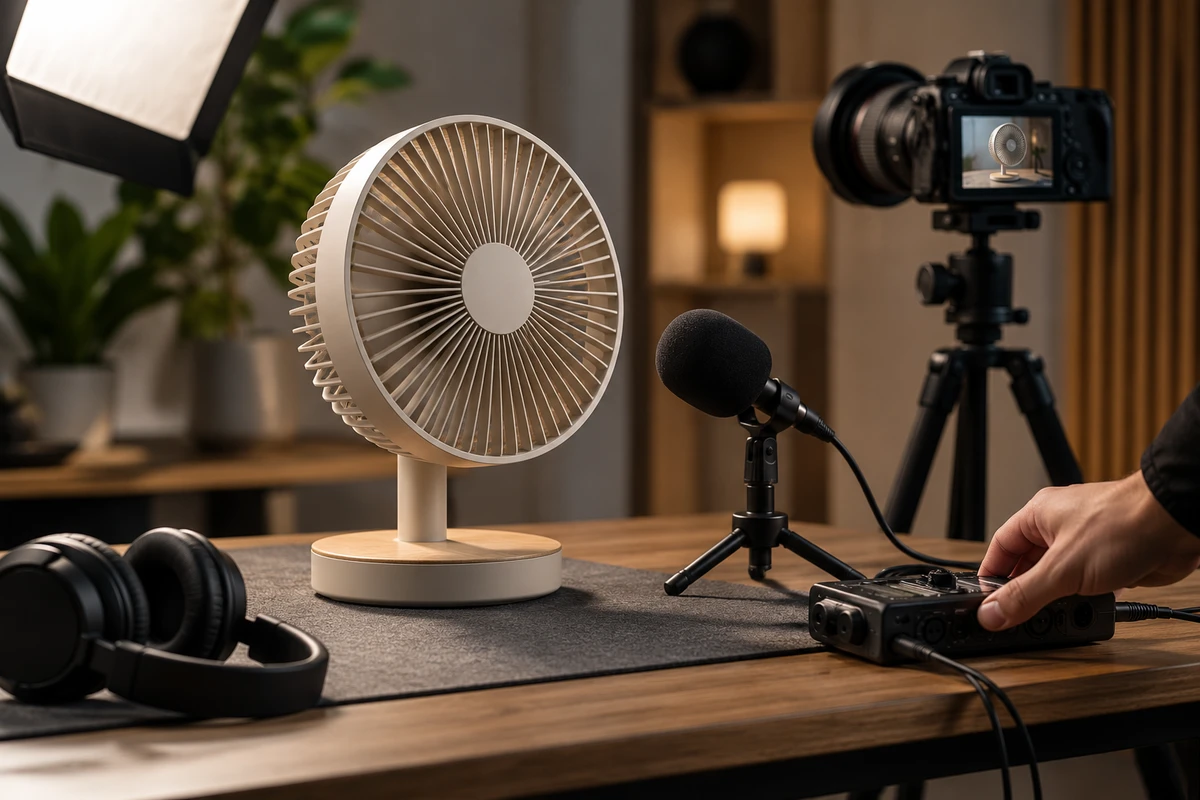
An overseas team asks for the product’s operating sound after a polished film has arrived from the China shoot. Removing the music sounds like a simple request. It may not be: the attractive slow-motion source might never have contained an audio track.
Decide before production whether sound is being purchased as creative expression, as a record of a particular product operation, or both. Those jobs need different capture and handover arrangements.
Check what the recording mode actually preserves
Sony’s current ILCE-7M4 S&Q Settings guide, checked October 26, 2026, states that this mode does not record sound and that shooting time differs from the time recorded in the movie. This is a model-and-mode-specific statement, not a rule that all high-frame-rate recording is silent.
Apple’s Final Cut Pro speed guide says retimed clips preserve audio pitch by default. An apparently unchanged pitch therefore cannot, on its own, establish that a file remains an unretimed location recording.
These are practical implications of current documentation, not a new industry announcement. Confirm the equipment and workflow actually being used, then inspect a real test file.
ONCE’s three-part sound handover
The following is an original production proposal, not a manufacturer standard or a completed ONCE customer test.
The operating record answers what was captured from this sample during this operation. Keep the action and audio identifiable, with the sample, operating state, recording position and relevant environment documented. Preserve the unprocessed original and identify adjustments to any listening copy. Renaming a silent clip cannot create that missing record.
The sound-assets package contains separately recorded details or licensed effects for creative use. Identify their source and permitted use. A later recording of the same product can be useful, but it is not synchronous audio from the earlier slow-motion take.
The advertising mix combines the approved elements into the story. Music, voiceover and designed effects can have legitimate roles. Review their creative suitability, permissions and product implications; “more satisfying” and “more authentic” are not interchangeable acceptance criteria.
Not every project needs a public sound library or all three packages. But if the buyer needs to assess actual operation, name the person responsible for obtaining the first. A finished mix alone may not permit its sources to be reconstructed later.
Test the file, not just the microphone connection
Record a short test in the intended production mode and import it through the actual editing workflow. Is there an audio track? What does it contain? How does it correspond to the picture? Recheck affected elements when the mode changes. For independent recording, agree the synchronization or identification method rather than assuming a nearby recorder completes the job.
Consider a fictional desk-fan brand wanting both elegant slow motion and an operating-sound reference for its overseas team. Capture an identifiable operation under agreed conditions before developing the slow-motion sequence and creative mix. A designed air sound is not evidence of what that sample emitted. No actual customer or acoustic test is assumed.
RevvyScales’ product-demo guide, updated October 18, 2026, also advises preparing a suitable recording environment when the product’s own sound matters. Only that production advice is adopted here—not its legal, platform or effectiveness generalizations.
The purpose of documenting the environment is to make the material interpretable. Identify possible contributions from ventilation, crew or other equipment, and state what the recording can and cannot answer.
Keep processing visible
Review the original record, adjusted listening copy and advertising mix separately. Identify retiming, replacement, layering, removed state changes and altered relationships between sound and action. Agree what counts as unwanted noise before accepting a broad instruction to clean everything up.
If only the final mix survives, removing music does not guarantee recovery of the complete original product recording. Any attempted reconstruction should be labelled honestly.
Nor does an ordinary production recording establish a noise rating, superiority over a competitor or an identical listening experience for every customer. Recording equipment, settings, position, environment and playback level affect what is heard. Acoustic performance conclusions need separately agreed methods, conditions and appropriate professional measurement. A shoot-day reference is not certification.
Scope capture as well as finishing
The brief can begin with two statements: which sounds need an actual record, and which serve creative expression. Then scope testing, location or independent recording, detail pickups, asset permissions, editing, mixing and documentation. Buying slow-motion imagery does not automatically include corresponding sound.
For a continuing content service, the potentially useful asset is the relationship between sample, state, recording conditions and approved use—not an anonymous folder of premium-sounding effects. Its economics still require real project records. Advertising sound can be richly designed while operating records retain their distinct identity.
Sources checked October 26, 2026. Precise publication dates were not established for the current Sony and Apple documents. The original AI cover is conceptual, not customer production or acoustic testing.