A furniture launch film made in China can show exactly how a sideboard complements a room—and still leave an overseas buyer unable to prepare for delivery. Does it arrive assembled? Which cartons must travel upstairs? Who can assess an awkward turn?
Commission delivery-preparation content as a distinct job. Its useful outcome is not a universal promise that the piece will fit. It is a buyer who knows what information to collect and where to send unresolved questions.
A room measurement is not a delivery-route assessment
CB2’s current How to Measure guide asks customers to measure doorways and hallways along the route and consider ceilings, fixtures, interior walls, stairwell banisters and turns. The guidance extends beyond comparing one doorway with one furniture dimension.
The Home Depot Canada’s Appliance Delivery FAQ likewise separates the destination space from delivery access. Its appliance preparation guidance is relevant to the distinction, not a furniture standard. Do not transfer its service commitments or numerical clearances to another retailer or product.
Both pages were checked on October 26, 2026; their precise publication dates were not established. These are examples of retailer guidance, not evidence of an industry-wide change.
Video-service provider Reelium’s furniture page includes arrival, box count and assembly among potential content subjects. That is a useful editorial direction. Its revenue and return-reduction claims are not adopted here.
ONCE’s delivery-readiness record
The following is an original commissioning proposal, not a moving standard or a completed customer test. For each applicable product version, connect five fields:
| Field | What production needs | What the buyer should understand |
|---|---|---|
| Shipping unit | Actual carton or assembled-unit identity and version | Which arriving object needs assessment |
| Route | Entrance, intermediate openings, turns, stairs or elevator | Which locations need measurements and photographs |
| Placement state | Approved assembly sequence and relevant removable components | Whether the demonstration concerns the same state as delivery |
| Open questions | Missing dimensions or unusual access conditions | Why a fit conclusion is not yet available |
| Responsible contact | Actual brand, retailer or delivery-team remit | Where to submit information for the next decision |
The record prevents a familiar ambiguity: the dimensions may be correct, yet describe the wrong state of the object. A carton, an assembled cabinet and a cabinet with its door open are different things to assess.
Brief the China shoot around the receiving market
For a fictional sideboard, imagine one sales version arrives flat-packed and another arrives assembled. Their finished appearance might match; their delivery explanations should not automatically share the same entry sequence. This is a hypothetical distinction, not a claim about a particular brand.
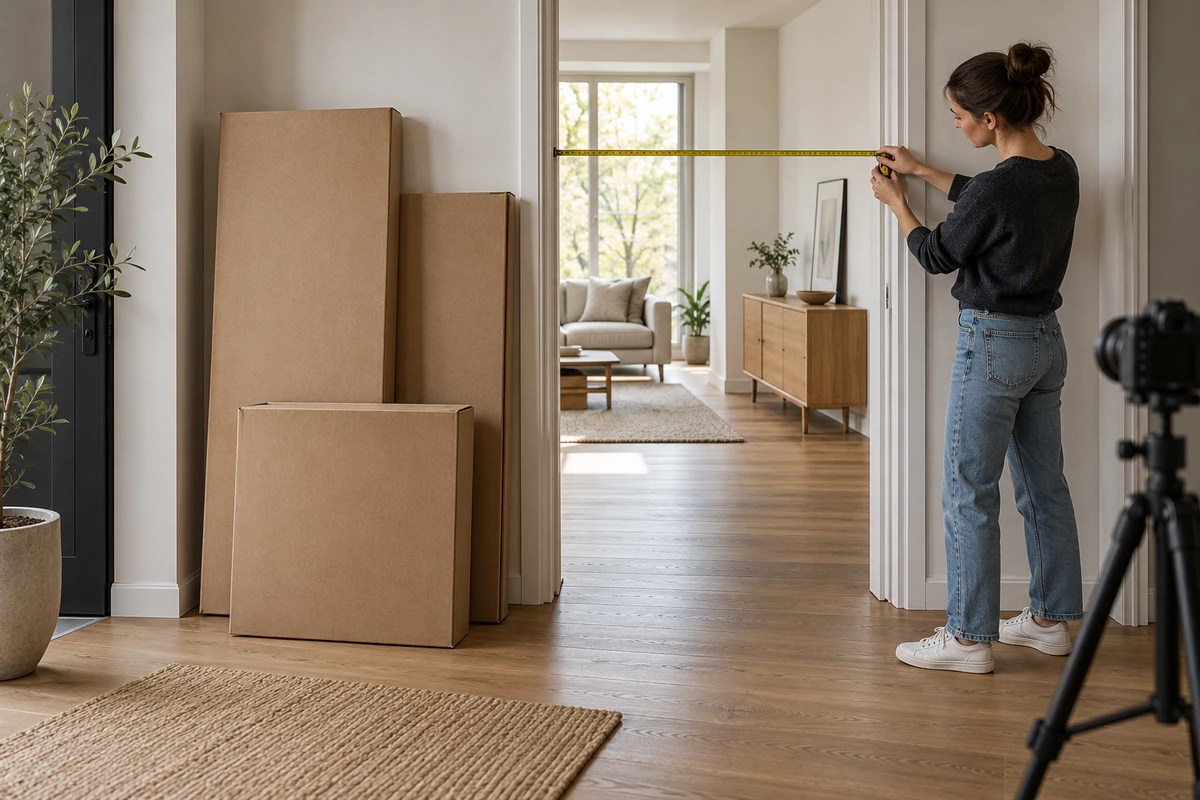
Start the shoot with the applicable arrival state. Then show where measurements begin and end, with relevant obstructions visible. Have the product owner approve dimensions, units and labelled parts before adding graphics. A tape measure in the actor’s hand is not enough if its reference points remain unclear.
Use an empty location or a clearly labelled illustration to explain route information where appropriate. Production should not improvise heavy lifting or test extreme manoeuvres for a dramatic shot. Handling, removal and permitted orientation require the relevant professionals and product instructions.
Finish with assembly or placement, while retaining the distinction between the demonstrated setting and the buyer’s home. A successful demonstration under stated conditions is not approval for every building.
Review what a viewer can do next
Ask a colleague unfamiliar with the project to use the final cut to identify the arrival state, measurement locations, missing information and escalation contact. This is a proposed internal usability check—not a test ONCE claims to have run or a delivery certification.
If the colleague knows the finished width but not whether the packaging stays on, revise the arrival explanation. If they submit only an entrance photograph, clarify the intermediate route. If they conclude that a wide doorway guarantees success, weaken that conclusion and make the assessment contact visible.
The smallest useful revision may be a short insert or a better diagram rather than a new lifestyle film. Video explains the information task; the responsible delivery team assesses the particular route.
Separate reusable instruction from changing facts
Scope a shared explanation of how to collect route information, product-specific arrival and dimensional material, and market-specific delivery terms and contacts. Approve those separately. A new fulfilment arrangement should not silently inherit a film made for another shipping state.
The estimate should name product-data review, packaging or sample preparation, filming, graphics, localization, delivery-team review and future changes. No standard price, saving or production-time claim is implied. Modular production makes sense only where actual update patterns justify it—not because more exported files look like more value.
After publication, review which details are still missing from access inquiries and which questions recur. Those observations can guide an update; without an appropriate comparison and complete delivery data, they do not establish that video reduced returns.
Furniture imagery helps a buyer imagine ownership. Delivery content should help that buyer prepare a useful question before the piece reaches the door. Purchase those outcomes separately, and make the handoff to the receiving market part of the brief.
Sources checked October 26, 2026. The original AI cover is conceptual, not a customer delivery or handling test.