A right-to-repair rule does not automatically turn every product launch into a repair-video project. The more useful procurement question is narrower: while the product, engineering sample and technical team are already available, which stable service actions are worth capturing for later use?
That distinction matters for brands sourcing in China and selling durable goods into Europe. A launch film is built to create desire and explain value. Service content must identify a product state, preserve an action sequence and remain correct after the campaign has ended. Treating those two jobs as one finished film usually makes both weaker. Treating them as two coordinated capture tracks can reduce the cost of returning to production later.
What the EU rules establish—and what they do not
The European Commission says Directive (EU) 2024/1799 on the repair of goods was adopted on 13 June 2024 and had to be applied by Member States from 31 July 2026. The obligation to repair is not a blanket rule for every physical product. It concerns products covered by EU repairability requirements and listed in Annex II, with the list updated as relevant requirements are adopted for further categories.
For covered products, the Commission describes obligations that include repair within a reasonable time and at a reasonable price, accessible information about repair services, and reasonably priced spare parts. It also explains that repair information may be made available through a website or instruction manual. A separate Commission notice published on 31 July 2026 gives household appliances and electronics such as washing machines, vacuum cleaners, phones and tablets as examples.
The rule does not prescribe one universal repair-video format. Scope still depends on the product category, product-specific legislation and national implementation. Legal, compliance and after-sales teams must make that determination. The production framework below is a way to act on an approved service requirement; it is not legal advice.
One shoot, two different content tracks
A sales track answers pre-purchase questions: What is this product? Why should someone choose it? What does successful use look like?
A service track answers operational questions: Where is the access point? Which module is replaceable? How can a technician identify the correct variant? What confirms that reassembly is complete? Which action must stop and move to an authorised repairer?
The tracks may share the product sample, set, lighting and some camera positions, but they should not share the same editorial logic. Brands planning a China-based launch can define the commercial deliverables through an ecommerce product-video production brief, then decide separately whether a service-evidence track earns a place in the same production window.
The key is to capture modular actions rather than commission one long tutorial before the technical scope is stable.
The ONCE two-track, four-shot-unit framework
1. Access
Establish product orientation, the maintenance entry point and the complete starting state. A close-up can show a latch or fastener, but a wider orientation shot is what tells the viewer where that detail sits on the product.
2. Sequence
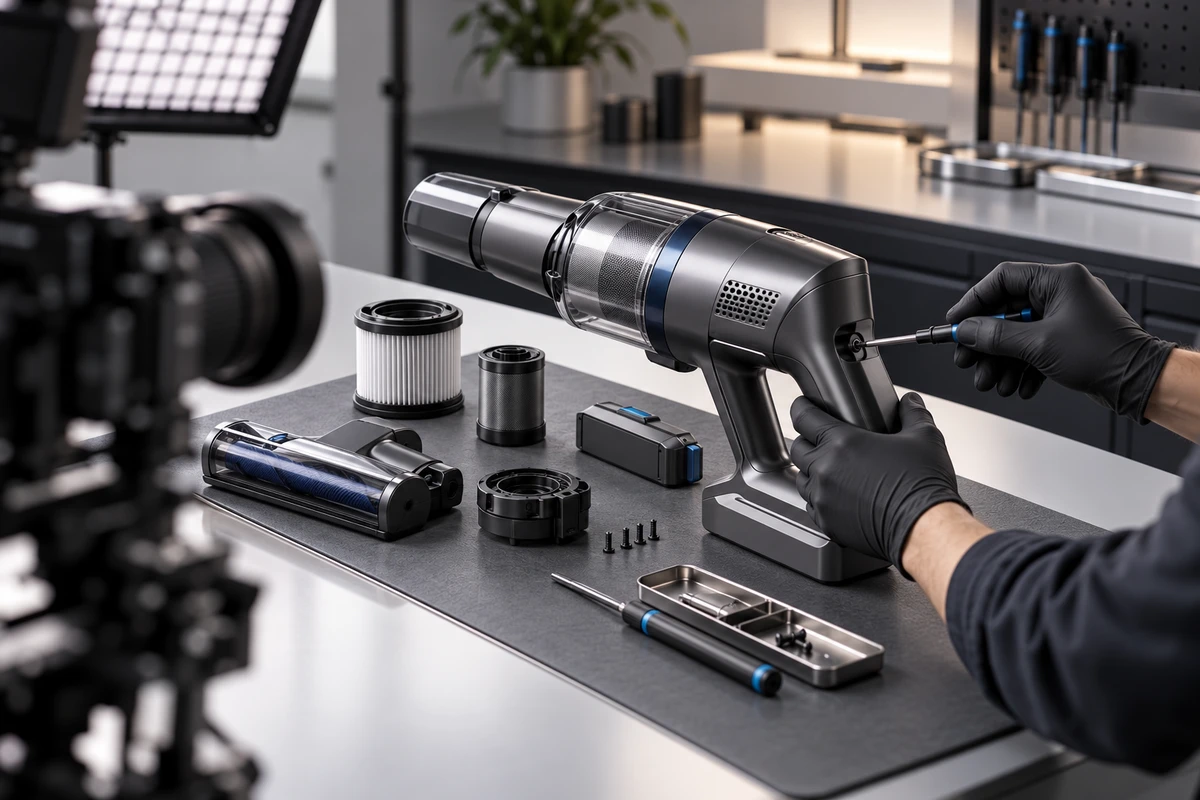
Record the approved order of actions in a continuous view, then add close coverage of hands, tools and contact points. The continuous view explains order; the close shot explains precision. If the procedure is restricted to trained personnel, the edit must not imply that it is a consumer self-repair task.
3. Identification
Capture the replaceable unit, connector orientation and meaningful model differences as independent assets. Keep part names, numbers and graphical callouts separate from the clean image. That makes a text or variant update less likely to force a full reshoot.
4. Reassembly and verification
Show the approved final state, necessary reset action and functional confirmation. Stop conditions, specialist tools and non-public procedures belong in the production exclusions before the camera rolls. They should never be improvised by the crew on set.
Every unit needs four metadata fields: model, market, intended viewer and source-document version. Without them, a clear video can become a convincing but outdated instruction after a hardware revision.
Do not publish one edit to three audiences
The highest production risk is often audience confusion rather than poor cinematography.
- A consumer version should cover only maintenance, consumable replacement and reset actions the brand has explicitly approved for consumers.
- A professional-repair version may show deeper access, but it needs the correct access controls, prerequisites and model mapping.
- An internal-training version can retain complete procedures, failure examples and inspection points; it should not become public by default.
The same source footage may support all three, but narration, warnings, captions and distribution permissions need separate approval. CGI or generative visuals can clarify an occluded structure. They must not invent a disassembly path or replace engineering verification. If a generated explanation conflicts with approved technical material, the technical source and verified physical action take priority.
A decision test before adding service capture
Service capture is more likely to justify its cost when the hardware will remain stable, the product has a long service life, the same unit ships to several markets, replaceable modules create recurring support questions, or physical motion is difficult to explain with text and still images.
It is less likely to justify a durable video when the design is about to change, all repair must happen inside a controlled facility, the procedure is not approved, or exposing the internal structure could encourage unsafe action. In those cases, controlled documents, diagrams and support channels may be more maintainable than video.
Video is not proof of compliance. It cannot replace the instruction manual, required website information, spare-part availability or the actual capacity to repair.
A procurement team can compare options without inventing an industry benchmark:
Fully loaded cost per maintained service module = (source review + incremental capture + technical approval + post-production and localisation + hosting and version maintenance) ÷ approved reusable modules.
This denominator matters. A long film with ten steps is not necessarily ten reusable modules. A module counts only when it has a stable task, a known audience, an approval owner and a version record.
Change the quote from “extra shoot time” to maintained modules
A useful brief should identify the covered model and market, intended viewer, approved technical source, prohibited steps, four shot units, technical approver, language versions, publishing location, update owner and retirement condition.
The handoff should include clean footage without burned-in labels, separate voice and caption files, shot IDs, model mapping and approval dates. This extends the same discipline used in a consumer-electronics pre-shoot fact sheet: claims, product state and visual treatment must agree before the material becomes expensive to correct.
The resulting acceptance test is not simply “Does the video play?” It is: Is the action correct? Does it match this model? Is it appropriate for this viewer? Is the approved version still current?
The durable change created by right-to-repair policy is not that every commercial becomes a repair class. It is that post-sale product information deserves the same production planning as launch content. Capture a service unit only when someone owns its accuracy and future maintenance. When that condition is absent, more footage creates liability, not an asset.