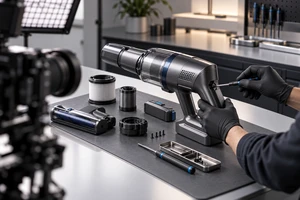
When a salesperson sends a brand film to a technical lead, the link usually arrives with context: why a scene matters, which capability it demonstrates, and what risk it addresses. When that link travels onward to procurement, finance, legal, operations, or senior management, the explanation rarely travels with it. The next viewer sees a polished factory, an abstract promise, and several specifications with no clear way to judge them.
A film built for a B2B buying group must work beyond the presentation room. Once the presenter disappears, the relationship between the problem, the proof, and the business consequence still has to survive. In other words, the film needs to be forwardable.
The first viewer is rarely the last
Recent research from the LinkedIn B2B Institute, combining an analysis of 1,000 B2B Cannes Lions submissions, a global lab study, and LinkedIn first-party data, argues that video can help buying groups with different priorities understand, share, and evaluate a brand's value. Its separate Hidden Buyer Gap research, developed with Bain, highlights stakeholders in procurement, finance, legal, and operations. They may not investigate product performance in depth, but they influence whether a vendor appears credible and safe enough to remain under consideration.
That exposes a common mismatch. Many B2B films assume the viewer already knows the project context, so they begin with a technical advantage or a sweeping brand vision. The person who receives the film later was not in the previous meeting. Before hearing another benefit, that person needs three basic answers: What problem is this solving? Why should I believe it? Why does it matter to my role?
A self-explaining shot is more than footage plus a caption
A self-explaining shot unit does not mean adding a specification to every image or turning the film into a manual. It is a small, complete chain of cause and effect: the viewer sees a problem or constraint, then observable proof, then the consequence of that fact.
A rapid montage of machinery only says, "we have equipment." Now imagine that the sequence first shows the production pressure created by frequent changeovers, then observes an operator switching a real interface and fixture, and finally lets a production lead explain what that design changes for scheduling or maintenance. The sequence can now be retold. An engineer sees the mechanism, operations sees the process change, and management sees how risk is addressed. They do not need to reach the same conclusion, but they are all following the same causal chain.
Sound carries context too. Voice-over can frame the constraint. Production sound gives the action physical credibility. An interview explains a choice. Motion graphics should reveal relationships that are difficult to follow with the eye. If these elements can still answer "what is happening?" after the salesperson's commentary is removed, the sequence has a life of its own.
Do not split one film into three unrelated stories
When several roles are involved, the obvious response is to write separate benefit lists for technical, procurement, and executive audiences. The danger is that each version becomes locally optimized but loses the shared fact. The technical cut becomes specifications, the procurement cut becomes stability and cost, and the executive cut becomes vision. Watched side by side, they can sound like three departments describing three different companies.
A stronger approach begins with one traceable fact and changes the entry point. The main film preserves the complete cause-and-effect chain: the business obstacle, the action taken by the product or team, the observable proof, and the consequence. Role-based cuts do not invent new conclusions. They enter the same chain from a different question: the technical cut reveals the mechanism sooner, the procurement cut foregrounds coordination and controllable boundaries, and the executive cut begins with the business meaning of the choice.
Public B2B production practice points in the same direction. MHF Creative argues that complex businesses rarely lack information; the harder job is deciding what matters to the buyer and choosing people, live action, product interfaces, animation, or motion design accordingly. The useful lesson is not a fixed format. It is a discipline: format should serve the communication job.
AIGC and animation can clarify meaning, not manufacture proof
Some processes cannot be filmed directly: data moving between systems, changes inside a material, or service coordination across regions. AIGC, CG, motion diagrams, and interface animation can make these hidden relationships visible and adjust emphasis for different role-based cuts.
Visibility, however, is not verification. A generated factory, a synthetic instrument reading, or an idealized operating scene can magnify misunderstanding when it travels through the account. A more credible division of labor is simple: live action and reviewable documents establish that something exists; animation explains how it works; AIGC supports conceptual transitions or visual extensions that cannot be filmed. The film language should make these roles legible instead of allowing style to blur the evidence boundary.
Run a no-explanation forwarding test on the rough cut
Do not review the film only with people who attended the brief and script meetings. Ask a colleague who knows the industry but was not part of the project to watch three context-free sections of the rough cut: the opening, the central proof sequence, and the ending. Do not explain the intended message or add sales commentary.
Then ask four questions. What problem does the film appear to solve? Which image made the claim believable? Can the viewer explain what the fact means for a particular role? If they had to forward it, which section would they send, and to whom? If the answers merely repeat a slogan, the proof and consequence are disconnected. If only the technical action remains, the business context is missing. If the viewer can reconstruct the causal chain in their own words, the film is ready to travel.
This is not another acceptance checklist. It is a writing and editing diagnosis that pulls the creative team out of the familiarity of "we already explained that" and into the information gap faced by the next viewer.
Forwardability determines how far the film can travel
The 2025 Edelman and LinkedIn B2B Thought Leadership Impact Report surveyed nearly 2,000 professionals, explicitly including both visible and hidden decision-makers. It found that hidden buyers actively discover, consume, and evaluate business content. For filmmakers, the implication is practical: the second viewer is not an afterthought. That viewer belongs in the script from the beginning.
The reach of a B2B brand film depends on more than media spend or the number of times sales sends the link. It depends on whether the film preserves its own logic every time it is forwarded. Establish the problem, make the proof observable, and show what changes as a result. To structure complex business value as a film that can travel independently, explore ONCE corporate video and B2B trust content services. If the project still needs to identify evidence shared by technical, procurement, and sales teams, see our guide to building one evidence chain for multiple B2B stakeholders.