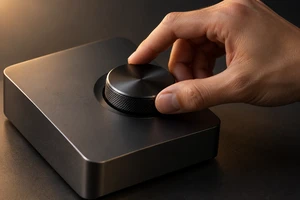
Changing the voice-over, subtitles, and packaging text does not fully localize a product demonstration. The moment a hand enters the frame, viewers see more than instructions. The hand may also point, invite, approve, hurry someone along, or establish a social relationship without the filmmaker intending it.
The useful question before production is not simply, “Which gestures are offensive in which countries?” It is: which part of this action is a product fact, and which part is social expression? The first should stay stable wherever the product stays the same. The second needs market review, a replaceable insert, or a reshoot.
One Hand Can Be Doing Three Different Jobs
Hand performance in a product ad has at least three layers, and they do not carry the same localization risk.
Mechanical action follows the product
Pressing, turning, inserting, removing, folding, and latching describe a physical relationship between hand and product. When every market receives the same product structure and feature, these actions can usually form part of a global master. They must still follow the real sample: the contact point, travel distance, and response timing cannot be rewritten just to make the shot feel elegant.
Mechanical action is not automatically universal. If a regional product has a different connector, opening direction, control logic, or safety step, the original shot is inaccurate even when it presents no cultural problem. Product teams should confirm reuse before translation teams do.
Deictic action directs attention
A finger points to a button, a hand sweeps through a sequence, or a presenter passes the product toward someone outside the frame. These actions help viewers navigate information. Their meaning can be affected by interface direction, subtitle placement, cropping, and reading habits.
Mirroring the shot is not a reliable shortcut. Product lettering, asymmetrical construction, hand dominance, and lighting can all reverse with it. The goal is not to impose one universal hand. It is to keep the gesture path, product information, and layout pointing toward the same conclusion in every version. These shots are best captured as separate inserts that can be replaced in post.
Social gesture builds a relationship beyond the product
Thumbs-up signs, waves, counting, an “OK” sign, or an open-palm invitation can communicate independently of the product. In its Designing for a Global Audience session, Apple used counting to three to show that people extend different combinations of fingers and advised designers to localize gestures when appropriate. Microsoft’s globalization guidance likewise warns that gestures and anatomical symbols may not convey the intended concept in every market.
This does not mean global advertising should remove every gesture. A more workable principle is: keep product contact truthful and make the social ending replaceable. Opening a device can belong in the universal master; the evaluative gesture that follows can be filmed in several versions or replaced with a facial response, product state, and sound.
A Three-Frame Review Decides Whether to Reshoot
Instead of maintaining an endless country-by-country taboo list, freeze each piece of hand performance at three moments.
Intent frame: What is the person trying to do?
This frame defines the narrative task. Is the person preparing to operate the product, asking the viewer to notice something, or expressing approval to another character? If the intention only becomes clear after the creative team explains it, viewers in another market have more room to infer something else.
Contact frame: How does the hand actually meet the product?
This frame checks product truth. Are the grip, contact point, force direction, and safety step accurate? ONCE’s article on turning product selling points into visible actions examines how action can communicate product value. The present question goes further: when the physical action travels across markets, can the social meaning before and after it travel too?
Interpretation frame: What remains after the action ends?
Turn off the subtitles and narration. Look only at the held hand shape, gaze, and product state. If the result depends on recognizing one cultural symbol, the shot should not carry essential information alone. W3C’s supplemental cognitive accessibility guidance recommends that symbols convey a single meaning and that designers remain aware of cultural differences. In advertising, that suggests confirming the key benefit through the product result, sound, or concise copy as well.
If all three frames remain stable, the shot is a strong candidate for the global master. If the contact frame is stable but the interpretation frame is not, keep the operation and replace the ending. If all three depend on local habits, design market-specific coverage in the storyboard rather than expecting post-production to rescue it.
Build One Shoot Around Replaceable Layers
Gesture localization does not require remaking the full commercial for every market. A more efficient production separates an action into combinable layers.
The first is a neutral product master. It contains only the hand and product needed to complete the task, avoids evaluative gestures, and clearly shows contact points, brand information, and the result.
The second is a market-facing character layer. It covers how a person invites, confirms, celebrates, or hands the product to someone else. It can vary the performer, dominant hand, amplitude, and interaction distance, or omit a gesture entirely.
The third is a direction and layout layer. Any shot pointing toward a button, price, subtitle, or interface is captured separately. The shoot protects safe areas for landscape, vertical, and square formats while recording which elements can be mirrored and which must never be reversed.
The brand then owns more than a finished film that merely looks global. It owns a clear asset system: some shots prove how the product works; others help the interaction feel natural in a particular market.
Accessibility Belongs Inside the Action Design
A gesture can be culturally neutral and still be difficult for some people to perform or understand. Hand dominance, joint mobility, limb difference, and movement speed can change a performance. Meta’s gesture design guidance uses reliability, comfort, and intuition as core criteria, calls for testing with a broad set of users, and advises against culturally inappropriate gestures. Although the page addresses hand-tracked interaction, the design lesson transfers: a product film should not frame one complex hand pose as the only correct way to use a product.
Production can capture left- and right-handed versions, different grips that reach the same result, and product-result shots that remain understandable without the gesture. This increases casting and editing flexibility while avoiding the suggestion that one body movement represents every user.
AIGC Can Replace a Background, Not Local Interpretation
AI can extend a frame, replace a location, or generate a market-specific character shot. Yet a plausible-looking hand does not guarantee that the action communicates the right idea. The ACL 2025 paper Mind the Gesture introduced 288 gesture-country pairs across 25 gestures and 85 countries, then reported substantial limitations in how the evaluated model types handled gestures across cultures. The authors also state an important boundary: the dataset focuses on offensive gestures and does not cover every gesture meaning or sign-language system.
An AI-assisted hand shot therefore needs two reviews. The production team checks anatomy, product contact, and temporal continuity. A reviewer familiar with the target market checks the action’s meaning, social relationship, and use context. A model can propose a version; it cannot be the final witness for how local viewers will read it.
Put Localization in the Storyboard, Not Only the Subtitle File
Global product advertising does not need identical hands. It needs viewers to reach the same truthful understanding of product value. A shot belongs in the global master when the product structure is unchanged, the action path does not depend on one cultural reading, and another visual or audio cue confirms the result.
In the brief, label each hand shot with three fields: product invariant, social-expression variable, and target-market reviewer. If you want to apply this method to storyboards, live-action production, and versioned assets, explore ONCE’s global marketing video work and services. Bring the target markets, product versions, channels, and known cultural requirements so the team can decide what to share and what to reshoot before the camera rolls.