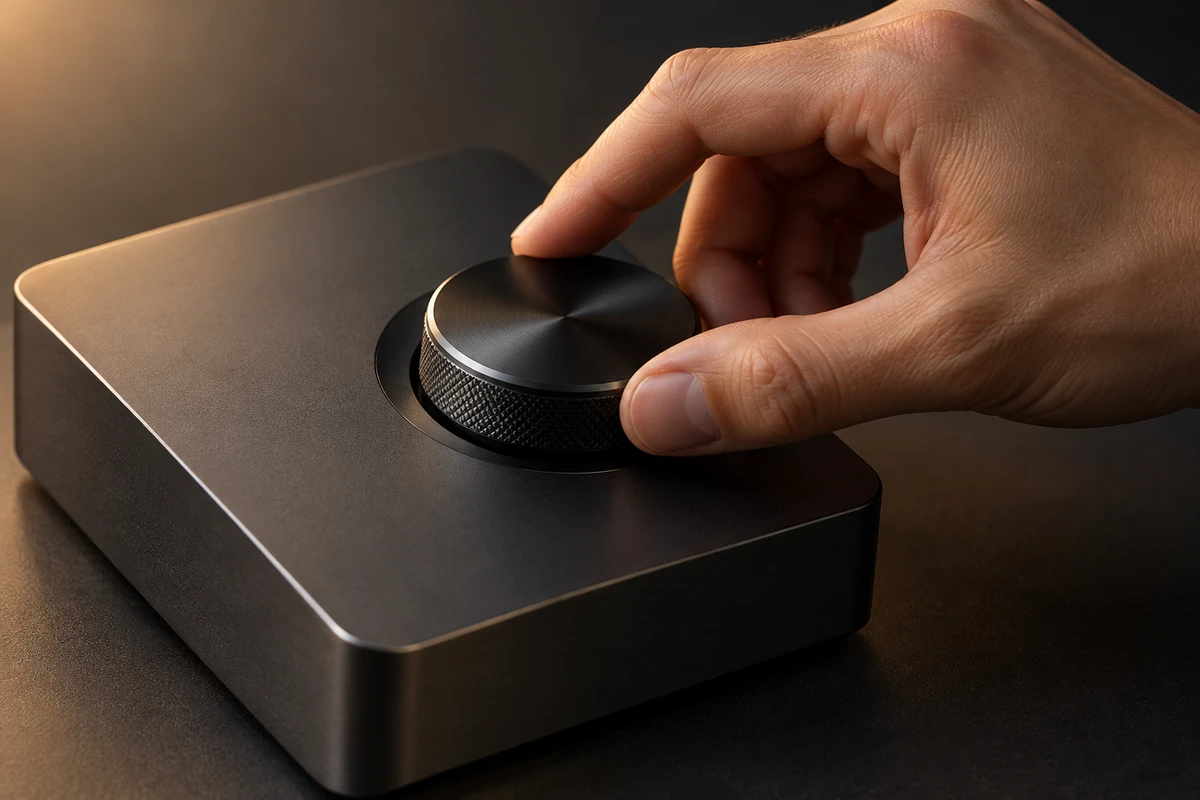
Two hands can turn the same dial, yet one shot makes its detents feel precise and its resistance substantial while the other looks like a performer is tracing a circle in the air.
The difference is rarely just beautiful casting or slower movement. Viewers cannot feel how much force reaches the fingertips. They infer it from indirect evidence: when the fingers begin to work, when the product starts to move, and whether the object springs back, settles, or keeps wobbling after release. Hand performance in a product ad is useful when it translates feedback that can only be felt into a visible and credible relationship.
The hand is a reference for force, not a premium prop
Five experiments on observing and performing lifting actions found that people use movement information to judge an object's weight. A 2024 study of object handovers also reported that available weight cues help receivers anticipate grip and load forces. Neither study is an advertising formula. Together, however, they support a practical observation: viewers read more than the distance an object travels. They also read how a hand prepares for that movement.
Making an object feel weighty does not require an exaggerated grimace or a theatrical drop. Smaller cues are often more credible:
- Before the lift, does the palm complete its grip and establish a stable opposition between thumb and fingers?
- As the product leaves the surface, do the wrist and forearm absorb the change, or do the fingertips float upward as if the object were empty?
- At the destination, is there a real adjustment that allows the object to settle?
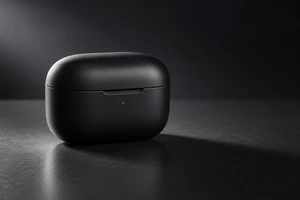
These are not fixed acting rules. A lightweight earbud case, a metal appliance and a tool case should not share the same grip logic. The performance has to answer to the real sample, not to a generic idea of elegance.
A believable interaction needs three cues to agree
A mechanical action becomes readable when three forms of evidence support one another.
Input: when does the hand begin to work?
If a dial rotates before the fingertip has established pressure, the surface appears frictionless. If a hand stays completely relaxed while a magnetic lid behaves as though it strongly resists opening, the apparent resistance lives only in the sound design.
Visible force does not mean excessive force. It may be a slight compression of the fingertip, a change in joint angle, or a wrist establishing leverage just before the product moves. The shot needs to preserve the order: input first, response second.
Response: where does the force go?
Weight, rotational resistance and closure feedback are different events. A lift is read through the relationship between the centre of mass and the arm. A dial is read through the correspondence between fingertip travel and angular change. A button may depend on travel, bottoming out and return.
When a shot shows an attractive hand but hides how far the product moves, rotates or compresses, the viewer receives an atmosphere rather than usable product information. A 2022 experimental study of online product presentation videos distinguished appearance videos from usage videos and found that usage information could improve perceived diagnosticity and mental imagery. Its scenario experiments used a limited set of products and a largely student sample, so the findings should not be turned into a universal conversion claim. The more careful creative takeaway is simpler: when a selling point depends on interaction, the result of the interaction must be legible.
Settling: what does the product say after the hand stops?
The half-second after release may reveal more than the turn itself. Does the dial stop exactly at its intended position? Does the lid rebound? Does the body rock because the tabletop absorbed the force? Each result changes the reading of substantial, smooth or loose.
Cutting away at contact, or using a speed ramp to skip the settling phase, removes the product's opportunity to show its own feedback. Slow motion can help only when the production knows what it is enlarging: fingertip loading, component travel, or the final return. For a related discussion of pace rather than mechanical force, see Product Ad Hand Performance: Calm Is Not Slow Motion.
Camera, edit and sound cannot manufacture performance
The hand establishes input. The product supplies a response. The camera must preserve both. Once those roles are reversed, the film can start inventing a feel that the product does not possess.
Frame the contact point and the product's movement before deciding how macro the shot should be. An extremely tight crop may show a fingertip while hiding the reaction of the product body against the table. Very shallow focus can reduce the response to an attractive blur. The edit should protect causal order and avoid combining input from one take with response from another to create an interaction that never happened.
Sound can confirm a bottoming-out point, latch or detent, but it should not carry substantiality by itself. A heavy low-frequency hit under a visibly effortless gesture exposes the disagreement between picture and audio. First check whether the action reads with the sound muted. Then use sound to reinforce feedback that already exists.
Performance cannot add resistance the sample does not have
More visible exertion does not automatically make a product feel more premium. If a light lid is performed as though it has strong resistance, the shot may imply stronger magnets, a damped hinge or a more secure closure. Without specifications or testing to support those implications, the effect is not merely a matter of acting style.
The US Federal Trade Commission's Policy Statement Regarding Advertising Substantiation says advertisers should have a reasonable basis before disseminating express or implied objective claims. This is US guidance, not a substitute for legal review in China or any other market. Its production lesson travels well: movement, sound and editing may communicate a performance claim even when the script never states one.
During rehearsal, keep three notes separate: what the sample actually did, what the performer changed to make it visible, and what a viewer might infer from the final shot. If the third column exceeds the first two, revisit the sample, framing or copy instead of asking for a bigger performance.
An invented dial, from attractive to readable
Imagine an unbranded desktop controller with no confirmed performance specifications. The creative team wants its dial to feel clearly indexed, but the current sample has only been verified to rotate; detent force and durability have not been established. This is a hypothetical method example, not a product claim.
In the first version, a hand enters, the index finger brushes the dial, a loud click plays, and the film cuts to a beauty shot. It is efficient, but the image never shows whether the sound comes from the mechanism. The hand and dial have no visible force relationship.
In the second version, the thumb and index finger establish a grip. The shot preserves a brief loading moment before rotation, then keeps fingertip travel and the changing index mark visible together. After the turn, it waits long enough to show whether the dial rebounds or settles. If the sample has no clear detent, the film does not add a click; the message changes to a verifiable angle or control path.
This is not simply a slower move. It gives every visible result a real cause.
AI hand-object shots need a contact review
Fine hand-object interaction remains a specific challenge for generated and machine-interpreted video. The CVPR 2026 HanDyVQA benchmark evaluates both manipulation and the effects of manipulation. That distinction is useful for production: a hand can look plausible while the interaction is still wrong.
AI can help with previsualisation, environments and pacing tests. Shots involving magnets, latches, dial positions or real weight should still be checked frame by frame for contact position, finger shape and count, product structure, direction of travel and the settling result. When the selling point depends on accurate mechanical feedback, filming the real contact and using AI for the environment or extensions is often the safer creative division of labour.
Film one silent, ordinary interaction first
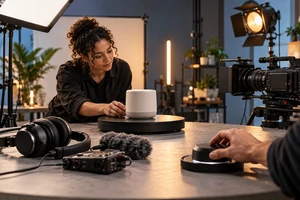
Before designing a premium gesture, ask someone familiar with the product to complete one ordinary interaction with the real sample. No slow motion, no added effects, no effort to make the hands look graceful. Preserve that silent reference. Then decide which force relationships the camera should enlarge and which details must remain unchanged.
The hand should not perform qualities the product does not have. Its more valuable role is to make invisible mechanical feedback traceable. If your next product film needs to communicate weight, closure or resistance, ONCE can help assess the real sample action, camera tests and bilingual adaptations. Explore our video production and brand content services, and bring the product together with the claim the film needs to support.