Making a hand movement feel unhurried does not require stretching every lift, turn, and release. A person who is not rushing, a film playing in slow motion, and a shot held so people can inspect a detail are three different things. Hand performance in product ads can lose its everyday credibility when all three become one uniform slowness.
A hand approaches a pen slowly, continues moving slowly after touching it, and finally leaves the frame slowly. Any single frame might look attractive. As a sequence, however, the movement may seem to be waiting for the camera. The performer is not necessarily the problem. The brief may have assigned the same display task to every moment.
Moving slowly on set is not playing footage slowly
When a performer deliberately slows down, the behavior on set changes. Where the hand waits, when the grip adjusts, and when the action continues all become part of the performance. Examining a new object and reaching for a familiar possession can have different rhythms. The same slow gesture cannot establish both relationships simply by giving them a consistent style.
Slowing footage changes viewing time. Adobe's official guide to changing a clip's frame rate explains that reinterpreting frame rate changes playback and duration. This helps separate two requests: “pick it up more slowly” and “we want to play this pickup more slowly” are not the same direction.
Creatively, the latter can expand an action that has already occurred. The former asks the performer to reorganize it on set. If the reach, contact, and settled grip already contain unnecessary waiting, slowing the whole clip will not give that waiting a reason. Conversely, an everyday action does not necessarily benefit from being slowed throughout. A fluent movement can become a solemn presentation.
Deliberately slow performance is not inherently wrong. Precise positioning, coordination with camera movement, or an intentionally ceremonial style can all justify choreography. The important distinction is that a designed presentation is not automatically a record of ordinary use.
One pen can contain more than one rhythm
Imagine an unbranded pen with a cap in a fictional advertisement. This is not a client project, a particular model, existing footage, or a rehearsal conducted for this article. Opening and handling must follow the actual sample.
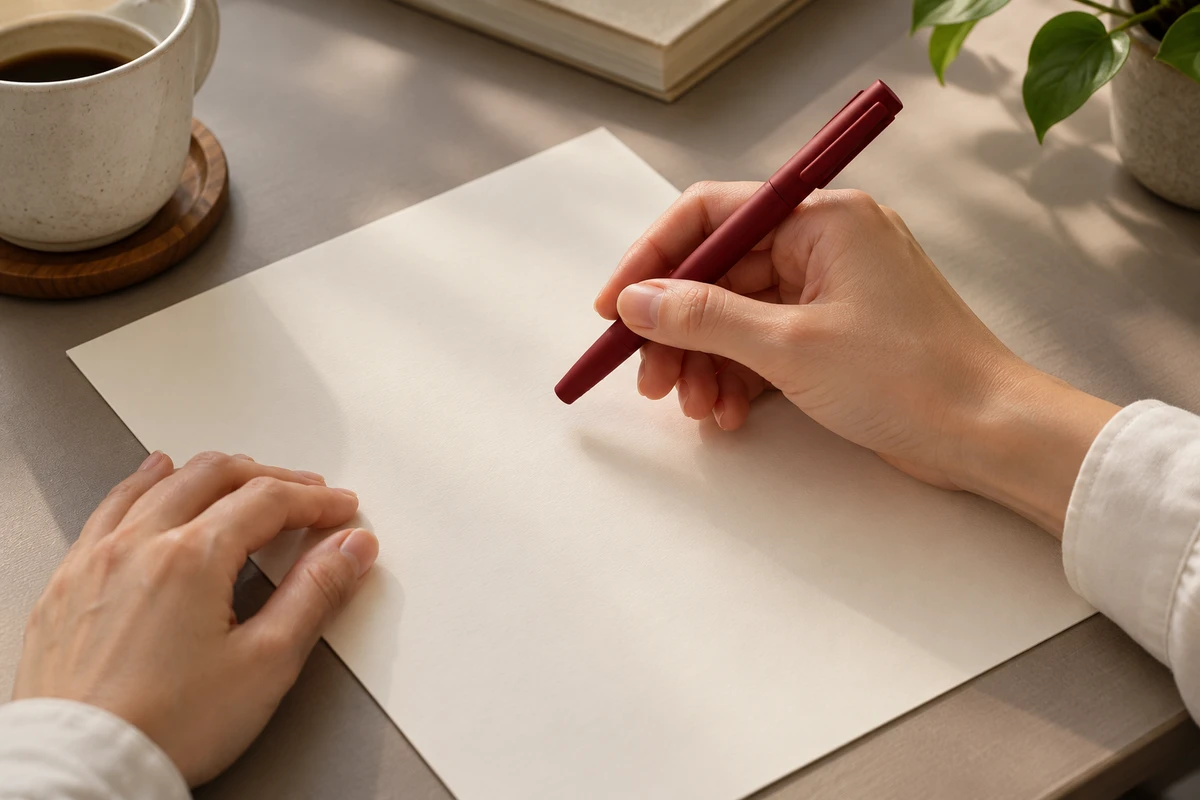
A person is about to write a sentence on a blank sheet of paper. Let her pick up the pen in a familiar way, remove the cap as the real design allows, and begin. If the audience needs to examine the barrel, a separate detail shot can provide that opportunity. Everyday use need not make room for product display at every instant.
If the idea concerns encountering a new object, a brief pause with the pen in hand may make sense. She examines a detail and then decides to write. The pause belongs to a particular act of looking, not to a rule that every metal object in an ad must rotate slowly. Both versions can feel unhurried, but they express different relationships with the product.
Nor must every part of an action receive equal time. The reach can be decisive. Placing the cap securely can receive more attention. Writing can then proceed at its own rhythm. An unhurried quality can emerge between those changes, not only from continuously reduced speed.
A requirement to keep the product mark facing the lens may conflict with an ordinary grip. Rather than asking someone to appear unaware of the camera while constantly maintaining a display angle, let the use shot show use and the display shot show the product. They can sit next to each other. One hand need not fulfill every task simultaneously.
Holding still is a different skill
The practitioner guidance Hand Modelling Tips for Mastering Stillness Under Studio Lights from BMA HANDS describes maintaining a precise pose without excessive tension as a hand-modeling skill. The useful distinction here is between tasks: a static presentation has its own professional requirements. It is not a fallback for unsuccessful movement.
Holding a product so the camera can inspect an outline, finish, or detail is a legitimate shot purpose. It need not pretend that someone happened to maintain the camera's ideal angle during daily life. An ad can openly arrange that hold and resume the action in another shot.
But an attractive photograph of a hand holding the product does not establish that the whole pickup works. Review the sequence from before the movement begins until use continues, rather than selecting only its most flattering intermediate pose. Ask whether this particular scene communicates its intended relationship, not whether it follows a standard gesture suitable for every product.
Interpolation cannot make the performance decision
Adobe's official time interpolation documentation distinguishes repeating or removing existing frames, blending adjacent frames, and analyzing motion to generate new frames. These describe ways of changing screen time. They do not explain why a person acts. Smoother movement and believable behavior remain different questions.
Speed changes therefore need review, not just a setting. Where fingers contact the object or occlusions change, check that the final image preserves the real construction and meaning of the operation. Visual smoothness does not automatically establish accurate use. This article does not prescribe universal frame rates or interpolation settings, and no software tests were conducted.
Give detail time without making the person keep waiting
During rehearsal, first retain a complete action without asking for something “more premium” or “slower.” It can be a starting point for understanding how this performer uses the sample, not a representation of every user or an automatically correct final take. Then change one specific requirement, such as giving a detail a clearer position, and see where the movement changes.
If that adjustment makes everything around it awkward, consider a different camera position, a separate detail shot, or a different edit point. Continually slowing the hand is not the only option. An ad pursuing dance-like choreography can also retain deliberately unusual poses, provided the film's style supports them. Such a presentation should not be described as an objective record of ordinary use.
Do not turn hand speed directly into a personality label either. Fast is not automatically careless, and slow is not automatically elegant. Meaning also depends on what the person is doing, what the object is, and the context supplied by the surrounding shots. This is a creative judgment, not a promise that a particular gesture will increase preference or sales.
For the next product ad, make “unhurried movement” more specific: where should people inspect the detail, and where should the person get on with the task? Bring the real sample and that action to a discussion through ONCE video production solutions. The goal is not slowness throughout. It is time to see what matters and room for the action to continue.
Source note: The BMA HANDS guidance and Adobe's Change the frame rate of a clip and Apply Time Interpolation Methods to adjust clip speed were checked on October 19, 2026. They support limited practitioner and technical definitions; the rest is original creative analysis. No hand-model rehearsals, software tests, or audience research were conducted. The cover is an AI-generated, unbranded concept, not a client shoot or a validated handling demonstration.