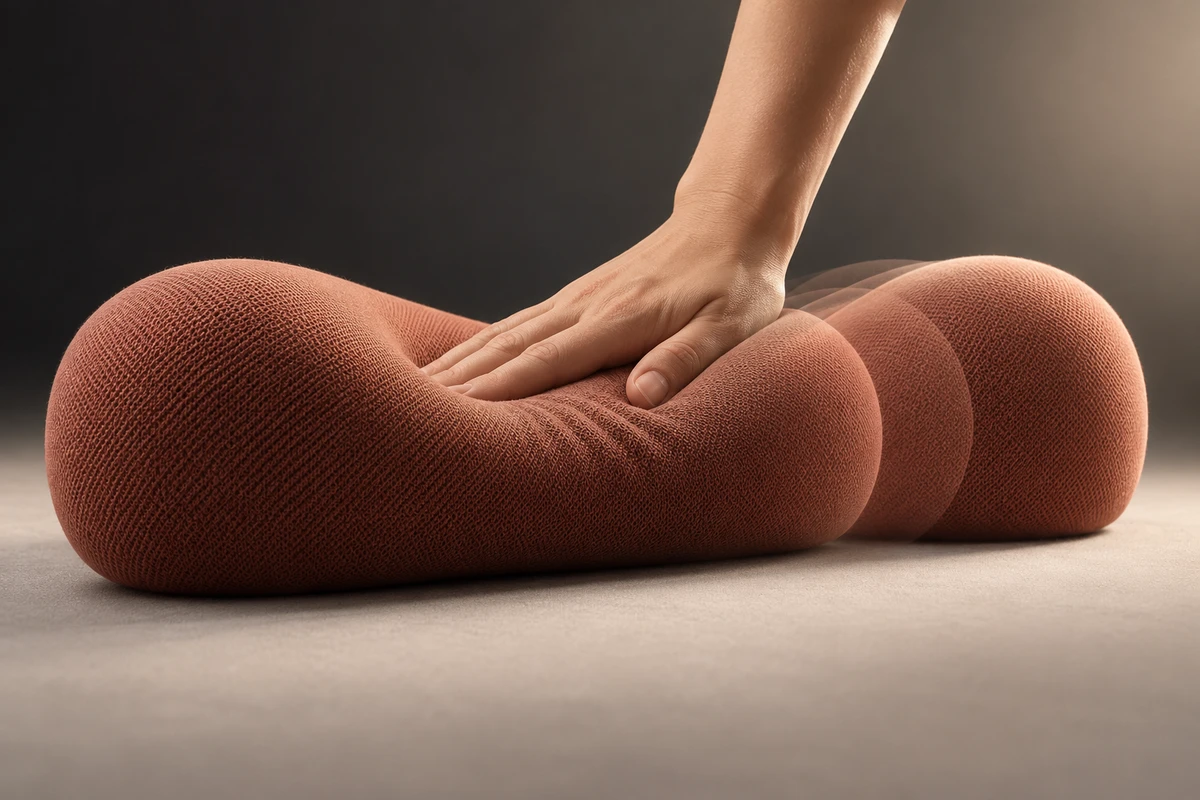
A finger presses into a cushion. The surface sinks, the camera slows down, and the material rises again. The shot looks soft, but it may explain almost nothing. We cannot tell how much force was used, how long the pressure lasted, how far the product recovered, or whether a crease remained. The image is polished; the tactile claim still depends on the copy.
Softness is not a single frame of indentation, and rebound is not footage played backward. In a product ad, both are time relationships: what force acts on which area, how the material changes, and what happens after the force disappears. When that sequence is legible, viewers have a better chance of imagining touch through a screen.
Softness, elasticity, and support need different evidence
Softness concerns how readily a material deforms when contact begins. Elastic response concerns how it recovers after the force is removed. Support concerns how the material resists further deformation under load. Everyday language often blends these ideas, but one generic press shot leaves viewers to fill the gaps with their own expectations.
Material testing offers a useful warning. ZwickRoell's overview of ASTM D3574 specifies specimen dimensions, compression fixtures, preloading cycles, deformation levels, and measurement cycles. Instron describes compression testing as measuring how a material deforms under a pressing load. A commercial shoot is not a laboratory test, but these sources make a simple point: material response only becomes comparable when force, time, and deformation are defined together.
So a hypothetical cushion should not be described as resistant to long-term sagging because a fingertip makes a neat indentation. Nor should a fast return in a high-speed shot be treated as proof of service life. A creative demonstration can make touch easier to imagine; it cannot replace a product test conducted under declared conditions.
Build one touch as five beats
Adding more close-ups is less useful than preserving a complete action: load, deformation, release, recovery, residual state.
Load: show where the force begins
If the frame only shows a surface changing shape, the action can feel like a visual effect. Keep the finger, palm, body weight, or a familiar prop visible so the viewer understands the source of the change. Direction matters too. A vertical press shows compression through thickness; a pull shows extension; a bend shows a change in curvature. These are not interchangeable versions of softness.
The performance should also be repeatable. A quick poke, a slow hold, and continuous kneading can make the same material appear to have different qualities. Start with an action close to normal use, then decide whether a more dramatic demonstration is justified. Do not ask the performer to keep increasing the force simply because a deeper dent looks better on camera.
Deformation: keep scale inside the frame
Macro photography reveals texture but removes context. At extreme magnification, five millimeters and five centimeters of indentation can look equally dramatic. Keep an edge, seam, finger joint, or uncompressed area in view so the audience can judge how much has changed.
Choose an angle that does not flatten the direction of pressure. A side or three-quarter view can show changing thickness; an overhead view can show deformation spreading outward. If the edit changes angle, preserve the phase of the action. A deeper press from a different take should not be smuggled into the sequence as though it were continuous.
Release and recovery: do not cut away from the answer
Many ads leave the shot the instant the hand lifts because the indentation was the attractive moment. Yet recovery can only be judged after release. Let the hand clear the material and leave enough visual space for its return. If the product regains its broad shape quickly but needs longer to smooth out smaller wrinkles, both stages carry useful tactile information.
Then hold briefly on the residual state. The surface may return fully, retain a shallow mark, or shift slightly. A truthful remainder does not necessarily weaken the image. It can turn an abstract promise of softness into a specific, believable response.
Slow motion reveals time and also changes meaning
Slow motion is valuable when the naked eye cannot separate stages: an initial rebound followed by gradual smoothing, for example, or different parts of a product recovering at different speeds. High-speed work has practical consequences. ARRI's guidance on high-speed lighting explains why high-frame-rate capture may require flicker-free lighting and frequency control. A camera's maximum frame rate is only part of the setup; light output, shutter settings, and exposure must still be tested together.
Slow motion is not a neutral magnifying glass. Research summarized by INSEAD reports 12 experiments with 27,227 participants and finds that showing products in slow motion can increase perceived luxury. The technique is therefore changing product character as well as revealing movement. Stretching the rebound of an agile shoe midsole into a long, breathing motion might make it feel soothing while weakening the intended sense of responsiveness.
A safer edit lets normal speed establish real timing and uses slow motion only for the phase viewers could not otherwise parse. The two versions can appear sequentially or side by side. If speed ramps are used for rhythm, keep the original-speed take in the internal review so post-production does not turn ordinary recovery into an extraordinary performance claim.
Sound can mark the action without inventing a material
A low rush of air during compression, fabric friction, or a light tap as the surface returns can make the phases easier to follow. Sound is especially useful at release: as the hand lifts, the sonic emphasis shifts from pressure to recovery, completing the action.
But effects can easily turn foam into jelly, an air bladder, or a spring. Production sound may need cleaning and layering, yet the design should follow visible behavior instead of suggesting a structure the product does not have. The demonstration should remain understandable on mute; sound can then add texture and emotion rather than carry the whole claim.
Let live action show response and graphics explain structure
For a real product on sale, deformation and recovery are usually best captured with the actual item under declared conditions. CG can add a cutaway, airflow, fiber direction, or layer structure to explain why the behavior occurs. The animation's timing, however, should not be presented as the product's measured rebound speed. Any comparison should identify whether it is a concept illustration, a visualization of technical documentation, or a reproduction of actual test data.
Generative imagery is better suited to background, color, and composition exploration than to a precise flexible-material demonstration. Across frames, a model may change thickness, texture, seams, or the path of deformation. A perfectly smooth “recovery” may simply be the system redrawing the object. A hybrid workflow can keep the real product action and use generated elements only for environmental extension or atmosphere that carries no performance meaning.
Make one honest change easy to read
A product ad does not need to become a materials laboratory, but it should not use luxurious slow motion as a substitute for explanation. Decide whether the audience needs to understand easy compression, recovery, or support under load. Then preserve the five beats that answer that question: load, deformation, release, recovery, and residual state. The simpler the action and the clearer its conditions, the more tactile the product can feel through a screen.
If you are planning imagery for cushions, footwear materials, textiles, flexible accessories, or another touch-led product, bring the real sample, material notes, and approved performance language to ONCE's video production solutions. A small action and frame-rate test can reveal what the hero film should amplify—and what it should leave to verified technical documentation.