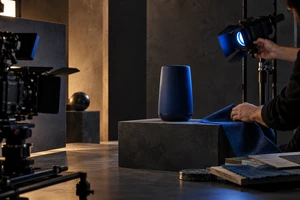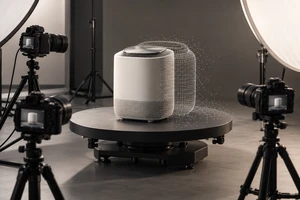
If the room is already effortless before the product arrives, the product has little left to change. It can sit on a handsome table while the voiceover insists that it matters, but the image has not earned that claim.
Effective product ad set design does more than create a premium backdrop. It makes a need visible through space: a distance that interrupts an action, a route that keeps breaking, an object that is hard to reach, or a state that refuses to change. The product then reorganizes that relationship through action. Viewers can understand why it exists before they have processed a specification.
A set is a condition, not a container
Research on scene perception offers a useful starting point. A review by Melissa Le-Hoa Võ and colleagues describes how “scene grammar” helps people use typical object locations and relationships to guide attention. Experiments by Tim Lauer and colleagues likewise show that an object’s consistency with its scene can affect recognition and semantic processing. These studies do not predict advertising sales, but they do establish that a background is not perceptually neutral.
A cup beside a sink, on a bedside table, or in a meeting room implies a different action, time, and social relationship. The more specific the scene, the easier it is for a product to acquire a reason for being there. The more the set resembles a generic showroom, the more likely the product is to remain a display object.
The first set-design question, then, is not which color belongs on the wall. It is this: before the product appears, which spatial relationship is not working smoothly?
Do not substitute clutter for a problem
Commercials often make an opening deliberately chaotic so the product has something to fix: cables become a knot, every surface fills with props, and the actor performs exaggerated frustration. The conflict is easy to read, but it can reduce the product to a tidying device—or make viewers wonder why anyone has tolerated such an implausible room.
More credible problems are usually smaller and directly connected to what the product can actually do.
The first is distance: a person must leave one position to complete an action, and the product shortens that distance. The second is path: someone repeatedly detours, moves something aside, or returns to a previous point, and the product changes the route. The third is access: an essential object is out of sight, out of reach, or blocked. The fourth is state: the room looks unchanged, but sound, steam, moisture, waiting, or a repeated gesture shows that the result has not happened yet.
None of this requires making a room ugly. It requires one visible action cost. A smart-home ad might show a person interrupting a task twice to reach a distant device. A portable-projector ad might begin with several people adjusting their bodies around a small screen. A cleaning-product ad might turn an interrupted route beneath furniture into the visual obstacle. These are creative hypotheses, not product promises; the real feature set must decide whether they are legitimate.
The product should change one spatial relationship
A product entrance should be a verb, not a reward.
The weakest version places the product in the center of the set and cuts to a hero shot. Neither the room nor the action has changed; the product has simply interrupted the story. In a three-study paper on narrative advertising, Matthias Glaser and Heribert Reisinger found that the strength of the product-story link affects viewers’ comprehension of the ad’s meaning, with consequences for narrative transportation and brand attitude. For a production team, that link does not always need dialogue. It can be built into a change in space.
Let the product turn far into near, a detour into a direct path, an obstruction into visibility, or an unresolved state into a clear outcome. The point is not merely to shoot a before-and-after pair. Retain the same spatial clue across both moments. A distance at the edge of the table, a narrow route, a half-open drawer, or an insistent sound introduced in the opening should receive a response after the product acts. Then viewers experience the product completing something instead of watching the commercial switch to a prettier image.
This is why the set, performance, camera, and edit cannot be designed separately. Blocking makes the problem credible. Product action changes the relationship. Camera geometry keeps the difference legible, and editing leaves enough time for the result to register. ONCE’s discussion of hand performance in product advertising looks more closely at how weight and resistance can live inside an action; set design supplies the condition in which that action matters.
Believability comes from usability, not lifestyle props
Many “lived-in” sets contain books, plants, cups, and a jacket draped over a chair, yet never answer whether anyone could actually use the space. Believability is not a prop count. It has at least three layers.
The first is physical usability. Where is the outlet? Can the cabinet door open fully? Is there enough space to operate the product after the actor sits down? Are an intake, hinge, projection path, or opening surface blocked? The second is action causality. Why is this prop here, why is the person touching it now, and what state did the previous action leave behind? The third is time trace. A recently used object should not look like untouched display styling: condensation, a slightly shifted chair, or a cable left in motion should come from the scene, not from an instruction to “add life.”
Materials also participate in contextual meaning. In a 2021 study, Lauer, Schmidt, and Võ found that materials associated with particular scenes could affect semantic object processing even when the complete spatial layout had been removed. For art direction, this does not mean that wood is inherently warm or metal inherently technological. It means that materials cannot be separated from where and how they are used. Tile, fabric, matte plastic, and reflective metal are both style decisions and evidence for why an object belongs in that place.
This differs from ONCE’s recent article on brand color in video. That article asks how a visual asset should be distributed; this one asks how props, distances, paths, and materials create the precondition for product action. A coherent palette cannot rescue a room whose causal logic does not work.
Live action, CG, and AI backgrounds solve different problems
A real location carries incidental truth: door swings, surface wear, window light, and the scale relationships between objects are difficult to invent from nothing. The trade-off is limited control over camera positions, lighting, sound, and continuity.
A built set can make walls, openings, and furniture serve the shot precisely. It also supports repeats and versioning. But every piece of lived logic must be added deliberately. Building only what the lens can see is perfectly valid, as long as actor paths, camera movement, and the product’s real dimensions enter the floor plan before the decorative surfaces do.
CG is well suited to exact structures, scale changes, and spaces that cannot be filmed, and it can place one controlled product asset in many environments. Its most common visual weakness is not simply that it looks artificial. It is that everything appears equally finished: no surface has been used, objects never occlude one another, and people and furniture seem to have been arranged in separate passes.
Generative AI is particularly useful in development: exploring spatial directions, testing composition and atmosphere, or producing environmental material that does not carry product facts. A beautiful frame, however, does not automatically qualify as product truth. The October 2026 AdSpark preprint evaluates product fidelity, instruction adherence, temporal coherence, audio alignment, and selling-point communication separately, and reports continuing challenges in product preservation, multi-shot storytelling, and selling-point visualization. It is new, preliminary research rather than a verdict on every model, but it supports a cautious production rule: independently verify the product, its critical action, and the before-and-after state.
Contact relationships deserve special attention in an AI-generated background. Does a hand actually depress the button? Does the surface carry the product’s weight? Does the reflection match the camera? Do cables, airflow, projection, and hinges obey the same room? Generative imagery can quickly create the appearance of life; people still have to construct the causality.
Write the set as an event
“A modern, warm, lived-in living room” is not a scene description. It describes a style. A useful description contains the problem, the spatial clue, the product action, and the outcome.
For example: a person organizes documents on a sofa while a distant device issues a second alert, interrupting the task. The shot retains the distance and the route between sofa and device. After the product intervenes, the person stays seated, the alert ends, and the documents never leave their hands. The final image still includes the original route so viewers can confirm that the change occurred in the same space. The product team—not the script—must validate whether that action reflects a real capability.
That paragraph pulls art direction, performance, cinematography, sound, and editing toward the same question. The set creates distance and path. Performance gives us the interrupted action. Sound makes an invisible state perceptible. Camera preserves the relationship. Editing gives the change time to land. The room is no longer a collection of departmental decorations; it becomes a spatial demonstration of product value.
A strong product-ad set may not leave viewers admiring the room. It leaves them remembering something more useful: before the product arrived, this action genuinely felt awkward; afterward, the space finally made sense.
If you are developing a brand film or product commercial, bring the product dimensions, a real operation video, and one target use situation to ONCE’s brand video production solution. We can discuss how to place the function inside the set, action, and shot rather than merely placing the product against a background.
Sources checked on October 14, 2026. The smart-home, projector, and cleaning-product situations are creative hypotheticals, not ONCE client work. Scene-perception research helps explain attention and semantic processing; it does not directly predict advertising conversion. AdSpark is an October 2026 preprint and should not be treated as a final conclusion about every model or commercial workflow.