For brands sourcing products from China, 3D is no longer just a trade-show flourish. Shopify treats 3D models as product media, Google Merchant Center accepts links to 3D assets, and Amazon publishes detailed requirements for models used in shopping experiences. The procurement question has therefore changed. It is not simply whether a studio can export a GLB file. It is whether a SKU deserves a spatial asset, which capture method fits the object, how truthfully the model represents scale and material, and whether the source can survive adaptation across channels.
The official rules current on 14 October 2026 confirm that 3D has entered commerce infrastructure. They do not prove that every category, market or merchant account has equal access, and they do not prove a conversion lift. Our recommendation is to buy a 3D model as a governed spatial product asset, not as a bonus file attached to a video shoot.
The platforms accept 3D, but they do not accept the same deliverable
Shopify product media supports GLB and USDZ models. A model can be up to 500 MB, while files larger than 15 MB are automatically optimized. Shopify also offers an iOS 3D scanner for compatible devices. Its own guidance warns that smooth, reflective, transparent, monochrome, flexible and very thin products are harder to capture. Upload support and capture suitability are separate decisions.
Google
Merchant Center lets merchants submit a publicly accessible 3D model
through the virtual_model_link attribute. Its current
documentation lists glTF and GLB, recommends roughly 10 MB and sets a 15
MB ceiling. Availability is currently concentrated in home goods and
shoes across markets including the United States, Canada, Australia,
Japan and India. 3D assets can be eligible for Shopping ads, while the
full “view in your space” AR experience is associated with free
listings. Google also notes that review of a new model can take up to
two weeks.
Amazon’s 3D technical requirements read more like a production specification. Amazon recommends GLB, requires real-world scale, caps geometry at 200,000 triangles, and recommends a physically based metal/roughness material workflow. Models should not contain cameras, lights or animation keyframes. The asset must match the physical product shown on the detail page; inaccurate scale or implausible materials can delay or prevent publication.
This is why one source model may be reusable, but “cross-platform” should never mean “one export uploaded everywhere.” A sound scope separates the master asset, the channel packages and the platform submission process.
Use the ONCE SPACE framework before requesting a quote
SPACE is a five-part filter for deciding what to build and how to buy it.
S — Suitability: does spatial media resolve a real buying question?
Furniture benefits when shoppers need to judge footprint and fit. Footwear can benefit from contour and detail inspection. Devices may need a clear view of ports, hinges or operating clearance. If the main question is color or front-facing styling, better photography and short video may still be the more efficient answer.
Physical capture conditions matter too. Rigid, matte and richly textured objects are easier candidates for scanning or photogrammetry. Mirror finishes, transparent parts, plain black or white surfaces, fur, flexible textiles and thin structures demand more intervention. A useful quote therefore separates capture from masking, material recreation, manual cleanup and dimensional calibration.
P — Platform: define the destination before the file
A Shopify product page, Google free listing and Amazon detail page do not share identical limits or review criteria. The brief should name the target markets, channels, SKUs, variants and launch dates before it specifies GLB, USDZ, texture packages, thumbnails, hosting URLs and validation reports. A supposedly universal model with no channel matrix simply defers compatibility risk.
A — Acquisition: scan, photogrammetry or manual modeling
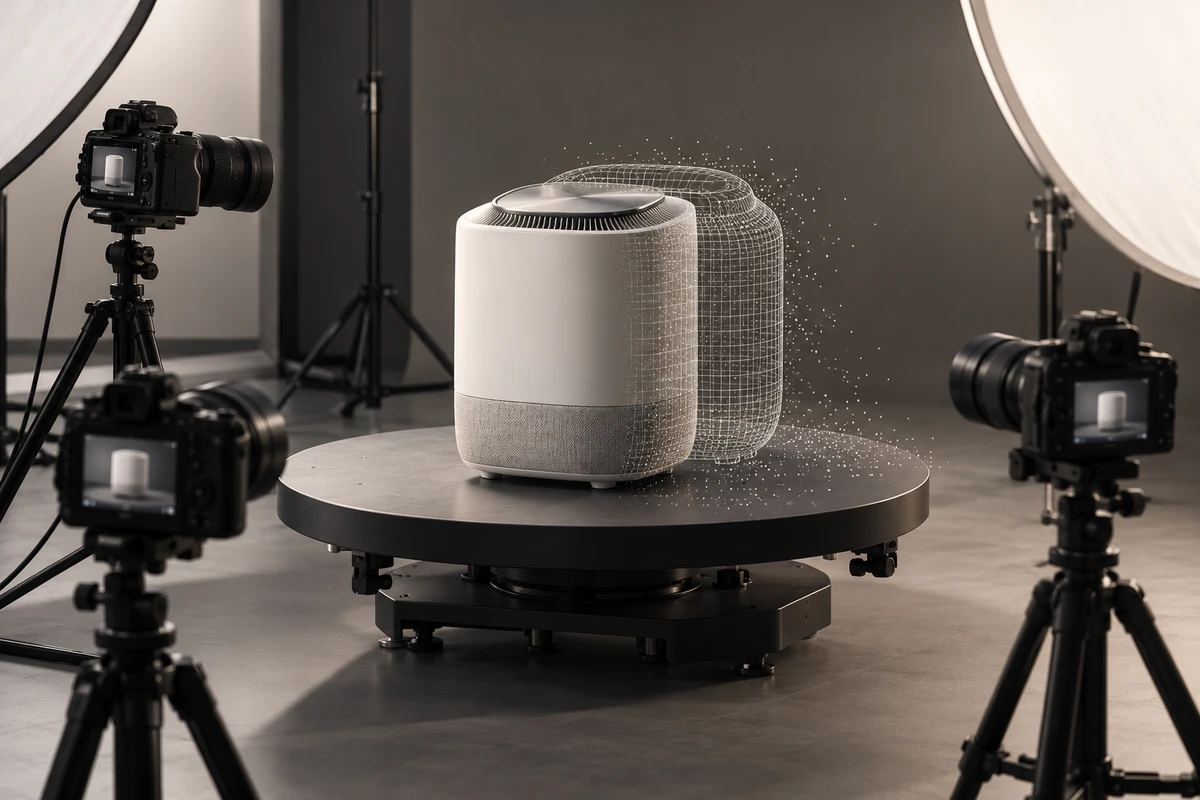
Mobile scanning is useful for rapid validation and regular shapes. Photogrammetry is better when a physical product has stable geometry and distinctive surface detail and can be photographed continuously from many angles. Manual modeling or cleaned CAD is often the safer route for reflective, transparent, soft or very thin products, and for products that have engineering data but no finished sample.
Apple’s Object Capture guidance offers a practical capture benchmark: adjacent photographs should ideally overlap by about 70%; below 50%, reconstruction may fail or lose quality. Apple also recommends consistent exposure and focal length while avoiding hard shadows and strong highlights. The procurement lesson is tool-agnostic: specify capture coverage, lighting consistency and responsibility for failed areas or reshoots.
C — Consistency: every asset must describe the same product truth
The most damaging model is not the least polished one. It is a model that makes the product slimmer, glossier or larger than the physical item, or quietly removes seams, ports and roughness. Use dimensions, color references, material samples and close-up reference images as shared inputs for 3D, photography and video. Our earlier article on true product scale in e-commerce video explains how perspective can distort size; a 3D error is more persistent because it follows the shopper through rotation, zoom and potentially AR placement.
E — Evaluation: “it spins” is not an acceptance test
Review at least five things: geometry integrity, real-world dimensions, material plausibility under bright and dark lighting, compliance with each target platform, and alignment with the current SKU and packaging revision. Record the source version, texture version, export settings and submission date. Platform approval is channel admission, not brand approval.
Combine spatial capture with a commercial shoot without confusing the jobs
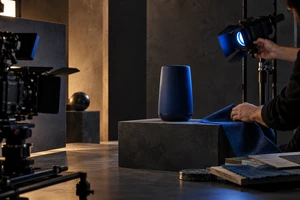
The efficiency comes from sharing sample logistics, styling, lighting and product approval—not from taking one extra photograph. A practical studio sequence uses four connected stations:
- Product registration. Record SKU, dimensions, weight, color, batch, moving parts and any details that must not appear.
- Material reference. Under controlled light, capture color and gray references, orthographic views, ports, seams and surface close-ups.
- Spatial acquisition. Lock focal length, exposure and soft light; capture high, middle and low orbits before flipping, opening or disassembling the product.
- Photography and video. Reuse the approved styling and product state for hero images, demonstrations and campaign footage so the assets do not describe different sample revisions.
This workflow does not make every SKU a good 3D candidate. It creates a model-ready reference set. Even if the brand launches only photography and video today, it retains dimensions, material references and multi-angle coverage for a later decision. That is more valuable than a “free model” with no source controls or validation path.
Separate three cost pools in the scope
3D proposals are often under-scoped because the quote covers model creation but ignores channel adaptation and maintenance. A more useful model is:
Total spatial-asset cost = master creation + channel adaptation and validation + lifecycle maintenance.
Master creation includes scanning or photogrammetry, manual cleanup, UVs, textures, materials and scale calibration. Channel work includes polygon reduction, compression, GLB/USDZ exports, hosting, validation and corrections after review. Lifecycle work covers color variants, structural revisions, packaging changes and retirement of obsolete versions.
A short-lived SKU with frequent changes and no supported destination may only justify a multi-angle reference set. A high-value product with a long lifecycle, a strong spatial buying question and several eligible channels is more likely to justify a governed master plus channel packages. This is a business judgment, not a platform promise; the brand should validate it against its own product-page behavior, customer questions and return reasons.
The procurement move to make now
Do not begin by asking what one 3D model costs. Start with ten candidate SKUs and score them through SPACE: Is the buying question spatial? Is the surface capturable? Do the target platforms support the category and market? Is the product revision stable? Can the team maintain the asset?
Build full models only for the strongest candidates. Capture model-ready multi-angle references for the middle tier. Keep photography and video as the primary tools for low-scoring products. This turns 3D from a one-off technical demonstration into a manageable product-content layer.
If your team needs to align product photography, dimensional references, spatial capture and channel packaging around samples sourced in China, ONCE can help structure the SKU and platform brief.
Sources and scope
- Shopify Help Center, “Product media,” “Product media types” and “3D scanner,” verified 14 October 2026.
- Google Merchant Center Help, “3D model link [virtual_model_link]” and “Display your products in 3D and augmented reality,” verified 14 October 2026.
- Amazon Seller Central, “3D model technical requirements,” verified 14 October 2026.
- Apple Developer Documentation, “Object capture” and “Capturing photographs for RealityKit Object Capture,” verified 14 October 2026.
Platform specifications can change by market, category and account eligibility. Confirm the requirements visible to the target account before launch. The procurement, studio and cost frameworks in this article are ONCE’s analysis; the platforms have not validated a universal performance outcome for this approach.