A cracker snaps on camera. The crumbs look beautiful, but the sound arrives half a beat late. A spoon pulls a glossy ribbon of sauce, yet the image does not tell us whether it is rich, sticky, or light. Food commercials often overestimate “looking good” and underestimate what the material is actually doing.
Viewers cannot taste through a screen. They infer texture from fracture, flow, rebound, bubbles, and residue. Sound contributes to that judgment, but it is not a layer of ASMR that can be pasted onto any product. Credible texture comes from three views of the same event: the image shows a material change, sound conveys its force and speed, and editing gives the result enough time to register.
Texture Is a Material Event, Not an Adjective
“Crisp, flaky, rich, smooth, juicy” may work on a pack, but they are not yet executable shot directions. Before production, each word needs to become an event that can happen, be recorded, and leave visible evidence.
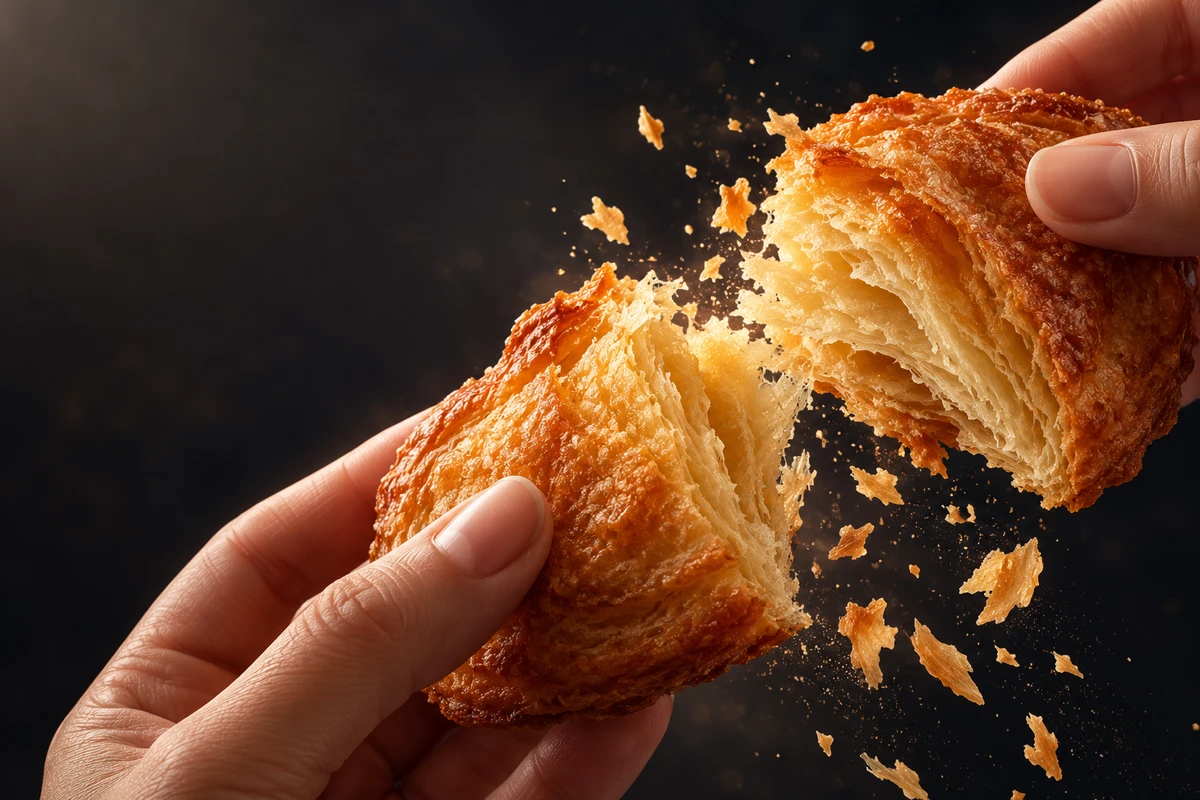
Crispness usually calls for a clear pressure point, sudden fracture, and defined fragments, paired with a short, distinct transient. Flakiness is different: layers separate, fine crumbs fall, and the sound is lighter and more densely detailed. Viscosity is communicated by a slow fold, surface ridges, and delayed recovery after the action stops. If a sauce disappears from a spoon like water, beautiful lighting alone will not make it feel rich. Juiciness or fizz needs a readable release of pressure: squeeze, rupture, droplets or bubbles, then a wet aftermath.
This is why food styling cannot serve only the hero still. Temperature, moisture, resting time, the cut surface, and action speed all change the material performance. The director, cinematographer, food stylist, and sound team should work from the same “texture event,” instead of separately pursuing a pretty frame, a loud track, and a fashionable transition.
Sound Should Grow Out of the Action
Sound can change how food texture is judged. In a study published in the Journal of Sensory Studies, Massimiliano Zampini and Charles Spence had participants actually bite potato chips while the loudness and frequency composition of the eating sounds were altered. Chips were judged crisper and fresher when the overall level, or specifically the high-frequency content, was increased. The study was published in the journal’s 2004 volume and first appeared online in February 2005.
That finding shows that audition is part of texture perception. It does not prove that making a crunch louder in an advertisement will automatically improve sales. The experiment involved real eating, a specific product, and a specific judgment task. Its more useful production lesson is that sound must agree with the force, fracture, and consequence that viewers see.
On set, one action can be recorded in layers: the light contact of a finger or utensil, friction as the structure deforms, the main fracture or release, and the tail of crumbs landing or liquid settling. Foley can restore details that production sound could not isolate. It should not give a soft cake the crack of a hard biscuit, or make a viscous drink behave acoustically like thin soda. The clearer the sound becomes, the easier it is to notice a material mismatch.
Louder and Closer Do Not Always Mean More Appetising
Food content often turns “sensory” into a universal template: move the camera closer, amplify chewing, and make every liquid bubble. A 2025 Journal of Advertising Research study analysed 2,308 online food and beverage video ads, combining human coding and machine learning to examine sensory cues across funnel outcomes. The pattern was not simply “more sound is better.” Crunch sounds were associated with some recall and consideration measures, while ASMR and bubbling sounds were associated with weaker purchase-intent or favourability measures in parts of the analysis. The paper, “Designing Delicious,” reports the full study and its limits.
A large observational analysis reveals patterns; it does not supply a universal causal rule for every brand. The useful warning is that sound should reinforce the product promise, not merely prove that the production has adopted a trend. A potato chip may make one clean fracture the centre of attention. Yogurt, ice cream, or soup may need continuous, low-impact sound and slower motion. Premium chocolate may benefit from restraint—or even a brief quiet moment after the wrapper opens—before the snap.
One practical test is to mute the image and listen. Would the soundtrack make someone imagine the same material? If it suggests a different food, the problem is probably not the mix. It is the creative hypothesis.
Give the Action a Cause and the Texture a Consequence
Splashes, pulls, and flying crumbs are familiar food-advertising devices, but motion alone does not guarantee appetite appeal. A direct replication examining whether implied food motion increases appeal used three experiments, 626 participants, and 56 food images. It found no evidence that implied motion universally increased appeal, tastiness, or freshness. The open-access paper details the replication. This does not mean moving food shots are ineffective. It means movement must carry interpretable information.
A texture shot should let viewers understand four moments: the material before the action, the force being applied, the transformation, and the state left behind. Keep only the most spectacular middle frame and the liquid may look like an effect with no source; crumbs may look like particles added in post.
Consider a sandwich biscuit. A light press first establishes the shell’s resistance. At the break, the crack and the fracture happen together. The shot then holds long enough to reveal the broken edge and the filling’s stretch before cutting to the pack. That hold is not dead time. It lets the texture evidence resolve. It connects with the way hand performance communicates product feel and the way editing pauses clarify cause and effect, but food imagery adds a stricter condition: every movement has to remain plausible for the material.
Give Live Action, Foley, and AI Different Jobs
Food production is not a binary choice between “fully filmed” and “fully generated.” A more dependable hybrid keeps the material behaviours that carry appetite and credibility grounded in reality, then assigns each tool to the work it does best.
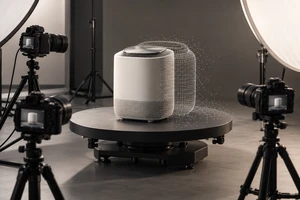
Live action is well suited to hero texture evidence: a fracture edge, a bubble bursting, sauce settling, or the ridges left after cream is pressed. Foley can re-record small sounds that genuinely exist but were lost in set noise. CG or generative AI can help previsualise movement that is expensive to repeat, extend environments, explore colour and composition, or create secondary transitions. But when the selling point is “fresh, real, and desirable to eat,” an untested generated image should not be the only proof.
A Scientific Reports online experiment published on 15 August 2026 asked 87 participants to rate 60 matched pairs of AI-generated and real food images. Ratings of healthiness and calorie content did not differ significantly, but the AI images were judged less realistic and produced lower willingness to eat. The authors report the full method and results. The study tested still images, not video, so it cannot settle the effectiveness of every generated food asset. It does establish a practical boundary: when appetite is the central task, realism is a variable to test rather than an assumption.
A hybrid workflow should therefore protect the material, not conceal it. A team might use AI or CG to compare camera positions and motion ideas, then film the critical texture with the real product. Or it might shoot the product and generate an environmental extension. The final test remains simple: is the promised mouthfeel supported by the same physical event in image, sound, and time?
Turn One Product Claim Into a Shootable Event
If the claim is “crispy,” do not stop at writing “we need crispness” in the brief. Define which layer fractures first, what the broken edge should reveal, where the primary sound originates, and what needs to remain visible after it. If the claim is “rich and smooth,” define flow speed, stretch length, surface recovery, and whether the vessel, temperature, or action might make the product appear too thin or too sticky.
That translation changes the production plan. The project may need fewer camera setups and more consistent food styling, a repeatable action rig, closer sound recording, or longer material tests. The creative discussion also becomes answerable: can this transformation let viewers accurately anticipate how the product will feel in the mouth?
The most persuasive moment in a food commercial is often not the biggest splash. It is the moment when viewers connect what they see and hear with their own bodily memory. If you are turning a food or beverage texture claim into film, ONCE can help define the texture event, food styling, shot design, and sound approach for a hero film and short-form content. Contact ONCE to discuss food commercial production.
Sources checked on 14 October 2026. The research is used here to explain sensory mechanisms and creative limits; it does not guarantee the performance of any individual product or advertisement.