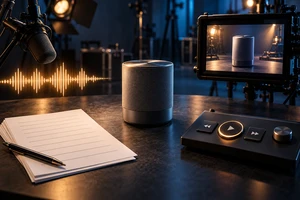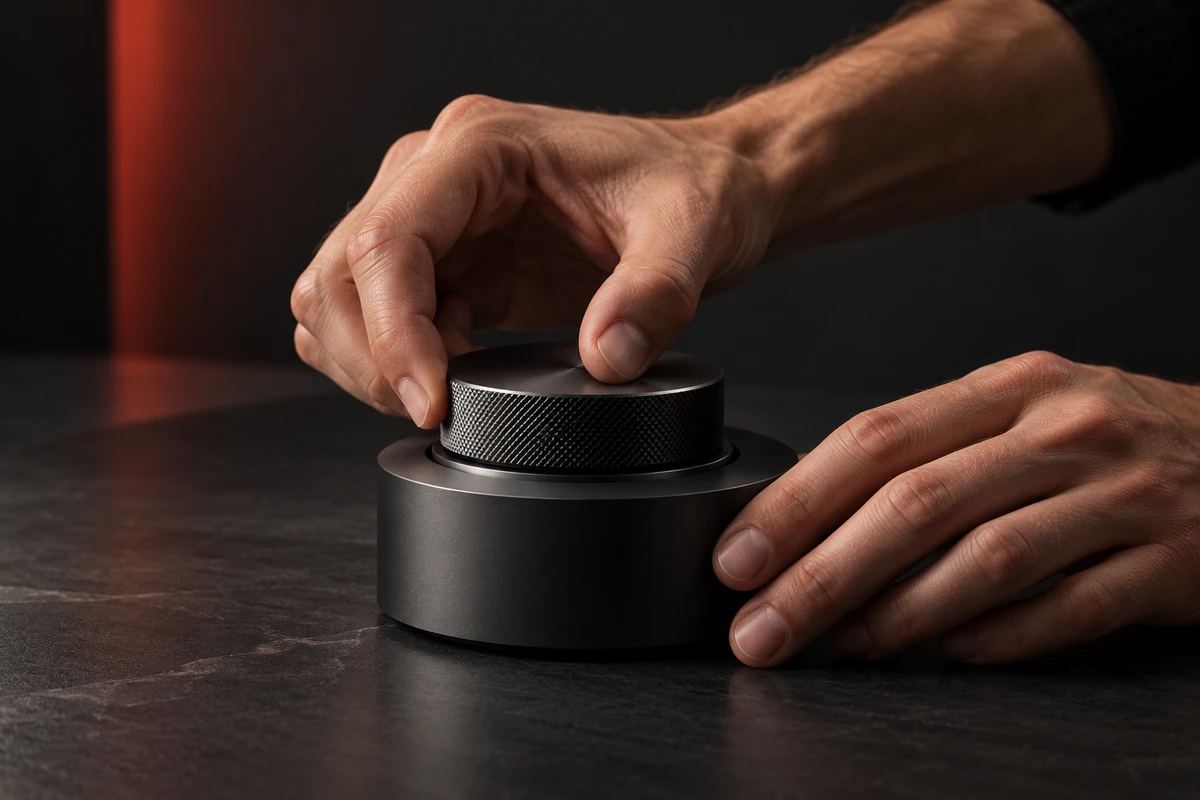
A hand moves slowly across the fabric grille of a speaker. The shot is beautiful. But if the speaker could be replaced by a perfume bottle, mouse or suitcase without changing the gesture, the action has explained very little about the product.
Hands in product advertising are often treated as scale references, compositional elements or a quick signal that somebody is using the object. Their more important role is to test the product on behalf of viewers who cannot touch the screen. As a hand grips, loads, pauses, turns and releases, it translates weight, resistance, texture, scale and feedback into movement. The hand is not a prop. It is a performer that needs to understand the product.
A hand in frame does not automatically create a sense of touch
The vicarious haptic effect research published in the Journal of Marketing Research used eight studies across images, GIFs and virtual reality. Merely including a hand was not enough: the hand needed to touch the product, and the effect weakened when the observed interaction was not a diagnostic hand movement. The research concerns psychological ownership and valuation, not a universal conversion promise. Creatively, it distinguishes a hand floating beside an object from a hand actively obtaining information.
A separate Journal of Retailing study, using six studies in the paper and five in its appendix, examined product weight. Compared with no hand or other hand positions, a hand lifting a product without external support increased confidence in weight judgments. The authors connect the effect to haptic imagery.
Neither study says every product film should become a hand-model demonstration. They suggest that the gesture should match the attribute viewers need to understand. Showing thinness should involve more than pinching a device between two fingers. Viewers also need to see how it lifts, stops and balances. Showing the resistance of a dial requires more than the final rotated position. The start of force, the break from rest and the return after release create the sensation.
Decide what viewers should feel before deciding how the hand moves
“Pick it up elegantly” is not an actionable performance note. It describes a mood without identifying the product information. A better direction begins with the physical attribute the action must communicate.
- Weight: let the hand receive or lift the product without support. Finger-closing speed, wrist drop, forearm tension and stopping distance together suggest lightness, stability or substance.
- Resistance: preserve the threshold between applying force and seeing movement. The value of a dial, latch, magnetic connection or hinge often lives in that instant.
- Material: use an exploratory action suited to the material. A slow fingertip pass may reveal texture; tapping, compressing or bending may reveal hardness, rebound or hollowness.
- Scale: keep a familiar human reference inside the same load relationship. Grip span, palm coverage and thumb reach to controls carry more information than a product simply sitting next to a hand.
The more accurate the action, the less exaggerated the performance needs to be. A thin device swung like paper can feel cheap. A product meant to signal solid construction loses weight if it moves without inertia. Advertising is not a laboratory measurement, but the body still needs to respect the product's basic physical truth.
Approach, contact, load, release: four beats inside one action
On set, hand performance is easily compressed into “pick it up.” A hand enters from outside the frame and, one cut later, the product has already moved. The tactile information in between disappears. Breaking the movement into four beats is not about making it slow. It gives each phase a distinct information job.
Approach
Where the hand travels and how it prepares to grip establishes intention. A thumb searching for a control and a palm moving under a base predict different uses. The approach also gives the camera time to establish scale and the contact surface.
Contact
The point of contact must remain visible. If fingers cover the port, switch or latch, viewers see that something happened without seeing why the product responded. Rehearsal can lock the feature that needs to be understood first, then choose the entry direction of the hand—not the other way around.
Load
Many product properties appear only after force is applied. Research on predictive weight judgments from observed grasps found that people could use movement cues to discriminate whether a real or pantomimed glass was light or heavy. It does not directly establish an advertising effect, but it shows that speed, trajectory and joint changes carry physical information.
Release
Letting go is not merely the end. It is the product's final response. A magnetic part aligns itself, a button rebounds, soft material recovers, or a stable base refuses to follow the hand. Cutting before release shows the human operation but hides the product's answer.
Direct the joint chain, not only the fingers
Real action travels from shoulder to elbow, wrist and fingertips. Even when the frame includes only a hand, force still originates outside it. A locked wrist and relaxed forearm can make a supposedly heavy object feel weightless, however tightly the fingers squeeze.
Begin rehearsal with one real operation at normal speed, then simplify it for camera. Real use reveals where people naturally grip, when they need visual confirmation and where they change hands. The filmed version can remove noise, but it should not remove the hesitation, added force or correction that makes the product property legible.
Fluency is not the same as weightlessness. An experienced user takes a shorter path and positions fingers early. A first-time user searches, confirms and adjusts. Both performances can work, depending on whether the film needs to communicate ease, expert control or discovery. Giving every product the same frictionless gesture merely makes different objects look like the same advertisement.
Camera, editing and sound must protect the action
The camera needs to see the load relationship. To show pressing, reveal fingertip deformation and product feedback. To show rotation, preserve the relative movement of fingers, axis and scale. To show weight, a very tight close-up may remove the wrist and forearm cues that carry the sensation.
Editing can change shot size without breaking causality. Cognitive research on continuity editing and event segmentation found that action discontinuity was a stronger predictor of perceived event boundaries than simple spatial or temporal change in the film material studied. A product action can begin in a medium shot and finish in close-up if grip direction, speed and load phase still connect. If one shot ends just before a press and the next begins with the product already running, viewers receive a result rather than a mechanism.
Sound enlarges subtle feedback: fingertip friction, latch engagement, a hinge stop or material rebound. It should not invent a material the product does not possess. Giving light plastic the impact of heavy metal may create an instant impression, but it conflicts with the eventual use experience.
Distribution changes the action too. Amazon Ads' current Sponsored Products video guidance says product-in-use videos should focus on the product and ideally show a person interacting with it; the format may also remove audio. In silent or automatically reordered feature videos, the hand action itself must explain the feature instead of waiting for voice-over.
Generative AI can previsualize the action, but critical contact still deserves live action
Hand-to-object contact remains a difficult generative-video problem. The CVPR 2025 HOIGen-1M paper reports that current text-to-video models struggled to generate precise human-object interactions, motivating a dataset of more than one million curated interaction videos and new evaluation metrics. This conclusion applies to the tested models and tasks; it does not mean every generated interaction fails.
A practical hybrid workflow separates responsibilities. Use generative tools to explore production design, setting, motion direction and transitions that do not carry functional proof. Capture crucial gripping, pressing, assembly, opening and load-bearing actions with the real product and a real hand. Those live-action layers can then enter an expanded environment instead of asking a model to infer contact points, joint posture and physical feedback from text alone.
If an interaction must be generated, describe it as observable stages and inspect the approach path, contact position, product-state change and result after release. Judging only the first and last frame can miss penetration, drifting grips and altered product geometry in between.
Good hand performance lets viewers complete a trial outside the screen
Not every product shot needs a hand. Still life establishes form, technical animation explains an internal mechanism, and a wider human scene creates need. Hand performance is strongest when it carries what a static view cannot prove: what the product gives back to the body after contact.
Before the next product film, write one action objective: “From this hand movement, viewers should feel ______.” Then divide it into approach, contact, load and release. If the answer is only “premium” or “beautiful,” the action has not found the product. If the answer is “the dial crosses a threshold and settles firmly,” camera, performance and sound finally share the same task.
Explore more craft decisions in ONCE's video production journal. If you are turning verified product features into filmable actions, visit ONCE's video production solutions to discuss action tests, shot design and the division between live action and generative production.
Sources checked on October 13, 2026. The speaker, dial, magnetic part and soft-material examples are creative hypotheticals, not ONCE client projects. The academic studies and platform guidance each have specific materials, samples and use conditions and do not replace testing with the actual product.