The video file may travel globally; the music rights may not. A soundtrack available inside TikTok, Instagram, or YouTube can be perfectly valid for one publishing path and still be the wrong foundation for a master that must later move to paid social, a product page, a retailer, CTV, or another country.
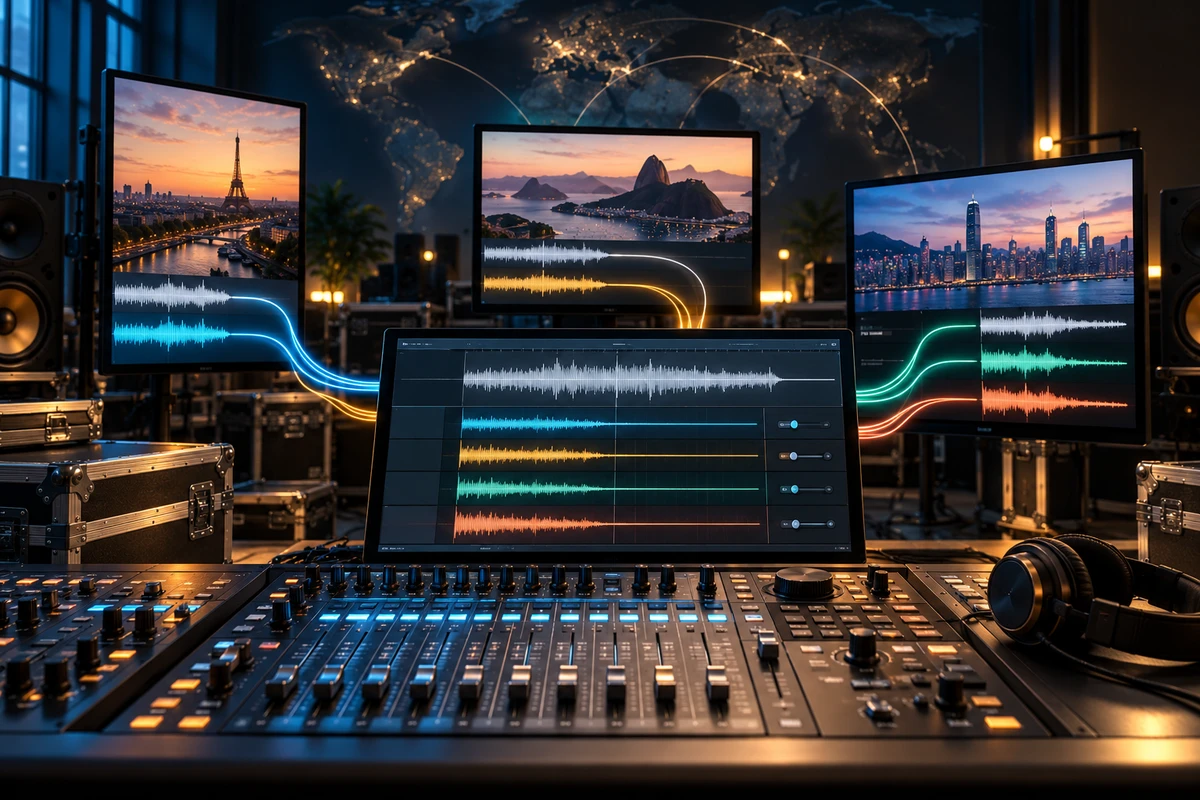
For brand teams working with production partners in China, this changes what “final delivery” should mean. The durable asset is not one MP4 with a song permanently mixed in. It is a layered audio package: a portable master, replaceable music, platform-specific releases, and a rights record that explains exactly where each version may run.
Platform availability is not a universal music licence
TikTok’s July 2026 guidance for its Commercial Music Library asks users to select the campaign region and lets them filter tracks by usable placement. Selected Commercial Sounds may be used in organic or paid TikTok content. A separate TikTok music-legality brief is even more direct: music in the library is licensed for use on TikTok only.
Meta draws a different line. Its current Instagram music-library guidance says the general licensed library is intended for personal, non-commercial use, while Sound Collection can support commercial uses such as ads in Meta’s stated environments. YouTube’s Audio Library guidance describes its tracks as copyright-safe on YouTube, but also says YouTube cannot advise on music issues that may arise off-platform.
These policies do not establish one common licence. They establish different promises for different products. A track being selectable, downloadable, or claim-free in one environment is not evidence that it is cleared for another platform, another territory, another account, or a paid campaign.
The underlying rights also matter. WIPO’s rights-clearance guide for filmmakers explains that recorded music commonly involves both the owner of the recording and the publisher or authors of the composition. Synchronising music to pictures, publicly communicating it, or modifying it can engage different permissions. WIPO also recommends documenting territory, term, distribution windows, advertising use, and cue-sheet information.
The practical inference is simple: if the right to use a track cannot be described independently of a platform interface, do not make that track an irreplaceable part of the global master.
Choose a soundtrack route for the job it must do
Platform-native music is a distribution layer
Platform libraries are useful for fast experiments, local cultural relevance, and channel-specific executions. Their advantage is proximity to the platform’s own creative language. Their limitation is that eligibility can depend on the platform, market, placement, account type, and the specific track.
Treat this music as a release-layer choice. Keep a master without the platform track, then add the native music during platform-specific finishing or publishing. If a track disappears, a market becomes unavailable, or the same edit moves elsewhere, only the music layer needs to change.
Commercial libraries and direct licences buy defined scope
For a campaign that must run across paid social, a brand website, retailer pages, events, CTV, or distributor channels, select a licence that names the relevant media, territories, term, paid use, edit rights, and authorised publishing entities. Confirm whether agencies, production partners, creators, affiliates, and retailers may publish on the brand’s behalf.
“Royalty-free” does not mean condition-free. “One-time purchase” does not automatically mean worldwide, perpetual, all-media use. The useful question is not whether a track has a licence, but whether the licence describes the campaign the brand will actually run.
Commissioned music buys control, provided the chain of rights is complete
An original score can support a long-lived sonic identity, frequent cutdowns, and multiple markets. It can also be delivered as 60-, 30-, 15-, and 6-second edits, instrumentals, stings, and stems. But “original” does not automatically mean the brand owns every necessary right.
The agreement should address composition, performance, recording, adaptation, re-editing, territory, term, and derivative sonic assets. Commissioning is not always economical for a short, single-platform test. It becomes more compelling when the same sonic system will be reused across product lines and campaigns.
Use the ONCE SPLIT framework before the final mix
SPLIT is a production-procurement check, not legal advice. Its purpose is to align creative, production, legal, and media teams before a platform-specific song gets locked into the picture.
S — Soundtrack role
Decide whether the music is a durable brand cue or a temporary platform signal. A durable cue needs broader reuse and adaptation rights. A temporary signal should remain replaceable. If the edit depends heavily on one song, create clean transition points so a replacement does not require rebuilding the picture.
P — Platform scope
Replace “global social” with an actual matrix: TikTok, Instagram, Facebook, YouTube, the brand site, Amazon, Shopify, CTV, events, and distributor pages. Separate organic publishing from paid amplification, and identify whether the brand, a creator, or a partner account will publish. Add territory and term to the same row.
L — Layered masters
Define the audio package in the contract: final mix, music-free release master, dialogue or voice-over stem, effects and ambience stem, portable licensed-music stem, and platform-specific versions. The portable master should allow music replacement without reconstructing dialogue and sound design.
This is more specific than asking for project files. A track appearing on a timeline does not prove the brand may reuse it. For the broader master-package structure, see ONCE’s corporate video final-delivery checklist.
I — Identifiers and evidence
For each published version, log the track title, track or licence ID, source platform or licensor, in/out points, filename, publishing account, territory, organic or paid use, and location of the licence record. Where cue sheets are required, retain the rightsholders, usage type, and duration as well.
T — Triggers for replacement
Predefine the events that reopen the music decision: a new platform, a new country, organic content becoming a paid ad, licence expiry, catalogue removal, a different publishing entity, retailer reuse, a rights claim, or a longer edit. The contract should say who monitors the trigger, who approves the replacement, and who pays for relicensing and remixing.
Price music by usable deployment cells, not by track cost
A cheap track can become expensive when it strands a finished edit. A more useful comparison is:
Music cost per usable deployment cell = (creation or licence + music edit and mix + rights administration + platform-specific versions + replacement reserve) ÷ accepted deployment cells
A deployment cell is a specific combination of market, platform, organic or paid use, term, and version. No invented industry average is required. Put the brand’s real media plan into the denominator and compare the routes.
- For a short single-platform test, native music can be efficient if a clean master is retained.
- For a defined multi-platform campaign, a commercial-library or direct licence that expressly covers paid advertising and territories is usually easier to govern.
- For a long-lived brand system spanning markets and product lines, commissioned music with documented reuse rights and stems can reduce future replacement friction.
Put six lines into the next production brief
- Platforms, publishing entities, territories, organic or paid use, and term.
- Soundtrack route: platform-native, commercial library, direct licence, or commissioned score.
- Whether the track may enter the global master; if not, where it will be added.
- Delivery scope for final mix, music-free master, dialogue, effects, music stems, and standard cutdowns.
- Ownership of licence records, purchase receipts, track IDs, cue sheets, and the version manifest.
- Replacement process and cost responsibility when scope changes or a rights issue appears.
One ad may need only one song, but it should not create only one possible future. Keep platform music inside the platform release, keep the portable audio structure with the brand, and the next distribution change becomes a controlled versioning task instead of a full rebuild.