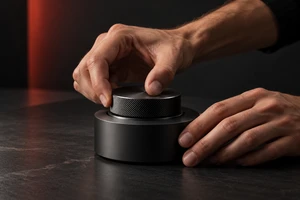
Imagine a coffee-machine sequence. A hand pushes the lever down, an indicator lights up, and the first drop lands in the cup. To make the opening feel faster, the editor compresses those moments into six rapid shots. The music drives forward and the images never lose energy. Yet the viewer remembers speed more clearly than the action that started the machine or the moment extraction became worth anticipating.
The rhythm of a product ad is not simply its average shot length. It determines when viewers form an expectation, when they confirm a result, and when they update what they understand about the product. A pause is not empty time when it makes a condition, response, or outcome readable.
Fast Cuts Capture Attention, but They Do Not Explain the Product
A 2026 study in the Journal of the Academy of Marketing Science combined frame-level measures of visual complexity and scene cuts from 42 public service announcements with eye-tracking data from 2,520 viewing experiences. In those materials and measures, shorter and visually simpler scenes produced greater attentional synchrony across viewers. Cuts increased synchrony, while visual complexity had a delayed negative effect. This is evidence about attentional focus, not proof that shorter shots improve sales. Its practical implication is more modest: speed works best when simplicity travels with it.
A separate, small experiment on native mobile-feed advertising compared 6-, 15-, and 30-second versions. Its 40 participants responded more positively to the 6-second ads but remembered them less well. The sample and setting do not justify a universal duration rule. They do show that attention, affect, and memory are different outcomes.
Fast editing can solve the outer problem of preventing a swipe. Product explanation still has to solve the inner problem of showing what happened. An ad can enter the problem quickly, change framing decisively, and remove irrelevant process while preserving enough time inside a key action for cause and effect to remain visible.
A Pause Can Perform Three Different Jobs
To decide whether a pause has value, do not begin with its frame count. Ask what the viewer completes during it.
Before the action: build expectation
A finger hovers over a button. A lid is about to close. Water is about to reach the filter. A brief hold before the action establishes the starting condition, giving the next change a reference point. Without a visible “before,” the “after” becomes a polished result with no mechanism.
This pause is especially useful when the claim depends on precision, resistance, magnetic alignment, automatic detection, or a safety response. The frame does not need to freeze. The camera may keep moving, the performer may breathe, and the machine may emit a preparation sound. The point is to avoid revealing the answer before the viewer has understood the question.
During the response: let the product answer the action
Product value often appears in a few dozen frames after contact: a dial passes its resistance point, a latch engages, a screen moves from waiting to response, or a structure remains stable under load. If the editor cuts on the musical accent and immediately leaves, the human gesture survives but the product feedback disappears.
This is not a reason to force slow motion. It is a reason to protect causality. The viewer should be able to tell which action triggered the change and what the product returned. If removing those frames makes the function harder to understand, they are not redundant.
After the result: give understanding a landing point
The coffee flow stabilizes. A case remains closed after the hand releases it. A cleaned surface returns to a complete composition. A brief hold after the outcome lets the viewer bind the change to the product and gives the brand, sound, or a short line of copy a place to enter without competing.
Research on event cognition offers a cautious explanation. In experiments using videos of natural activities, event boundaries affected object recognition and the updating of memory over the next few seconds; objects present around a boundary were better recognized in specific tests. This does not mean an extra half-second guarantees brand recall. It does suggest that the feeling of “an event has ended” plays a role in how viewers reorganize what they have just seen.
Cut for the Action, Not for Every Beat
Music can provide an editing spine, but it cannot decide the right product cut. Cutting every action on a beat may make a sequence orderly without making its cause and effect clear.
Research on continuity editing and event segmentation asked viewers to divide a commercial film into meaningful events. The study distinguished cuts that preserved space, time, and action; cuts that changed space or time while preserving action; and cuts that also disrupted action. In its material, action discontinuity had the strongest effect on perceived event boundaries. For product advertising, the useful inference is that framing and location can jump as long as the direction, stage, and outcome of the action still connect.
A medium shot may show a hand lifting a vacuum, a close-up may show the latch engaging, and a low angle may show the body clearing the floor. The sequence can move quickly, but “lift, connect, bear weight” cannot be rearranged. A musical accent can emphasize the latch. It should not remove both the approach before it and the stable state after it.
Powerful rhythm often comes from establishing a pattern and then breaking it when the product changes state. One slightly longer shot after three short shots feels important. Conversely, one clean cut inside a series of slower shots can direct attention toward a function. Rhythm comes from difference, not from making every beat equally fast.
The More Complex the Frame, the More Ruthlessly It Needs a Priority
The 2026 study of visual complexity and scene cuts matters because it discusses short shots together with simple imagery. A frame containing a facial reaction, a product action, three lines of copy, a price card, and a moving background may remain unclear even when it lasts two seconds. Extending the shot merely prolongs the competition.
Before editing, give each shot one verb: open, align, filter, fold, lock. If a shot needs three verbs to explain its job, it may need to be divided. If the verb is clear but the action is still unreadable, framing, occlusion, or screen direction may be the real problem. A pause cannot rescue an image with no visual priority.
Copy should not repair missing action either. Text is useful for naming a result, adding a number, or qualifying a condition. The product response should still be visible. When viewers must read a long sentence, track a hand, and decode an animated interface at the same time, “information density” can become information cancellation.
Platform Pace Can Be Fast While Product Causality Stays Complete
Google Ads' current ABCD guidance for video creative recommends getting to the heart of the story faster, using engaging pacing and tight framing, keeping the message focused, showing the product early, and placing the ask after context has been established. It does not require every second to move at the same speed.
It is more useful to separate platform pace from product pace. Platform pace determines how quickly the ad enters a conflict, how often the visual state changes, and when branding appears. Product pace determines the minimum time a function needs to move from condition to outcome. The first can be accelerated by removing greetings, decorative inserts, and repeated reactions. The second cannot be accelerated by deleting causality.
This distinction matters even more in vertical video. The frame is smaller, copy is closer, and the cost of swiping away is low, so the reason to watch must arrive quickly. Once the critical demonstration begins, however, the product needs a clear position, fewer competing movements, and a visible end state. The path to the product can be fast without turning the product into a flicker.
Generative Video Can Create Motion, but It Cannot Make the Brand Wait
Generative video editing is improving temporal consistency. CVPR 2025's VideoDirector treats color flicker, content distortion, and preservation of spatiotemporal layouts as central technical problems and proposes methods to address them. That work concerns whether an image can change coherently. It does not decide which frame carries the product's value.
Generative tools and automatic editing can be effective for rhythm drafts: comparing shot lengths, testing music speed, and creating transitions that do not carry functional proof. At a critical action, someone still needs to confirm that the right gesture caused the change, that the product geometry did not drift, and that the outcome remains long enough to understand. Software can align a cut to a beat. The brand must decide whether that beat creates energy or removes meaning.
Keep the Moment in Which Understanding Happens
During review, mute the music and ask three questions on the timeline. Before the action, does the viewer know what is about to happen? During the feedback, can the viewer see the product answer the action? After the result, is there enough time to confirm the change? If all three answers are yes, a very short sequence can still be clear. If one answer is no, additional copy and impact sounds usually hide the problem rather than solve it.
A pause is not reserved for slow advertising. It may last only a few frames, sit inside a rapid montage, or begin when the sound drops out while the image completes the action. Its value is not duration. Its value is moving the viewer from “I saw a lot” to “I understand what this product did.”
For more on shot design, editing, and commercial craft, explore ONCE's video production insights. If you are developing a product ad, you can also review our video production solutions and discuss how product action, editing rhythm, live action, and AIGC should divide the work.
Sources were checked on October 13, 2026. The coffee machine, vacuum, and case are hypothetical creative examples, not ONCE client work. Every cited study has its own materials, sample, and measurement limits and cannot substitute for audience testing or business results for a specific ad.