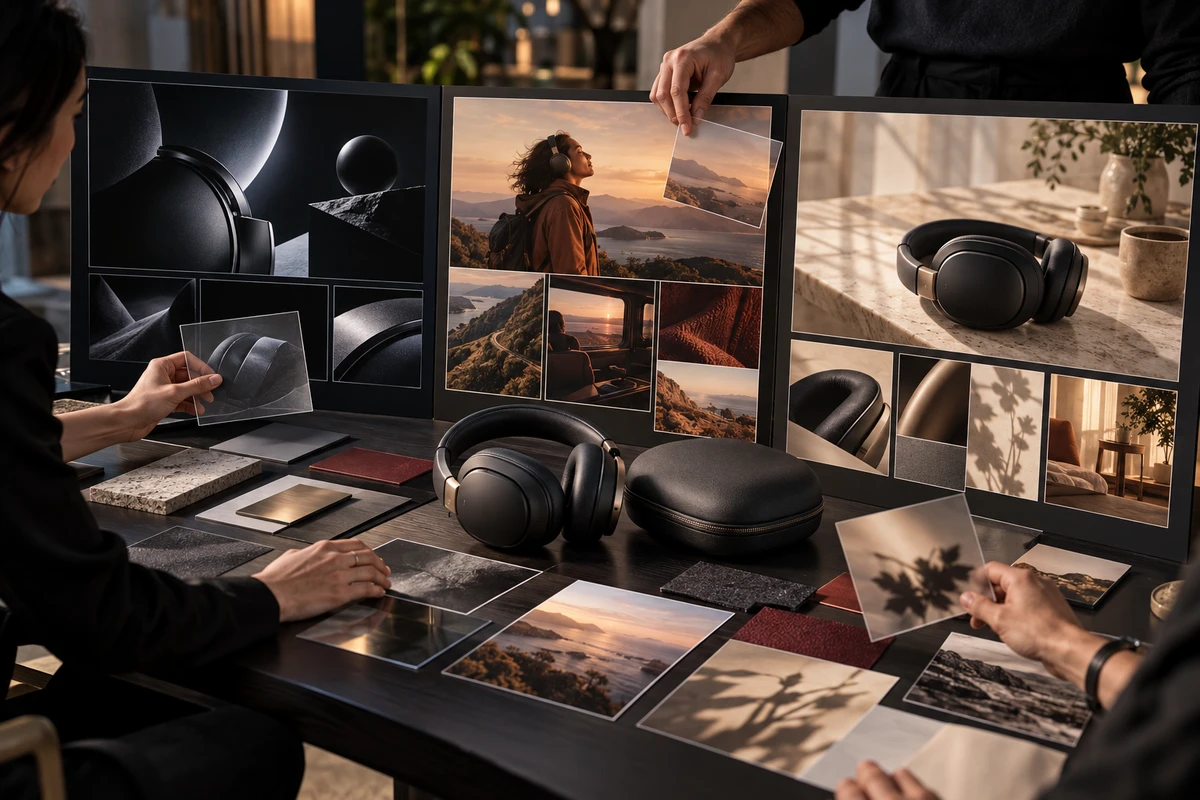
Give three directors the same launch brief and they should not return three cosmetic variations of one answer. One may turn the product into a bold visual symbol. Another may begin with a person and a use situation. A third may build the film around precisely controlled product choreography. The difficult question is not which PDF looks best. It is which proposal has the strongest reason to be made for this launch.
A practical decision starts by fixing the release date, the core product proposition and the version map. Then test each treatment against four questions: Does this world belong to the brand? Does the product cause something meaningful to happen? Can the hardest shot be tested? Will the idea survive outside the hero film? If a proposal relies on imagination to fill one of those gaps, it is not yet a production-ready direction.
Put the treatment back in its proper role
A director treatment is a specific interpretation of a shared brief: what the audience encounters first, when the product enters, how the talent performs, and how camera, design, edit and sound produce the intended experience. It is not simply a mood board, and it does not replace the script, storyboard, production schedule or bid.
The Association of Independent Commercial Producers' live-action guidelines describe a bid proposal, which may include a treatment or storyboards, as a creative roadmap and stress clear, specific communication between the production company and the contracting client. That is a useful way to read a treatment. A brand is not choosing a stack of references; it is choosing a route that can be translated into shots, resources and approval gates.
All shortlisted directors should therefore begin from the same confirmed inputs:
- one communication task rather than a list of equal selling points;
- product facts that may be shown and claimed;
- the release date and immovable launch moments;
- the separate jobs of the hero film, launch event, short cuts and vertical assets;
- prototype status, budget range and brand mandatories.
If the directors have received different brief versions, or one has quietly assumed that an unconfirmed feature or effect is available, the comparison has no common baseline.
One hypothetical product, three genuinely different proposals
The following example is entirely hypothetical. It is not an ONCE client project and does not describe the capabilities of a real product.
Imagine a pair of foldable over-ear headphones launching in 21 days. The proposition is not a vague promise of freedom. It is: headphones that take listening seriously can still fit naturally into daily commuting and travel. Confirmed product actions include folding, placing the headphones in a hard case, unfolding and wearing them, and operating a physical control dial. Deliverables include a 45-second hero film, a 20-second launch-event reveal, two 15-second feature cuts and a 9:16 social version.
Treatment A: a folding sculpture in darkness
The headphones float in a black space. A line of light reveals the hinge, earcups and metal edges in stages. The folding action becomes a precise sequence of motion before a fast transition brings the product into the brand colour.
This route is immediate, product-led and strong on a large launch screen. It could also yield a memorable key visual. Its weakness is meaning: if the motion only displays complexity, viewers may see an expensive object without understanding why folding matters in daily use. It also makes the hero moment dependent on repeatable hinge movement, reflection control, motion control or compositing. That shot should not be attempted for the first time on the main shoot.
Before awarding this route, ask for a focused test: one continuous fold with the real prototype under the intended light, checking hinge reflections, brand colour and transition speed. If the test fails, simplify the movement to a turntable, slider and edit relay before adding more post-production to an unreadable structure.
Treatment B: one pack-away action from desk to departure gate
A character finishes work, folds the headphones and places them in a bag. The same packing gesture carries the film through city travel and a departure setting. Keyboard sounds and transit announcements gradually give way to the private world of the music.
This route gives the clearest answer to why the product matters. It also gives the brand a human attitude rather than a sequence of beauty shots. But its risks sit in locations and performance. Does the film need a real office, transport environment and airport? Can the talent make several states feel natural within a short runtime? With 21 days remaining, permits, moves, extras and sound reconstruction could turn a good story into an unstable critical path.
The treatment becomes viable when the director separates the emotional idea of travel from the literal requirement to film in an airport. If continuous movement is the real mechanism, one controlled location, partial art direction and sound transitions may be enough. If the airport identity is essential to the proposition, access, timing and a fallback need to be part of the award decision.
Treatment C: a departure ritual on one tabletop
The whole film happens on a table in the early morning. A character packs a laptop, passport, headphones and case. The fold lands on the first beat of the music. Each camera setup can also become a feature cut or a vertical opening.
This is the most controllable route. Product actions are easy to read, and the hero film, short cuts and stills can share one designed environment. Yet control is not the same as ownership. A tabletop, natural light and packing gestures can quickly become generic lifestyle advertising.
For C to work, the treatment must define a relationship a competitor cannot simply inherit. The packing rhythm, control-dial sound and brand music might form a recognisable departure ritual. Brand colour might arrive through the bag lining, indicator light and final action rather than a painted backdrop.
There is no automatic winner. A concentrates investment in one product memory. B explains the product through a person. C trades scale for precision and version efficiency. The brand is choosing which value the launch cannot afford to lose, and whether the corresponding risk is visible and manageable.
Review the treatments through four gates, in order
Gate 1: brand ownership
Hide the logo and ask whether a competing brand could replace the product without damaging the story, colour system or sound. If the answer is yes, the treatment needs more than decoration. It needs a product action, character choice or sonic relationship derived from the brand proposition.
Gate 2: product causality
Rewrite the film as before, product action, after. The product must change something in the scene rather than arrive for a final hero shot. In this example, folding connects serious listening with everyday portability. If that relationship is not visible, material close-ups are only supplementary beauty.
Gate 3: testable execution
Do not stop at “Can we shoot it?” Identify the one shot whose failure would change the idea. For A, it is the fold and transition. For B, it is the performance across spaces. For C, it is whether tabletop choreography can feel distinctive. Test only that risk before the award, and write the test as an observable result rather than a request to “see how it feels.”
If a treatment uses AI-generated concept frames, it should identify whether they are directional references or intended conditions for the final film. The team should also check the generation tool, source materials and any third-party people, products or stylistic references. WIPO's current filmmaking rights-clearance guide notes that undisclosed generative-AI use, project inputs and third-party rights can affect the chain of title. Concept frames can focus a conversation; they do not prove that a location, person or product detail can lawfully and consistently appear in the final commercial.
Gate 4: channel recomposition
Versions should not begin as crops made after the hero film. Google Ads' current creative guidance checks, among other attributes, early brand presence, duration relative to objective, and the inclusion of 16:9, 9:16 and 1:1 orientations in an ad group. This is not a universal creative formula, but it shows why delivery requirements influence what must be filmed.
Ask each director: What opens the 15-second cut? Can the product and person coexist in a vertical frame? Will the launch reveal make sense without the preceding hero-film setup? “We will solve it in post” is not yet a version plan.
Reverse the approvals from release day
This is a working rhythm for the hypothetical 21-day project, not a universal production timeline.
- T-21: Lock the proposition, approved product facts, version list and final decision-maker. Compare treatments only against this shared baseline.
- T-19: Select one preferred route and record two questions that still require an answer. Approve the direction, not every frame.
- T-17: Test the hardest shot. Only after it passes should the relevant equipment, location or post method become part of the production plan. If it fails, switch to the lighter fallback.
- T-15: Lock the 45-second structure, launch reveal, distinct openings for the two 15-second cuts and the compositions that require separate 9:16 coverage.
- T-12: Confirm storyboards, shot list, prototype actions, location and art direction. Product and rights questions cannot remain assumed.
- T-7: Review the hero film and essential short cuts in the same rough-cut batch, starting with proposition, product action and version entry points.
- T-3: Freeze product copy, captions, end cards, brand assets and channel-specific export requirements. New creative moves to a post-launch version rather than reopening the master.
The bottleneck is rarely the speed at which a director writes. It is the brand's ability to make timely choices about product truth, channels and approval ownership. The release date does not move because the internal team is still comparing adjectives.
A one-page, two-column treatment review card
Do not turn this into a false-precision score. Put the question on the left. On the right, allow only a confirmed answer, a condition to test, an owner and a deadline.
| Review question | What this project must state |
|---|---|
| What has this director added? | What observation, rhythm or scene does this proposal contribute beyond repeating the brief? |
| Where does brand recognition begin? | In the opening passage, how do product, action, sound or human relationship make the brand present? |
| How does the product create causality? | Which action changes the character's situation or the viewer's understanding, and who approves the fact? |
| What is the hardest shot? | What is lost if it fails, and what test will be completed by T-17? |
| What is the lighter fallback? | How will the core idea survive without the risky location, complex equipment or unconfirmed effect? |
| How do the versions divide their jobs? | Where do the 45-, 20- and 15-second films and the 9:16 version begin and end? |
| What are the references? | Which frames are previous work, third-party inspiration, stock, CGI or AI concepts, and which are not promises of final delivery? |
| What is still assumed? | Which prototype, location, talent, music, rights, feature or approval dependency remains open? |
| Who approves, and when? | At which gate do brand, product, legal, production and the final decision-maker respond? |
If the right column fills with “to be refined later”, “should be fine” and “leave it to the director”, the treatment is not ready for a production award. A strong proposal can preserve imagination while naming what is decided, what must be tested and how the idea survives a failed test.
When a beautiful treatment should pause
Pause even a popular proposal in three situations.
First, its most affecting moment depends on an unconfirmed product capability. Change the action or narrow the claim before editing creates a false cause.
Second, the central scene depends on one high-risk condition without a test or fallback. Creative work can take risks, but the team should choose them rather than discover them late.
Third, the hero film is complete but every supporting asset is only an excerpt. A launch needs a system of content, not one landscape film and several differently sized fragments.
The final choice does not have to be the safest or the most expensive treatment. It should make four things clear: why this is the brand's film, why this product action matters, why the idea deserves to be made now, and what changes first if the test fails.
ONCE's brand film production and TVC and commercial production pages describe the current path from communication task and director approach through production and multi-format delivery. If you are comparing director treatments for a product launch, use the project brief form to share the product, target market, channels, release date, current treatments, prototype status and budget range. We can first establish a common review baseline and identify the shot that must be tested before discussing full production.