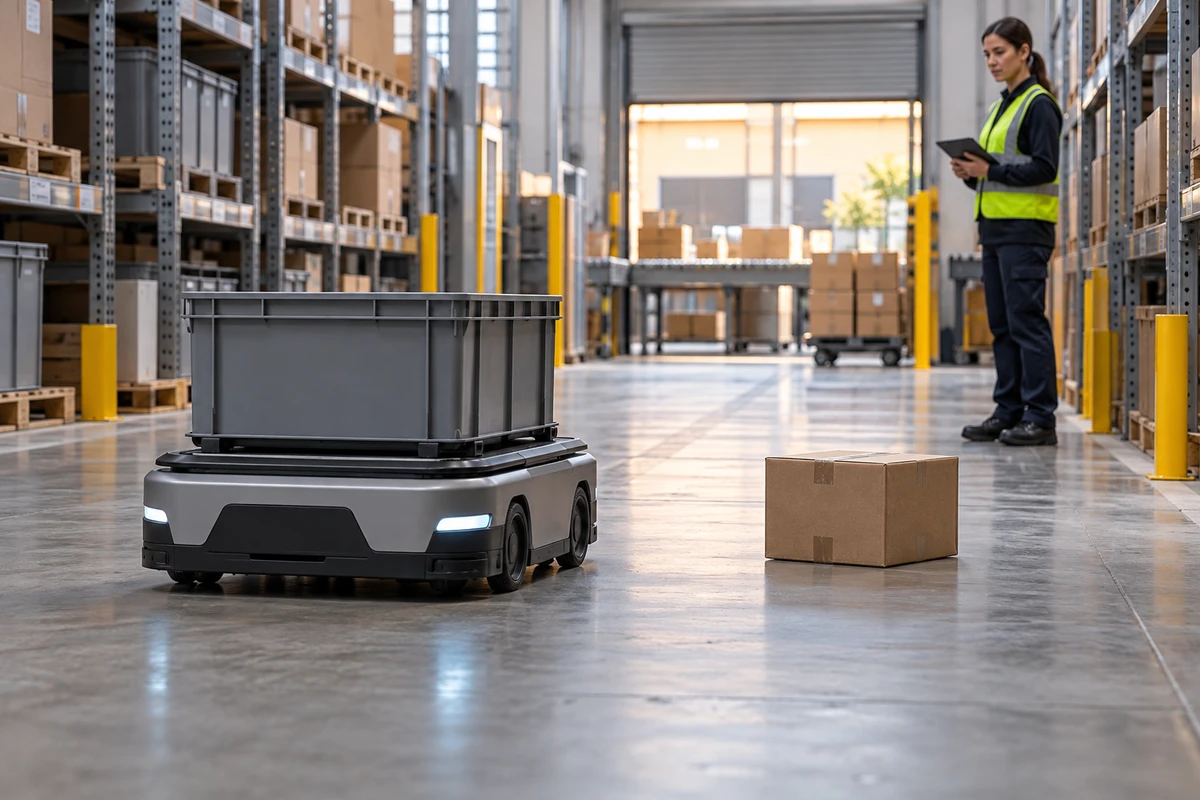
In a robot product film, an autonomous mobile robot can travel neatly down a warehouse aisle, turn, pass a box and dock at a workstation. The shot may look convincing. Yet it proves only that this machine completed this task, on this route, under these particular conditions. It does not automatically prove that the robot can understand every obstacle, make autonomous decisions in any warehouse, sustain a throughput target or deliver a return on investment.
Before filming, separate the claim into three layers: what the robot physically did, why the system changed its behaviour, and what part of the operational workflow was actually completed. All three can appear in one edit, but they need different footage and different approval evidence.
A fluid tracking shot proves continuity, not autonomy
A low tracking move is excellent for giving the robot speed, scale and mechanical presence. The problem is that when the camera travels in the same direction, viewers cannot easily tell whether the route was cleared in advance, whether the obstacle was fixed, or whether the turn came from a predefined path rather than a fresh system decision.
The answer is not to avoid cinematic camera movement. It is to stop asking one shot to prove more than it can. Let the tracking shot carry the brand rhythm. Add a locked continuous wide shot that preserves the starting point, aisle, temporary obstacle, people and destination. They show the same mission, but answer different questions.
NIST's current mobile robotics research describes AMR performance in relation to operating environments and parameters, including forced delocalisation, static and dynamic loads, multi-vehicle operation, navigation, docking, object detection and protection. Its 2022 small-obstacle avoidance research also reports that performance changes with robot specifications, obstacle size and environmental conditions. The production lesson is simple: one successful detour should not stand in for conditions the product team has not tested.
If the film only claims that the robot can complete one approved transport task, a clean route may be enough. If the script says autonomous obstacle avoidance, dynamic rerouting or human-robot collaboration, the footage must also show the environmental change and the system's real response.
Split one mission into action, decision and outcome
Consider a hypothetical warehouse AMR. It collects a tote of components from receiving, travels through a shared aisle and delivers it to an assembly station. This is a production-method example, not an ONCE client project, and it does not imply that any real model has these capabilities.
Action: what the machine physically completed
The action layer includes starting, travelling, turning, slowing, docking, lifting or unloading. Show the real relationship between the robot and the tote. Was the load positioned in advance? Was the carrier secured? What visible state confirms that docking or transfer is complete? Close-ups of wheels, sensors, lifting hardware and indicators can improve understanding, but they cannot replace the full action.
This layer can answer, “Can it perform the movement?” It cannot by itself explain why the movement occurred. Even a highly accurate path may be preprogrammed or guided by markers. If the film does not show the task input and a changing environment, the voice-over should not promote the shot into evidence of real-time intelligence.
Decision: what change triggered the system response
The decision layer puts input and response on the same timeline. When an approved box is placed on the route, does the robot slow, stop, wait, replan or request human intervention? A map, fleet-management screen or event log can help explain the response, but it needs to come from the approved system version and share a timing reference with the physical action.
The most useful view is rarely a dramatic close-up of an obstacle appearing. It is a continuous wide shot, interface record and robot state that can be reconciled with one another. Do not improvise a more hazardous or technically unsupported test merely because it looks more exciting.
Outcome: was the operational job completed
Reaching the destination does not necessarily complete the transport task. The outcome may require the tote ID to be confirmed, the workstation to accept the load, the dispatch task to close, an operator to collect material safely, or a downstream process to start. Choose a visible completion criterion that the brand can approve, rather than relying on a narrator to announce “greater efficiency.”
One filmed run also cannot establish long-term throughput, reliability or ROI. If those claims appear, they need to match the brand's approved measurements, conditions and customer permissions. For US-facing advertising, the FTC's substantiation policy requires a reasonable basis for objective express and implied claims before they are disseminated. The implication created by a picture matters alongside the words.
Film the same mission four ways, not ten identical beauty takes
Ten repetitions of the same clean route produce more editing options, but little new information. A stronger plan gives four runs four distinct observation jobs.
- Baseline mission. Under approved conditions, record dispatch, pickup, travel, docking and handoff without interruption. Secure a continuous master first, then add branded moving shots.
- Controlled change. Change one variable only, such as placing an approved static obstacle at a defined position. Keep the load, route, lighting and software version constant, and record the actual response.
- Recovery and handoff. Show obstacle removal, task continuation, human confirmation or reset after a safe stop. If the product requires manual recovery, film the approved human procedure instead of editing it into an apparently autonomous recovery.
- System view. Record task dispatch, map or fleet state, event time and completion marker. It may not all enter the hero film, but it gives post-production and technical reviewers a reliable sync reference.
Use one mission ID across all four runs. Record the sample, software build, load, route, obstacle condition, operator, start and end time, and what may be shown publicly. This prevents post-production from combining the interface from run A, the docking from run B and the sound from run C into a “perfect” operation that never happened.
This goes beyond a general feature demonstration. ONCE's guide to filming smart hardware as verifiable state changes is useful for recording starting state, feedback and reset. Here, the same logic is extended into a four-run warehouse mission in which action, decision and operational outcome are approved separately.
When human interaction and recovery need their own footage
If people share the aisle, cross the robot's path or handle the load at close range, they cannot be treated as set dressing. OSHA's current warehouse guidance notes that poorly integrated automation can introduce struck-by and caught-between hazards, and that workers need to understand hazards associated with industrial robots. Published on 23 April 2026, ANSI/A3 R15.08-3-2026 emphasises risk assessment, management of changes to the application and operating environment, and safety through the machinery lifecycle.
These references do not certify a promotional shoot. They do change the production plan. Human paths, robot speed, obstacle placement, emergency-stop responsibility, exclusion areas and reset procedures should be approved by the brand, integrator or site safety lead. Moving a floor marking, blocking a sensor or sending talent into an active route for a stronger composition is not an ordinary creative adjustment.
Recovery or collaboration footage is usually necessary when:
- the script explicitly claims dynamic obstacle avoidance, human collaboration, autonomous recovery or unattended operation;
- buyers need to know whether an exception leads to stop, retry, reroute or human intervention;
- robot movement is only one part of a workflow that also depends on a workstation, conveyor, access gate or fleet system;
- the real application differs materially from the demo site in flooring, aisle width, lighting, load or pedestrian traffic.
If the film is purely a launch visual about form and engineering design, and makes no safety, performance or autonomy claim, there is no need to force every exception into the hero edit. Keep a separate sales demonstration or technical evidence cut instead.
Post-production and AI can explain the setting, not invent a decision
Composited interfaces can make maps and task states readable. 3D animation can explain sensor coverage or a material route. Generative AI can help previsualise art direction or extend a background that carries no product-performance claim. It should not add an obstacle response that never occurred, remove real human intervention, or turn a controlled path into an apparently autonomous run through a busy warehouse.
The IAB published its AI Transparency and Disclosure Framework V2 in August 2026, using a risk- and materiality-based approach to when and how AI involvement should be disclosed in advertising and marketing content. It is not a single global law. For production, the practical step is an asset ledger: label continuous live capture, approved interface material, explanatory graphics and generated environments separately. If a generated or composited element changes what a viewer could infer about product capability, review both its use and its disclosure.
Sound deserves the same care. Keep real motor sound, alerts and warehouse ambience on separate tracks. Enhancement may help pacing, but it should not make the robot appear quieter, faster or equipped with alarms the approved product does not have.
A claim-to-shot matrix for the brief and final review
| Intended claim | Footage and approval required before filming |
|---|---|
| Completes transport in a defined scenario | Continuous baseline mission, load and route conditions, visible completion criterion |
| Responds to a static obstacle | Approved obstacle type and position, continuous wide shot, real slow/stop/reroute result |
| Operates from a dispatch task | Dispatch screen, mission ID, sync reference between physical action and completed system state |
| Shares a work area with people | Approved blocking and site safety plan, real robot response; the mere presence of a person cannot imply safety |
| Recovers after an exception | Real exception state, recovery trigger, manual or automatic steps, and a completion criterion after recovery |
| Improves throughput or efficiency | Approved measurement method, baseline, period, conditions and wording; a single demonstration is insufficient |
During final review, mute the film and ask whether the images distinguish action, decision and outcome. Then compare the footage log to confirm that interface, sound and physical behaviour have not been mismatched across takes. Finally, check every strong adjective, number and safety implication against the approved support. If one layer exists only in the viewer's imagination, reduce the claim, film the missing evidence or identify the sequence as an illustration.
A strong robot product film does not need to resemble a test report. It does need to let creativity rest on real capability. To plan a project, use ONCE's product video production service and share the robot model, intended buyers, application site, proposed claims, sample and software status, channels and launch date. We can first translate action, decision and outcome into footage that can be filmed, synchronised and approved, then plan how the hero film, sales demo and short versions can share one production.