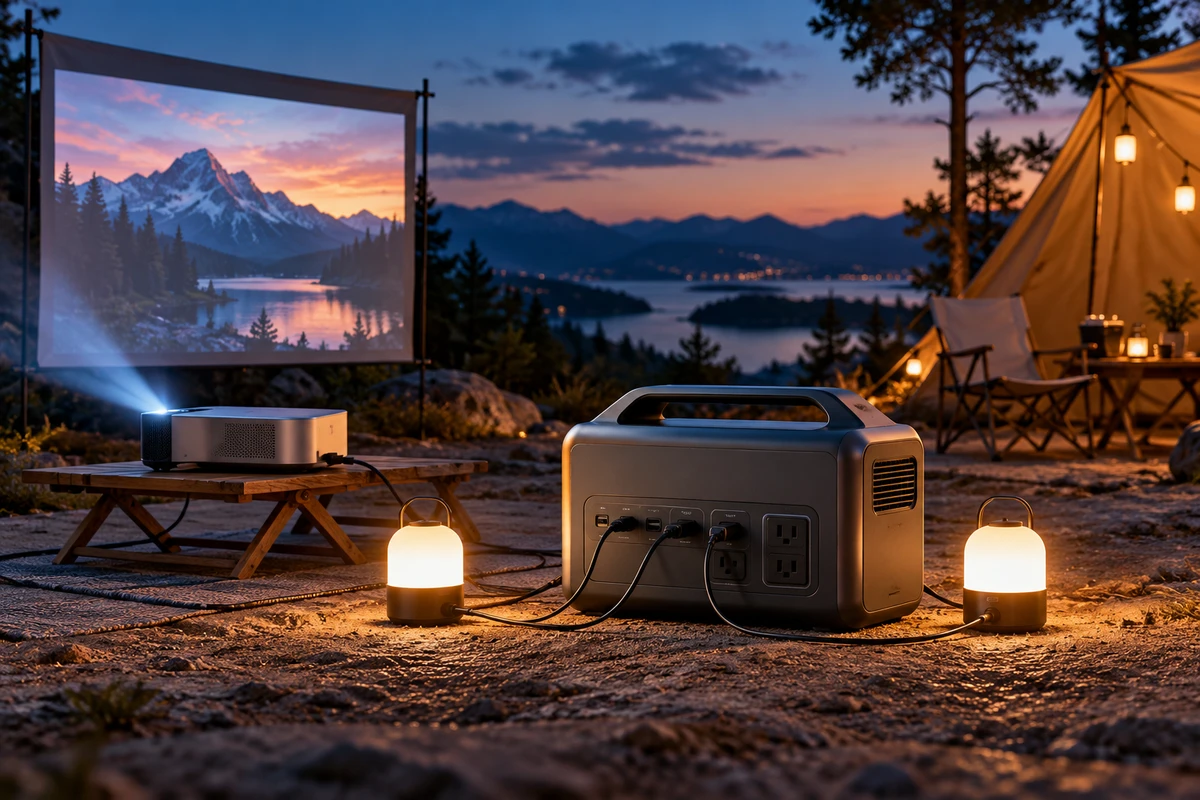
A portable power station sits beside a tent, running a coffee maker, a projector and a string of lights. The people on screen settle in for the evening. Viewers can easily read three claims into that sequence: the product belongs outdoors, it can power those devices, and it will keep doing so for a long time.
The camera, however, has recorded only one arranged period of use. It has not established runtime, continuous output or a safety classification. Nor has it explained how the inverter, battery-management system or protective logic works. The problem is not the lifestyle scene itself. It is asking one attractive scene to support three different kinds of claim.
A clearer production separates the film into three lines. The scenario answers why the product is needed. A controlled demonstration records what happened under defined conditions. A technical explanation shows how internal relationships work. They can be intercut, but they require different footage, approvals and acceptance tests.
A scenario is not just a backdrop; it can change the implied use
Consider a hypothetical portable power station in the 1 kWh class. It is not an ONCE client product and does not represent the specifications of a real model. The brand wants two settings: a weekend campsite and temporary household backup during an outage.
At the campsite, a coffee maker and lights establish the product's role in an off-grid task. In the home, powering a router, lamp and phone can still read as temporary portable use. But a fixed distribution panel, wiring concealed inside walls, daisy-chained units or a permanent installation can make the same object look like a residential energy-storage system.
That distinction is more than art direction. In its 2025 Q&A on portable power packs, UL Solutions explains that a portable pack certified to the scope of UL 2743 does not become a correctly certified stationary residential energy-storage system merely because it is combined with a separately certified switch or panel. The practical production lesson is that props, wiring and spatial relationships can create a product claim.
An art-direction review should therefore ask:
- Does the image show temporary use, portable outdoor use or a fixed installation?
- Are the load combination, cables, adaptors and placement permitted for this model?
- Does talent block ventilation, place soft furnishings too close, or treat rain, sand or heat as harmless atmosphere?
- Does a home, vehicle or outdoor setting introduce an application that needs a fresh product, safety or compliance approval?
The lifestyle line is complete when a viewer understands the task without being led towards an unapproved use.
A controlled demonstration should answer one question
A useful starting principle is to give design, function, performance and context shots separate responsibilities. For a portable energy product, the controlled demonstration should go further: it should prove one approved fact without replaying the entire lifestyle story.
Suppose the intended claim is not “powers your evening,” but “under a defined starting charge, environment and connection setup, the unit powers one compact projector and two lights at the same time.” Footage carrying that claim needs a record of:
- the sample and firmware version;
- starting state of charge, output mode and port combination;
- load device models and their actual operating range;
- ambient temperature and start and end time;
- whether the product display, load response and outcome share one timeline;
- any derating, error, restart or human intervention.
The finished film may retain only a few seconds, but the production archive should keep the continuous master and the shot log. If those conditions cannot be confirmed, reduce the wording to an observable fact, such as “three devices connected,” rather than promoting it to an all-night performance claim.
For US-facing advertising, the FTC's substantiation policy expects a reasonable basis for objective express and implied claims before dissemination. The FTC's small-business advertising guide also explains that words, pictures and the overall context are considered together. A montage that moves from dusk to late night can therefore create a duration inference even when no runtime number appears.
Use animation to explain a mechanism, not to generate a result
The internal story is often the hardest to film and the part a brand most wants buyers to understand: cells store energy, the inverter supplies AC output, the BMS monitors states, and the thermal design manages heat.
The US Department of Energy's 2025 battery energy-storage report identifies state of charge, temperature, voltage, current and input/output power among important measurements used for functions such as charge control, thermal management, fault detection and load management. It is a system-level reference, not a feature list for a particular portable unit. Product animation still needs that model's approved architecture, terminology and state definitions.
Before animation begins, define which task it performs:
- Architecture: show how cells, inverter, interfaces and airflow relate.
- Energy path: show where energy moves during charging or discharge.
- State explanation: connect an approved display value or warning to its defined state.
- Protection illustration: explain which monitored condition may lead to derating, stopping or an alert.
Do not add sensors, cooling hardware or protective behaviour because they look plausible. Explanatory arrows are not live measurements. Generative AI may extend a campsite, weather condition or non-functional background, but the product body, wiring, operating state and human action still need to match approved material.
The IAB's August 2026 AI Transparency and Disclosure Framework V2 uses a risk- and materiality-based approach to disclosure. A useful production practice is to label live capture, interface recordings, explanatory 3D and generated environments separately. If a generated or composited element changes what viewers could infer about capability or authenticity, review both its use and its disclosure.
Safety footage is about approved normal use, not a dramatic failure test
Lithium-battery advertising can quickly drift towards “let's make the test more exciting.” A normal commercial shoot should not improvise crush, penetration, overcharge, short-circuit, extreme-temperature or flame demonstrations. UL Solutions' public lithium-ion battery safety guidance describes how mechanical abuse, abnormal temperatures and charging or discharging beyond safe limits can be associated with shorts, overheating and thermal-runaway risk.
Safety communication is better served by recording correct connection, clear ventilation, status indications, cable inspection and the approved shutdown procedure. Certification, transport testing, recall status and safety conclusions belong to the relevant documents.
On 20 August 2026, the US Consumer Product Safety Commission announced a recall of one portable power-station model because its circuit board could overheat. This does not establish that the category as a whole is unsafe. It shows why a safety claim and a pre-publication check must remain tied to a specific model, batch, market and current status.
The product or safety owner should approve loads, connection methods, environmental conditions, emergency stop and power-down procedures before filming. The production team translates approved conditions into executable shots; it should not invent destructive tests for the brand.
One 45-second film can give the three lines different jobs
This is a production example, not a universal edit template:
- 0–12 seconds — task line. Evening begins at a campsite. Talent needs power for projection, lighting and mobile devices. Establish portability, position and motive without introducing an unapproved runtime claim.
- 12–25 seconds — condition line. Show connection, product state, two load types starting and selected moments from a continuous master. On-screen wording states only conditions and results supported by approved material.
- 25–35 seconds — mechanism line. Use a technically reviewed animation to explain the energy path, inverter output or state monitoring. Keep illustration distinct from live data.
- 35–45 seconds — return to the task. The viewing or lighting task is completed, and the ending returns to the product's role and one central promise. A night image completes the scene; it does not prove all-night runtime.
A product-page cut can retain more conditions. A social edit can focus on one task. Neither a vertical crop nor a shorter duration should remove the qualifying condition while leaving the strongest claim on its own.
Claim, shot and approval matrix
| Intended communication | Primary shot task | Approval required before filming |
|---|---|---|
| Suitable for temporary outdoor power | Show the relationship between people, product, loads and environment | Approved setting, instructions, talent actions and prop list |
| Powers named devices simultaneously | Record continuous connection, product state and load response | Sample version, port combination, device models, environment and duration |
| Explain inverter or BMS behaviour | Use reviewed architecture or energy-path animation | Product architecture, terminology, state definitions and engineering approval |
| Show safe normal-use practices | Show correct cables, ventilation, warnings and shutdown | Model-specific manual, target-market material and site safety plan |
| State a certification or test result | Present the correct document name and applicable model | Valid document, standard version, scope, and legal or compliance approval |
| Position the product for home backup | Show an approved household task without exaggerating installation | Permitted use, connection design, and target-market installation and advertising requirements |
During final review, mute the film. Ask what a viewer would infer from the images alone. Then map each inference to approved product information, a controlled demonstration or a clearly identified illustration. If one beautiful shot implies use, performance and safety while only one layer is supported, split the shot, reduce the claim or obtain the missing approval.
A strong portable power-station film does not need to resemble a laboratory report. Lifestyle should create desire, controlled demonstration should establish facts, and animation should create understanding. To prepare a project, use ONCE's product video production service and share the target market, model, sample status, specifications, proposed scenarios, key claims and delivery channels. We can separate the three lines before deciding what needs live action, continuous recording or technical illustration.
Sources checked on 11 October 2026. Product filming and distribution requirements remain subject to the specific model, target market, valid documentation and approval by the appropriate product, safety and legal owners.