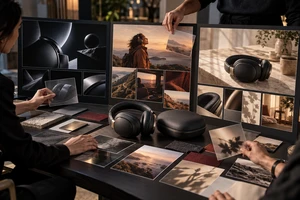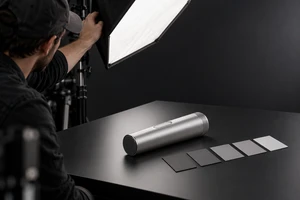
A new television is advertised through the viewer’s older television or phone. A spatial-audio product is heard through unknown speakers. Fragrance, textile hand-feel, seating comfort and mattress support cannot be transported through a video at all. In these categories, treating video as an experience replica encourages over-grading, exaggerated sound design, synthetic before-and-after shots and claims such as “immersive” that no buyer can properly verify.
The stronger strategy is to acknowledge the medium’s limit. Video should build understanding and a reason to care, then hand the final judgment to a compatible device, store demo, sample or trial. For brands connected to Chinese manufacturing, that changes the production brief: procure an evidence-and-handoff system, not just an attractive master file.
Start with the input and the promised output
The input is a product advantage that depends on a viewing device or a physical sensation. The output is not a perfect copy of that sensation. It is a defensible chain from claim to explanation, proxy and real-world verification.
The technical reason is straightforward. The W3C’s June 9, 2026 Media Capabilities Working Draft treats display capability as part of media selection and notes that sites can avoid sending HDR content to an SDR display. YouTube’s HDR upload guidance says compatible devices can show HDR, while non-HDR viewers receive an SDR version. Incorrect metadata or grading can also produce the wrong result.
There is no single “true image” experienced by every viewer. Capture, master, platform transcode and endpoint hardware can each alter color, brightness, detail or sound.
That does not make video useless. It can explain why the difference exists, show a proxy that survives ordinary devices, state the test conditions, and route the viewer to a place where the experience can be verified. What it should not do is imply that an enhanced representation is a direct demonstration of normal product performance.
A demonstration is a claim, not decoration
The US Federal Trade Commission’s advertising guidance says advertisers need support for express and implied claims before an ad runs, and that material omissions can also mislead. FTC enforcement material adds that product demonstrations should accurately depict normal consumer use; an altered demonstration cannot be presented as proof of a material attribute.
Generative AI raises the stakes. Google’s July 2026 policy update permits and supports labels for AI-generated or modified ad assets, while YouTube requires disclosure for realistic content that is meaningfully generated or altered. Disclosure answers how an asset was made. It does not substantiate the product claim. An AI-enhanced color, soundstage or surface reflection does not become product evidence merely because it carries a label.
At script stage, classify each visual as one of three things: a real demonstration, an explanatory visualization or an emotional expression. All three are legitimate creative devices. The last two must not masquerade as the first.
A current commercial signal: advertising explains, retail completes the experience
On June 22, 2026, Best Buy introduced its “Believing is Seeing” RGB LED television campaign. It connected television spots, digital content, creators, a product hub and in-store displays, calling the store the ultimate way to experience the technology. This is evidence of one retailer’s operating choice, not proof that every category has adopted the same model.
The structure is still useful. Online media did not have to reproduce a new television through whatever screen the audience already owned. It explained the technology, created curiosity, supplied comparison cues and directed shoppers to a place where the difference could be inspected. Brands with distributors, trade-show booths, samples or trials can design the same kind of experience handoff.
The ONCE SENSE workflow
SENSE is a production and procurement checklist, not a platform rule. It is designed for claims involving color, soundstage, texture, scent, comfort, quietness or spatial scale—advantages that change with endpoints or physical conditions.
S — State the reproduction limit
Say what an ordinary screen, speaker or headphone cannot faithfully establish. Put the clarification next to the relevant representation, not in distant fine print. A useful statement might say that the visual explains the technology and that actual color should be evaluated on a compatible display or in store.
E — Explain the mechanism
Break the experience into a mechanism that can be understood: light-source architecture, material layers, driver design, noise path, pressure distribution or manufacturing process. The mechanism shot should answer why the experience may differ, not simply add spectacle.
N — Name a verifiable proxy
If the sensation cannot travel through the media channel, choose a proxy that remains valid on ordinary devices: instrument output, controlled conditions, a cutaway, a repeatable operating step, a third-party specification or an authentic response under a defined test. State what the proxy supports and what it does not.
S — Send the viewer to verification
Every asset should map to a real next step: local retailer, trade-show location, sample request, trial, compatible-device version, booked demonstration or clear return policy. The call to action is not a decorative “learn more.” It is the next station in the experience path.
E — Evidence-lock the claim
For each material claim, retain approved language, test conditions, source footage, color and audio versions, AI alteration records, territory and reviewer. When a platform transcodes the asset or a market re-edits it, the team can still identify which version supports which statement.
Roles and deliverables
A useful scope for an experience-led product video usually includes:
- a truth-preserving master plus HDR, SDR and major-platform compression versions where relevant;
- separate mechanism and proxy-evidence shots, labelled so later editors do not confuse their purposes;
- test conditions, sources, qualifications and market applicability for every material claim;
- a record of generated, repaired, extended or enhanced components and required disclosures;
- one consistent path from video and product page to store, sample or trial;
- endpoint QA on an ordinary phone and laptop, plus the target TV, headphone or other relevant device.
This is why “price per finished video” is a weak comparison. A more useful management denominator is:
Cost per verified experience claim = (truth-preserving master + mechanism/proxy evidence + endpoint versions + disclosure and review + experience handoff + QA) ÷ claims that pass technical, claim and verification-path checks
This is not an industry benchmark and it makes no conversion promise. It makes hidden work visible. A cheap asset that fails on common endpoints, has no verification path and cannot trace its claim support has not completed the assignment.
Quality control by project type
Directly visible features
If size, controls, ports, packaging and ordinary visible functions reproduce reliably, keep the process simple. Authentic capture, clear explanation and standard format adaptations are enough.
Endpoint-sensitive features
For HDR displays, spatial audio and similar claims, make a fidelity version and a safe fallback. The fidelity version serves compatible endpoints. The fallback does not pretend to recreate the experience; it uses mechanism, proxy and handoff.
Physical or in-person features
For textiles, fragrance, seating, mattresses, furniture scale and industrial performance, design the sample, trial or showroom path early. Success is not that viewers believe they have already felt the product. It is that they understand the difference worth verifying and can reach the next step without friction.
Teams distributing across feeds, muted placements, full-screen video and connected TV can also use ONCE’s analysis of how viewing environments change video acceptance criteria. The goal is to verify the asset on the surfaces that will actually mediate the claim.
Completion standard: five questions before release
- Can the viewer’s current endpoint genuinely reproduce the difference being claimed?
- Is the shot a demonstration, an explanation, a simulation or an emotional expression—and is that distinction clear?
- What pre-publication support exists for each objective claim, and do the test conditions match the advertised use?
- Does the story remain accurate after SDR fallback, muted playback and platform transcode?
- Where can the buyer complete real verification, and is that route available in the target market?
When a product advantage cannot survive the viewer’s screen, speakers or network conditions, the professional response is not to make the effect louder. It is to redefine the job of video: explain the difference honestly, provide verifiable cues and hand the final experience to a place capable of delivering it.
Sources and limits
This analysis draws on the W3C Media Capabilities Working Draft dated June 9, 2026; YouTube Help’s HDR upload guidance; FTC advertising and product-demonstration guidance; Google’s July 2026 AI-labeling update; and Best Buy’s June 22, 2026 RGB LED campaign announcement. The SENSE workflow, deliverables and cost denominator are ONCE analysis, not platform rules, legal advice or performance guarantees.