There is no universal point at which every brand film should record its final voiceover. In an animation-led explainer, the finished narration may need to enter the timeline early. In a corporate film built around interviews and real operations, recording it too soon can force the edit to serve an obsolete script. In a visual and music-led commercial, a scratch track can hold the place until the picture order is stable enough for a final performance.
The useful purchasing question is not simply “before or after the edit?” It is which of three things is being locked: the words, the timing, or the final voice.
Separate content lock, timing lock and voice lock
A narration normally passes through at least three states.
- Content lock: facts, wording, names, figures, calls to action and required qualifications are approved. Pauses may still change, but the meaning should not.
- Timing lock: a scratch track has been placed on the timeline. The team can hear sentence length, pauses, emphasis and the relationship between each section and the picture. This approves usable timing, not the final voice.
- Voice lock: the speaker, language, performance direction, pronunciation and selected take are confirmed. The recording can move into cleanup, sound design and mixing.
Adobe's current overview of post-production and picture lock describes picture lock as the point at which the final cut and its timecode become stable enough for sound and effects to sync precisely. That supports placing final audio near picture lock in many live-action workflows. It does not mean every production should wait until the end: when animation, captions or product motion must follow speech, narration needs to become an input earlier.
Scenario one: narration controls the picture duration
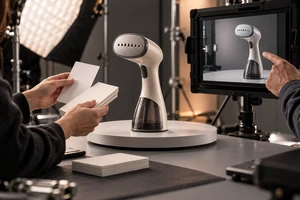
Product explainers, technology films and motion-graphics-heavy brand videos often build the image around language. The second on which a keyword lands can determine when a diagram appears, when a parameter changes and when an animated action completes. A word-count estimate cannot capture actual pauses, emphasis or breath.
A practical sequence is scratch read, content approval, final voiceover, then detailed animation. The scratch track exposes sentences that are too long, technical terms that do not speak naturally and sections with too much information. Once the words are approved, the final performance becomes the timing base for detailed motion.
Before this recording, the buyer should expect a voice-ready script, pronunciation list, target duration, performance reference and a named approver. “Final” means that the writing and performance task are stable; it does not mean that music and the final mix are finished.
Scenario two: real footage determines the story
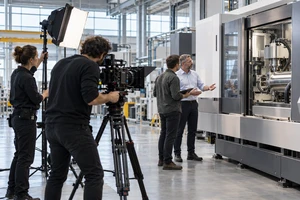
Corporate films, documentary-style brand stories and leadership interviews often find their strongest material on location. An interview may produce a more specific line than the script. A factory, laboratory or customer site may change the order in which the business is best explained. Recording the final narration before the shoot can make the editor protect a voice track at the expense of better evidence.
These projects benefit from an early scratch track at approximately the intended pace. It can estimate coverage and total length. During the rough cut, the team can then place interview selects, observed actions and narration on one timeline and decide what should be said by a person, shown by the picture or connected by a narrator.
The right point for final recording is when the principal interview extracts and section order are stable, and narration is no longer being used to fill every gap. This keeps the recording out of the last-minute rush without letting it dominate the editorial judgment.
Scenario three: picture and music lead the commercial
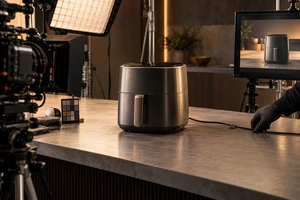
In a commercial driven by performance, product close-ups, action and music, narration may appear only at the opening, turn or end. Here the scratch track is a placeholder. It tests whether a line covers an important action, whether the call to action lands on the brand frame and whether music must make room for intelligibility.
Once shot order, durations and major rhythm points are stable, the voice artist can perform against the actual picture. Recording a polished performance before that relationship exists can leave the team choosing between damaging the visual edit and squeezing the voice.
Casting, auditions, pronunciation work and performance direction can begin earlier. What should wait is the take most likely to be invalidated by a picture change. Teams planning a campaign can review ONCE's TVC and commercial production scope and put the voiceover milestone beside the hero film, cutdowns and vertical versions.
A scratch track is a decision tool, not a casual read
A usable scratch track should contain the actual current wording, be read near the intended emotional register and pace, preserve meaningful pauses, and identify sections and emphasis points on the timeline. A phone recording can be enough for early discussion. A mechanically even placeholder cannot honestly represent the final rhythm.
Make the following items visible deliverables rather than fragments in a chat thread:
- a versioned, voice-ready script with pronunciations for names, figures and abbreviations;
- the scratch recording and the exact script version it represents;
- a timecoded rough cut or animatic marking the beginning and end of each narration section;
- final-session takes, the selection decision and any pickup lines;
- separate voice, music and effects stems when they are included in the agreed delivery scope.
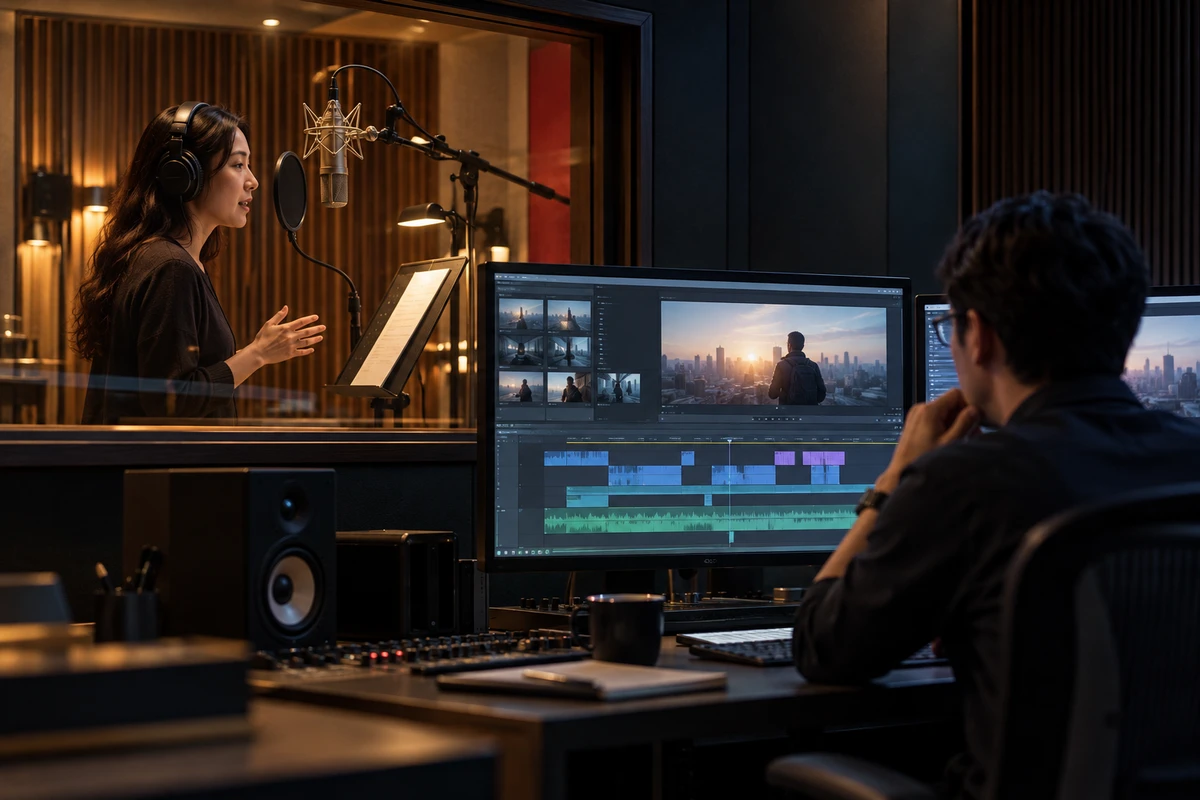
Premiere's current documentation shows that teams can record voiceover directly into a marked In and Out range, including a pre-roll. The tool makes recording easy. It does not decide which script version has been approved, so the project still needs a clear record linking the audio file to the writing and cut.
The speaker changes the workflow
A professional voice artist is usually most efficient once the writing, duration and performance direction are clear. The scope should distinguish auditioning, the main session, directed takes, pickups caused by text changes and subjective requests for a new interpretation.
An executive or technical expert may have less availability than the studio. A project can record one complete, factually safe version while that person is available, then prepare a very small pickup list after the rough cut. Giving a non-professional speaker large amounts of unapproved advertising copy to repeat is rarely a useful backup plan. If the person appears on camera, the voice and lip movement become part of the shot structure and the spoken lines need to be settled before production.
A multilingual release should not ask the translator to force every language into the duration of the Chinese or English master. Break the meaning into replaceable blocks, preserve visual breathing room and flexible transitions, then test each target language at a natural speaking pace. YouTube currently allows eligible creators to attach multiple language audio tracks to one video or Short and asks uploaded dubs to be roughly the same length as the video. That is one platform workflow, not proof that the same picture master will fit every website, exhibition, sales presentation or social placement.
Put re-recording triggers in the scope
Separate three types of change in the estimate or production confirmation:
- Fact or copy changes: a figure, product name, legal qualification or sentence meaning changes. This normally triggers a re-record and may trigger a re-edit.
- Performance changes: the wording stays fixed while tone, emphasis or pace changes. This belongs inside the agreed direction and take allowance until that allowance is used.
- Picture changes: shot order or duration no longer fits the approved audio. The team must decide whether to adjust a pause, record a short pickup or reconform and remix the sequence.
Acceptance should also be layered. First verify the words, then judge whether the performance serves the film, and finally test intelligibility in the complete music-and-effects mix. A dry voice file cannot reveal whether music masks the message. A final mix alone makes a misread number or name harder to isolate.
Synthetic or cloned voices add rights and labelling questions
AI narration can support timing tests and, when properly cleared, a final version. But a voice identifiable as a real person is not simply a software setting. Article 1023 of China's Civil Code provides that protection of a natural person's voice applies by reference to the rules for portrait rights. For a cloned voice, the relevant project owner should define the person, languages, uses, media, territories, term, permitted edits and derivative uses, with legal review appropriate to the actual release. The Civil Code text is available from the Supreme People's Court.
China's Measures for Labelling AI-Generated and Synthetic Content took effect on 1 September 2025 and includes audio among the covered content types for applicable service and distribution providers. Production should retain the service used, source of the voice, generated sections, human edits and approval record, then let the publishing party determine the applicable labelling method for its territory and platform.
A shoot-ready voiceover plan is a chain of responsibility
The plan should identify who approves the words, who verifies facts, who selects the speaker, which cut the scratch track supports, which picture milestone triggers final recording, how languages are adapted, which changes create pickups and which stems will be delivered.
If you are preparing a brand or corporate film, collect the intended use, duration, current script, speaker, languages, channels and final approver. Then compare ONCE's brand film production and corporate film production scopes. ONCE can help decide whether narration should drive the picture, connect real evidence or carry only a few information beats—and place scratch recording, final recording and version delivery in one production plan.