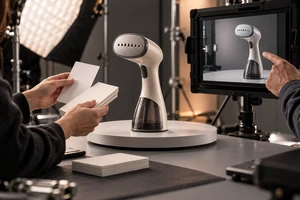
A countertop appliance is powered up in a clean kitchen set. Its indicator is on and the demonstration works. Then the camera moves closer and a black cable cuts across the worktop. The brand asks post-production to remove every trace of it. The engineer worries that the audience will assume the product is cordless. When the footage reaches the compositor, the cable also passes behind a hand, appears in the countertop reflection and disappears into steam. Removing “one wire” has become a frame-by-frame reconstruction job.
The real problem is not whether a cable looks attractive. It is what that shot has been hired to do.
When a shot must prove connection, charging, power or continuous operation, the plug and cable are product facts. When a shot exists to establish shape, finish and brand character, the cable may be a production variable that can be routed, hidden or cleaned up. A reliable scope does not apply “show every cable” or “remove every cable” to the entire film. It decides shot by shot what the viewer needs to understand, how the product actually works, and whether visual cleanup could create a new misunderstanding.
Classify the shot before deciding what happens to the cord
Proof shots: make the real connection legible
If the plug, charging port, dock, adapter or cable storage affects the purchase decision, the cord is not set clutter. The whole cable does not need to dominate the frame, but the audience should be able to tell where power comes from, which state the product is in, and how the result follows the action.
A continuous “connect, switch on, begin operation” sequence can be divided into three clear views: the plug or port, the control action, and the operating response. A hero cut can compress that sequence; a product-page or sales-demonstration version may preserve more of it. Removing the cable and adding a caption that says “mains powered” is not equivalent. The picture may still imply the opposite.
Real-use scenes: tidy the route without changing the condition
In a kitchen, living room or workspace, a cable can often follow a counter edge, furniture line or the rear of the product so that it does not pull attention away from the action. That is reasonable only when the route does not change the product’s real installation or use, obstruct ventilation or drainage, interfere with a lid or door, cross talent movement, or conceal a connection the buyer needs to see.
The brand should provide the actual market version, approved power configuration and current operating instructions. A product or engineering owner confirms continuous-run limits, cable movement boundaries and whether any extension or alternate connection is permitted. Camera and art departments can then design a route around the shot. A crew should not improvise a hidden battery, substitute adapter or internal power modification simply because it produces a cleaner frame.
Hero shots: cleanup is possible when production captures the right material
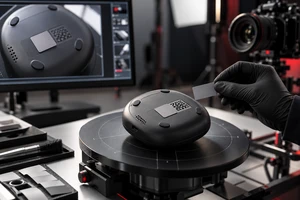
Turntables, beauty angles, material sweeps and floating-product shots sell form and finish. In these shots the power cord is often not the message. The product can be filmed unpowered, the cord can be routed into a non-visible direction, or a genuine powered take can be supported by material for a planned cleanup.
“We can fix it in post” is not a production plan. Adobe’s current After Effects Content-Aware Fill documentation explains that the tool analyses the current and surrounding frames to create replacement content. Complex areas may need reference frames, while moving footage can require a tracked mask. Post-production still needs evidence of what was behind the cable; software cannot know that background from nothing.
For a planned cleanup, capture at least:
- the performance take, with the product, talent and cord completing the intended action;
- a clean plate, with camera, lens, focus, exposure and lighting unchanged while the cord or product is removed;
- a static product reference showing the connector, silhouette, reflections, contact shadow and product position;
- occlusion references for hands, steam, liquid, fabric or any element crossing the cable;
- a shot log with shot number, lens, frame rate, shutter, product state, power method and intended cleanup area.
If the camera moves, the background texture, reflection and cable relationship move too. Adobe’s motion-tracking documentation notes that a track depends on a feature that remains identifiable through the shot. Reference marks can help when they are planned, but the marks also need to be removed. Post or VFX should therefore decide where they belong before the camera rolls.
Concept and animation shots: simplify the image without presenting it as live proof
3D animation, generative environments and concept shots can explain power flow, internal construction or a future use case with a cleaner image. If the treatment omits a condition the real product needs, however, it should not carry the burden of proving real operation. The review sheet should distinguish recorded function, visual simplification and concept imagery, with product, compliance or legal owners reviewing claims where required.
A shot-level responsibility sheet reveals the real cost
Treating “wire removal” as a single post-production line item hides the pre-production and on-set work that makes it achievable. A comparable quote should define each relevant shot with the following fields:
| Scope item | Brand and product team | Production team | Acceptance test |
|---|---|---|---|
| Shot purpose | Confirm proof, real use, hero or concept role | Translate the role into framing and action | A corded product is not mistaken for a cordless one |
| Product state | Supply market version, original power system and instructions | Log sample, port, adapter and operating state | The screen version matches the approved product |
| Cord treatment | Approve which connections must remain visible | Route, conceal, film unpowered or plan cleanup | The treatment does not create a capability that does not exist |
| On-set conditions | Name engineering and safety owners | Confirm outlets, load, crew movement and reset time | Product and location owners allow the setup |
| Post-production material | Approve the cleanup area and claim boundary | Capture take, plate, reference, occlusion layers and metadata | No drift, smear, false reflection or broken edge at speed or frame by frame |
| Change responsibility | Approve sample or script changes | Explain the effect on reshoots, tracking and paint | Each change maps to a shot, cost and date |
Product preparation should separate power, connection, installation and consumable inputs. Cord treatment comes after that inventory: first confirm the original accessories and genuine operating condition, then design a cleaner shot. “The crew will hide it somehow” is not a substitute for product information.
When a small cleanup becomes a VFX shot
A cable against a flat, static background with a locked camera is generally less complex than one crossing fingers, hair, steam, liquid or a mirror. Difficulty rises further when:
- the cable crosses the product silhouette, requiring the body edge and material to be rebuilt;
- the cable appears in glass, metal or a glossy worktop reflection;
- the cable casts a visible shadow that must be removed separately;
- camera, product and talent move at the same time;
- shallow focus, motion blur, sensor noise or compression texture must be matched;
- the same take must survive horizontal, vertical and multiple cropped versions.
That is why a quote should not stop at “basic cable cleanup included.” It should name the shots, duration, resolution, camera movement, occlusion level, available plates and required outputs. A wider cleanup request after the sample is approved may affect tracking, roto, paint, reflections, shadows, grain and every final export—not just one mask.
A poor pattern is to orbit a running appliance handheld while its cord repeatedly crosses the talent and background, then request a cordless look after the shoot. A smaller, more dependable plan might keep the genuine connection in the proof sequence, use a locked or repeatable move for the beauty shot, and capture an unpowered hero take plus a clean plate. The product truth is clearer and the post-production is more controllable.
Define the start conditions and what “finished” means
For powered products, a production plan does not replace the product manual or on-site safety judgment. Before filming, the brand should provide the current operating information, original power components and approved public demonstration. The location and technical owners confirm the actual supply, cable routing, load, moisture, heat and access conditions that apply. Production places cable restraint, crew movement, lighting equipment and camera positions on the same set plan.
Any hidden power source, replacement adapter, internal modification or extended run needs explicit approval from the person authorised to give it. It should never be an experiment introduced only to improve composition.
Review the delivery in three passes:
- Check the fact. Does the product operate under its real condition? Have cleanup or editing altered the connector, plug or state?
- Check the image. At speed, paused and enlarged, do edges, reflections, shadows, grain and motion remain continuous?
- Check the versions. Do horizontal, vertical, subtitled and market versions preserve the same approved functional boundary?
The completion standard is not “there are no cables anywhere.” It is that every shot completes its assigned job: the connection is understandable when it is evidence, the image is clean when the cable is not the subject, and no visual simplification changes what the product can actually do.
If you are planning a small-appliance, consumer-electronics or smart-hardware film in China, share the product model, market, use context, sample location, original power system, required demonstrations, formats and delivery date. ONCE can first classify the cable-related shots into visible connection, controlled routing, unpowered hero and planned cleanup, then scope the studio conditions, engineering input, on-set material package and post-production work. See the ecommerce product video service and U-STUDIO production options for the public service boundaries.
Research note: this article was checked on October 8, 2026 against Adobe’s official After Effects documentation for Content-Aware Fill and motion tracking, Amazon’s seller guidance for product video, Blackmagic Design’s current Fusion support materials, and ONCE’s public sample-preparation guidance. Tool capability is not a guarantee of automatic cleanup. Product power and on-set safety decisions remain subject to the current manual, location conditions and authorised technical owners.