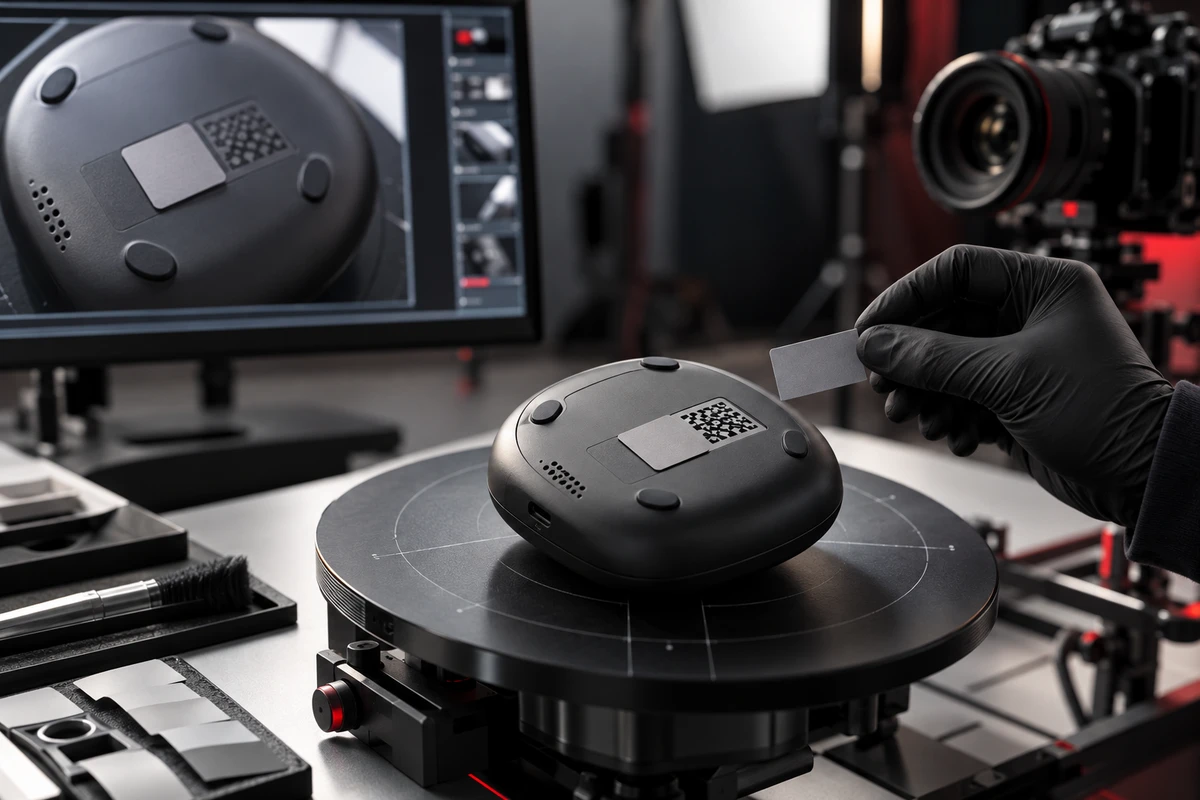
When an unreleased smart device reaches the turntable, the easiest detail to miss is often the label underneath it. On a production monitor, that label may look like a soft grey patch. In a 4K master, a product-page crop, or a paused frame, its serial number, QR code, or engineering-sample marking can suddenly become readable.
The useful question is not simply whether the frame looks clean. It is what the mark represents, whether it has been approved for release, and where it may send a viewer. For a pre-launch product, neither “blur every label” nor “keep everything because the sample is real” is a reliable policy. Classify each visible mark first, then decide at shot level whether to retain, conceal, replace, avoid, or reshoot it.
Start with four classes of visible information
GS1 distinguishes a GTIN, which identifies a trade-item type, from a serial number, which identifies an individual instance when combined with the product identifier. Both may appear inside a barcode or two-dimensional code, but exposing them can have different consequences. The production team does not need to make a legal determination. It does need to separate product-level identity from item-level identity so the product, marketing, security, or legal owner can make an informed release decision.
Public product identity
A brand name, approved model designation, target-market regulatory mark, or other information intended to appear on the retail product can support credibility. Yet “public eventually” does not mean “approved today.” If the model name, certification copy, or regional variant is still moving, the brand should nominate one owner to approve the exact version allowed on camera.
Item-level or batch identity
Serial numbers, IMEIs, internal asset IDs, order labels, batch numbers, and tracking codes can point to a specific unit, test batch, or internal workflow. They are not automatically sensitive, but camera and post-production teams should not decide their release status by instinct. A shared shot list only needs the label location, identifier class, and an internal reference. The full value does not need to be copied into a widely circulated call sheet or review thread.
Active destinations
A QR code or barcode is not merely a graphic texture. The GS1 Digital Link standard explains how two-dimensional codes can carry product identifiers and connect users to web resources. That means a visible code needs two checks: whether it looks correct and whether it remains readable in the actual exported video. If it is intended to scan, confirm the destination, territory, access state, and launch timing. If it must not be public, do not rely on the assumption that it is too small to scan.
Prototype residue
Temporary calibration stickers, development-board numbers, test-team labels, incorrect regional text, or an unapproved packaging code may be authentic to the prototype without being truthful about the retail product. Keeping them can make an advertisement less accurate, not more. The better choice may be an approved replacement label, an angle that excludes the surface, or separate evidence and beauty shots.
“We cannot read it on the monitor” is not an acceptance test
Product footage may be exported at several resolutions, reframed, sharpened, paused, or turned into still images. A label that appears insignificant in a wide shot can dominate a square crop or a vertical version. Exposure decisions therefore need to be tested against deliverables, not only against the camera monitor.
For each relevant shot, define a practical worst case: the highest-resolution master, the tightest planned crop, and the frame in which the label faces camera most directly. If a barcode or QR-like mark is present, test the final export on at least two ordinary mobile devices. Scanning the physical sample proves nothing about the encoded pixels in the final file. A failed scan on two devices is still a result for those versions and devices, not a promise that the mark can never be recognized elsewhere.
A typical failure happens when a blur looks fine in the edit, but the tracked mask slips for six frames as the product rotates. Another occurs when a code occupies only a small part of the original frame but becomes readable after an ecommerce team creates a tighter crop. The problem is not whether an effect was applied. It is whether the exact release files were checked.
Choose the treatment for the shot, not for the whole project
Put an approved label on the hero sample
If a label remains visible through a close-up, the cleanest option is often to prepare a version approved for the target market, product revision, and release date. The brand should supply or approve the artwork. The art department can then own size, material, placement, and reversible installation. It should not invent model numbers, regulatory copy, or product claims for visual convenience.
Use reversible concealment on set
A neutral tab, blank plate, or material-matched cover can work when the label itself is not part of the shot task but the surface texture matters. Before applying anything, confirm that it will not cover a vent, sensor, control, or assembly seam, and that it will not damage the only working prototype. Record who may attach it, who installs it, and how the sample will be restored.
Control visibility with angle, depth, and reflections
Camera position and lighting can keep a label on the far side, in shadow, or outside the focal plane. That is a composition technique, not an information-security guarantee. It is useful when the label is irrelevant to the communication task. When strict non-readability is required, acceptance still needs to happen on the final exports. And if the shot is meant to prove a connector, underside structure, or installation action, hiding the label must not break the evidence.
Track, cover, or replace the label in post
Treating a label on a moving object is more involved than adding a static blur. Adobe's documentation notes that Content-Aware Fill uses information from the current and surrounding frames, and that complex results may require reference frames. Mask tracking must still survive rotation, perspective change, occlusion, and drift. A hand crossing the label or a strong reflection can make the repair more demanding.
A clean plate, an unobstructed turntable pass, and stable trackable features can preserve options for post. None of them guarantees automatic, invisible, or inexpensive removal. The bid should therefore identify the shots and versions included in the replacement work, rather than treating “fix labels in post” as an unlimited line item.
Reshoot when the visible fact is wrong
If an incorrect label appears in a critical product-identity, functional-evidence, or target-market shot, a reshoot can be more controlled than repeated repair. This is especially true when the label crosses textured surfaces, reflections, or several occlusions. Reshooting is not a punishment for failed post. It is a way to restore credible evidence when the photographed fact itself is inaccurate.
Build a shot-level exposure register
The working document does not need to reproduce every sensitive value. It does need to bind each decision to an owner and a release file.
| Field | What to record |
|---|---|
| Shot and sample | Shot ID, internal sample ID, side of product, and visible area |
| Identifier class | Product identity, item identity, active destination, or prototype residue |
| Applicable version | Market, language, aspect ratio, channel, and release date |
| Release state | Retain, conceal, replace, avoid, or reshoot; “fix in post” is not specific enough |
| Treatment | Approved label, reversible tab, camera control, tracked replacement, or another defined action |
| Decision and execution owners | Who approves release and who performs the on-set or post-production action |
| Acceptance evidence | Export filename, key frame, crop version, and scan-test result |
For projects with several SKUs or prototype revisions, add two separate fields: which physical unit carries the mark and which unit appears in the selected take. ONCE's guide to preparing multi-spec product samples is a useful companion for appearance, accessories, spares, and sample-version control. The exposure register adds the missing release decision for information visible on those samples.
Accept the release files, not merely the edit timeline
A practical sign-off sequence has five stages:
- The product or brand owner approves an allowed-information list and marks every unresolved field.
- The crew records the actual treatment for each shot, updating the register when a sample, label, or angle changes.
- Post exports the highest-resolution master and the planned critical crops; proxy files are not used as acceptance evidence.
- Quality control steps through product rotation, hand occlusion, changing reflections, and transition edges. Any visible code is tested on the final export, and the result is recorded.
- The approver signs off the exact filenames, versions, territories, and release date. The register is archived with the approved masters.
Completion is not “the serial number looks blurry.” Every visible mark has a class, treatment, owner, and matching release-file check. Information meant to remain is accurate and readable. Information that should not be public is treated in every approved version. A code's intended scan state has been tested. Prototype residue has not been presented as final retail truth.
This article was researched on October 8, 2026, using current public GS1 guidance on identification, serialisation, and Digital Link, together with Adobe's official documentation for object removal and mask tracking. It is a production and acceptance method, not a substitute for the brand's legal, compliance, information-security, or target-market review.
If you are preparing a pre-launch product film, send ONCE's ecommerce product-video team the product or SKU list, target markets, prototype status, label photographs, shot list, release timing, and required aspect ratios. We can identify which decisions must stay with the brand and turn the on-set treatment, post-production scope, and acceptance files into a workable production plan. A video itself cannot guarantee sales, platform approval, or regulatory compliance.